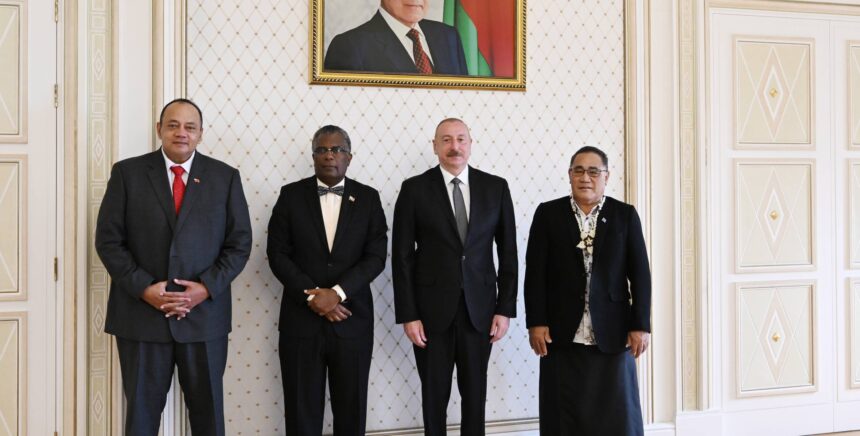
This week, on May 13, 2024, President Ilham Aliyev met with three representatives from island nations and shared Azerbaijan’s goals and vision for organizing the 29th session of the Conference of the Parties to the UN Framework Convention on Climate Change (COP29) in Baku this November. The official guests of the head of state were Governor-General of Tuvalu Falaniko Toafina, Prime Minister of the Kingdom of Tonga Siaosi Ofakivahafolau Sovaleni, and Minister of Foreign Affairs of the Commonwealth of The Bahamas Frederick Audley Mitchell. During the friendly conversation, the guests discussed the climate-related challenges their countries face with President Ilham Aliyev.
For instance, the representative from the Commonwealth of The Bahamas mentioned that a single hurricane five years ago resulted in the loss of 30% of the country’s GDP, and efforts to address the disaster’s aftermath are still ongoing. Considering that 80% of Bahamian land is only one meter above sea level and that tsunamis have become almost a daily occurrence due to climate change, the problem is more than serious. However, thanks to tourism, The Bahamas and Caribbean countries are among high-income nations, making it difficult to secure concessional loans for disaster recovery.
Meanwhile, the Prime Minister of the Kingdom of Tonga agreed that rising sea levels threaten small island nations, openly admitting that “his country lacks resources and land area” and thus the government “must do everything possible to preserve the existing small piece of land.” All three high-level guests acknowledged being pleasantly surprised by “the inclusion of small island states in the discussions on what can be done at the upcoming COP in Azerbaijan” and appreciated President Aliyev’s initiative.
As a result of this meeting, Falaniko Toafina, Siaosi Ofakivahafolau Sovaleni, and Frederick Audley Mitchell adopted the Baku Communiqué, aimed at supporting Azerbaijan’s initiative to address the protection of small island states at COP29.
Before delving into Azerbaijan’s goals and objectives in supporting and protecting the interests of small island states, it is worth expanding on the issues these states face and the global initiatives to assist them. Over the past 50 years, extreme weather events have led to 2 million deaths and economic losses exceeding $4 billion, according to experts from the World Meteorological Organization (WMO). Between 1970 and 2021, approximately 12,000 natural disasters occurred, according to UN news reports. Consequently, the main burden of weather, climate, and water-related risks falls on the most vulnerable communities.
According to the WMO, in the least developed countries over the past half-century, natural disasters have sometimes resulted in economic losses of up to 30% of GDP. In small island states, one in five natural disasters led to losses exceeding 5% of GDP, with some natural catastrophes wiping out the entire GDP of these countries. But there’s more to the story.
Climate fluctuations exacerbate existing problems, such as rapid population growth, limited resources, and remoteness from major consumers and suppliers, leading to excessive dependence on international trade and impacting the economic and social conditions of these societies. To address these issues, the UN recognized Small Island Developing States (SIDS) as a distinct group in 1992 and developed the Barbados Programme of Action two years later to provide assistance.
In 2014, the International Conference on Small Island Developing States in Samoa adopted an agreement to promote their development. On September 27, 2019, countries worldwide reviewed the implementation of this agreement and discussed further steps to support small island states. The discussions primarily highlighted the financial support needed by these states, with references to the situation of Cook Islanders, whose archipelago is beyond rescue despite a population of fewer than 15,000. However, these discussions often remained just words.
Today, there are 57 SIDS divided geographically into the Caribbean, Pacific, and Africa, Indian Ocean, Mediterranean, and South China Sea regions. These countries, as sovereign states and subjects of international law, participate in many international organizations. However, not all structures prioritize their proclaimed goals. For example, the Partners in the Blue Pacific alliance, formed in 2022 by Australia, the UK, New Zealand, the USA, and Japan, initially aimed to protect island states’ interests but appears more focused on countering China’s influence in the Pacific region.
Here, Azerbaijan’s role in protecting SIDS’ interests becomes relevant. Azerbaijan’s longstanding leadership in the Non-Aligned Movement, comprising countries from various continents with diverse languages, religions, customs, traditions, and political systems, has provided extensive experience in promoting intercultural and interreligious dialogue, achieving mutual understanding, and harmony among different civilizations. The Non-Aligned Movement includes countries with political stability and economic success, as well as those plagued by chronic conflicts and instability, and even those whose physical existence is at risk. Azerbaijan has treated all these countries equally, earning the trust of small island states.
During the meeting with President Ilham Aliyev, Tonga’s representative Siaosi Ofakivahafolau Sovaleni said Azerbaijan’s initiative for small island states “not only pleasantly surprised us but is highly appreciated.”
This experience enables Azerbaijan to prioritize the protection of island states’ interests at COP29.
“The most important topic at the conference will be finance,” said President Ilham Aliyev during the meeting with the official representatives of the three states most vulnerable to climate change due to their geographical location. “We are actively working on securing financial resources to address this issue. But we also understand that for some countries, climate change is a problem, while for others, it is a matter of existence. We understand this clearly. Helping small island states is something we consider our moral duty. Therefore, we promise that the issue of small island states, their support, and protection will be at the center of discussions. As the president of COP29, we will prioritize this issue.”
Rauf Nasirov