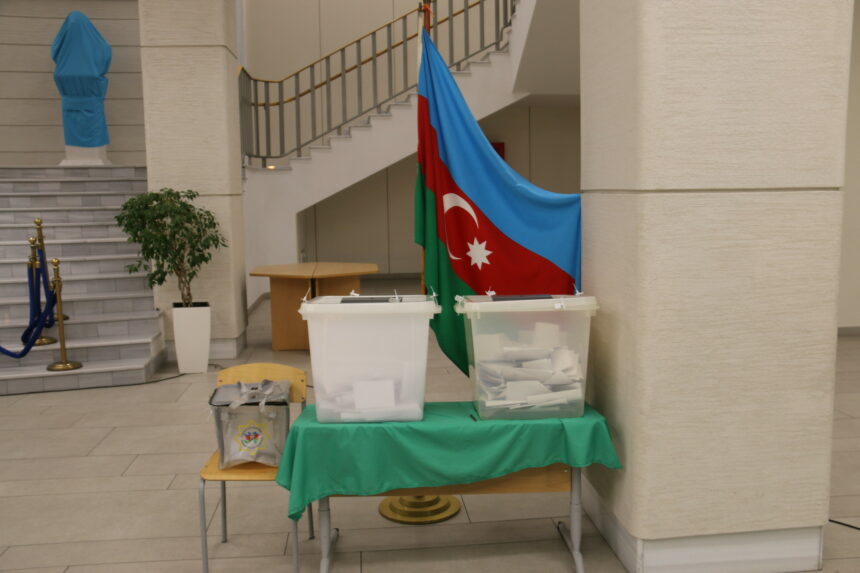
On February 7th 2024, Azerbaijan hosted snap presidential elections which produced an unsurprising and landslide victory for the incumbent President Ilham Aliyev, who received 92.9 per cent of vote. This is a record result, surpassing the previous 88.7 per cent high of 2008. Thus, Aliyev is set to start his fifth presidential term, as the constitutional limit on the number of terms was abolished according to the outcomes of a 2009 referendum. Aliyev’s rivals were not particularly popular politicians, as second place Zahid Oruj got just below two per cent, and the major opposition parties Musavat and Popular Front boycotted the election. International observers in general did not find systematic violations, although the OSCE mission indicated that the elections “were not competitive” and were “held in a restrictive environment”. However, the most significant international consequence from this election came with the one-year suspension of the voting rights of the Azerbaijani delegation in the Parliamentary Assembly of the Council of Europe (PACE), which caused Baku to withdraw its participation for an indefinite period until its voice is restored. The formal reason for the motion in question was Azerbaijan’s unwillingness to invite a PACE mission to monitor the upcoming vote.
The decision to hold this snap election in Azerbaijan now instead of April 2025, announced on December 7th, was not too unexpected as such a prospect had been discussed for quite a while. However, it is hard to point to the exact reasons behind this decision, since there are several plausible explanations worth considering. Aliyev himself in one of his pre-election interviews justified the elections as corresponding with the restoration of Azerbaijan’s full sovereignty over the entirety of its territory, including Karabakh. He subsequently viewed this as the end of an epoch. According to his explanation, the elections which were to happen throughout the whole country for the first time since 1991, ought to herald a new phase in the political, administrative and economic development of the country.
Yet, as experts we might speculate on some more reasons. One of these is linked to the timing connected to the government’s expectations of a peace agreement (or at least a framework document) with Armenia. They expected such a document to be signed sometime soon after the election. Then, the possible intention could have been to treat this vote as a kind of referendum in support of such an agreement. At the same time, the government may have hoped that traditional western pressure related to the lack of electoral transparency and pluralism might be minimal at a time of potentially groundbreaking negotiations. The factor of Russia, traditionally trying to play the role of kingmaker in the South Caucasus, may have also mattered in the calculations. Baku might have believed that if Moscow gains a foothold in Ukraine throughout 2024, then it will behave much more assertively, trying to use the election due in 2025 to put pressure on the government on several matters, most importantly renewing the mandate of the Russian troops in Karabakh. There is now certain inquietude in Baku regarding the risks of facing an emboldened and more assertive Russia, as bargaining over the withdrawal of troops in an election year would have been extremely difficult. This would ensure that domestic stability would have been a priority in these circumstances.
Another explanation concerns the planned reshuffling of the government and maybe even certain political and constitutional reforms. Significant amounts allocated to electoral expenditures in the current and past years’ budgets, led to speculations that the government is planning a major referendum to introduce some major changes. In fact, a number of experts share this view. These hypothetical changes are said to comprise comprehensive administrative reform and maybe even a transition from a presidential to a mixed regime, which could help to share responsibilities and risks for the government. Furthermore, the constitutional changes which have been expected for some time, particularly since the end of the Karabakh War of 2020, may address post-war realities.
Finally, the rationale behind the decision to hold snap elections may be purely technical. In winter 2024-25, Azerbaijan is to hold both parliament and municipal elections, while it has recently been announced that the global COP29 conference will be held in Baku next November. Given all this, the government may have decided that holding so many important events in a short-time frame would be too demanding logistically. In fact, this parsimonious explanation could easily be the most accurate one.
When it comes to the implications of the election, it would be most fitting to turn to President Aliyev’s inauguration speech on February 14th. Then, he mentioned the decay of the global order and failure of international law throughout the last 15 years as key reasons for Azerbaijan to pursue its foreign policy in the way it has been doing. This statement confirms a suggestion that the five-day war of 2008, when the West did not provide significant help to Tbilisi to repel a Russian invasion and soon launched a détente with Moscow, was a turning point in Aliyev’s understanding of global politics and Azerbaijan’s core interests. Aliyev emphasized that Baku “acts in the real world” and has to cope with reality, which in his view has been recently characterized as the dominance of might over right. This influenced his approach to conflict resolution with Armenia. Aliyev is clearly worried about the alleged attempts of some foreign powers to strengthen Yerevan’s military capacity instead of pushing it to peace. Azerbaijan’s demands remain the same: providing unimpeded access to the Zangezur corridor (a road between mainland Azerbaijan and Nakhchivan) for Azerbaijani citizens and making amendments to constitutional laws that would otherwise make Armenia’s recognition of Azerbaijani territorial integrity inherently dubious, as they directly deny Baku’s sovereignty over Karabakh. We should expect a more assertive stance from Azerbaijan after the election. It will push the Armenian government to convert the rather mixed signals it has been issuing this far into an unambiguous commitment to accept the aforementioned conditions.
Aliyev also emphasized Baku’s foreign policy trend for prioritizing bilateral relations over multilateral integration formats. In his view, the second format has been discredited by the inability (or the unwillingness) of the international community to maintain the primacy of international law and punish transgressors, as well as its double standards. For example, this can be seen in the failure to exert effective pressure on Armenia to end its decades-long occupation. At the same time, he singled out cooperation within the Turkic Council format as the ultimate priority for Azerbaijan, since it represents “a proper family” for the Azerbaijani nation and also due to Baku’s significant authority within the organization. Thus, decisive steps towards a further rapprochement with Turkey and intensifying partnerships with Central Asian nations can be expected on the country’s agenda during the next presidential term. At the same time, Aliyev’s speech should dispel speculation about Baku’s alleged plans to enter the Russian-led Eurasian Economic Union or even CSTO. A firm commitment to non-alignment and an independent foreign policy has been reiterated.
On the other hand, some post-election signals from Europe suggest that western institutions would like to improve relations with Azerbaijan and resume an active role in the conflict resolution process. Replying to the congratulatory message from Charles Michel, president of the European Council, Baku indicated its willingness to re-engage in the Brussels negotiation format should it exclude actors with an anti-Azerbaijani stance (first of all France). The President of the Council of Europe Marija Pejčinović Burić expressed a desire to develop cooperation with Baku, which can attest to an attempt to somehow overcome the anti-Azerbaijani vote and search for ways to return to “business as usual”. Overall, Baku has made it clear that this would only be possible following the restoration of its full-fledged participation rights in PACE.
Murad Muradov is the deputy director of the Topchubashov Center, a Baku-based think tank. His areas of expertise cover European politics, the politics of identity and nationality, and international political economy.
Rusif Huseynov is the director of the Topchubashov Center, Azerbaijan. His main interests are in peace and conflict studies, while his focus areas mainly cover Eastern Europe, the Middle East, the Caucasus and Central Asia.