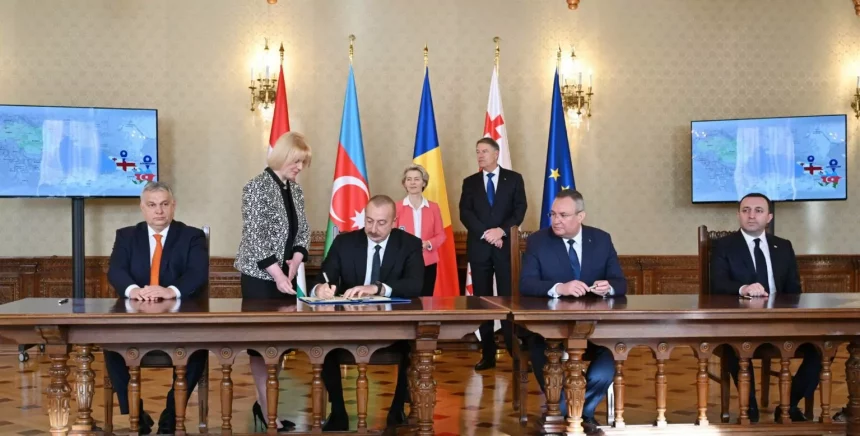
In December 2022, Azerbaijan, Georgia, Hungary and Romania signed an agreement to build a strategic partnership in the field of green energy development and transmission (President.az, December 17, 2022). According to the document’s text, the four countries plan to work together in developing a 1,195-kilometer submarine power cable under the Black Sea, effectively creating a renewable energy transmission corridor from Azerbaijan, via Georgia, to Romania and further onward to Hungary. The project looks viable in the context of the European Union’s Green Deal (aimed at the bloc’s carbon neutrality by 2050) and specific EU emissions reduction targets for 2030. However, it requires the further development of renewable energy sources (RES) in Azerbaijan, as the country’s green energy sector is still nascent, and the numerous memorandums and partnerships regarding future investment opportunities in the country have yet to materialize.
As a whole, the project will require increased energy transmission infrastructure development in each of the signatory countries. The most expensive part of the project will assuredly be the underwater cable running along the bed of Black Sea. It is expected that this link will have a capacity of 1 gigawatt (GW)—which translates to about 8.8 terawatt hours per year, representing approximately 15 percent of Romania’s overall annual electricity consumption—and is set to be accompanied by additional fiber-optic telecommunication cable (Miniszterelnok.hu, December 17, 2022). The cost of the undertaking (i.e., its submarine section) is estimated at 2.3 billion euros ($2.4 billion) and should be at least partially funded with the EU’s money (Twitter.com/OliverVarhelyi, December 11, 2022). The relevant feasibility study has already been underway since September 2022 (Cesi.it, September 20, 2022), and construction of the cable could be completed by 2029 (Romania-insider.com, December 19, 2022).
The EU’s involvement is not surprising, as the project (and other similar transboundary investments to be funded by the EU) fits perfectly into the main energy objectives of the bloc: decarbonization of the EU’s economy and building independence from overreliance on Russian energy imports. Notably, these two arguments were the core rationalizations in European Commission President Ursula von der Leyen’s speech accompanying the signing of the agreement (Ec.europa.eu, December 17, 2022).
In this context, it is also crucial to examine the project’s proposed schedule. EU member states are already struggling to secure green energy imports (in the forms of electricity or hydrogen and its derivatives) by 2030 when stricter EU decarbonization targets will most likely enter into force. Therefore, the discussed Black Sea cable corresponds to, for example, Germany’s “hydrogen diplomacy” around the world and plans to construct green ammonia import terminals in the Benelux countries (Belgium, the Netherlands and Luxembourg).
Likewise, the project represents a critical development for countries in the South Caucasus. On the one hand, Azerbaijan may serve as a perfect example of a petrostate that is just starting the transition toward paying greater attention to the RES and hydrogen sectors. In this, Baku counts on its tremendous offshore wind potential—estimated to be as high as 157 GW (Worldbank.org, June 3, 2022)—and, in 2022, already signed the first agreements on future green energy and hydrogen projects, including those initiatives agreed upon with the United Arab Emirates’ Masdar and Australia’s Fortescue Future Industries (News.masdar.ae, June 5, 2022; Fmgl.com.au, December 15, 2022). On the other hand, the projected future transit of energy supplies from Azerbaijan to Europe will have to go through Georgia, which is substantially interested in maintaining its current transit status (Azerbaijani oil and gas are currently being transported through the country) in the long term. Effectively, Tbilisi will then benefit on both geopolitical, through increased outside interest in supporting the country’s stability and integrity, and economic grounds, through taxes, workplace creation and further infrastructure development within Georgia, among other approaches.
Despite the fact that the Black Sea cable project is still in its nascent phase of development (no binding investment decisions have been taken so far), it indeed seems to be prospective, especially when taking into account the EU’s probable financial backing. Skeptics of the project may argue that, currently, Azerbaijan still has almost no infrastructure in place to maximize its solar and wind capacities (Minenergy.gov.az, April 21, 2022). However, Baku has presented an ambitious pipeline of prospective projects to be completed in-country, as long as the Azerbaijani government can indeed secure enough investments to enable the export of green energy by 2029.
The discussed energy link has limited capacity from the perspective of the Romanian and Hungarian economies. Even so, the project should be viewed more as a prelude for increased investments aimed at facilitating the supply of Azerbaijani green energy resources to Europe. Hence, in the future, it might be expected that the interested parties will discuss the potential creation of a hydrogen energy hub in the South Caucasus. Green hydrogen could then be produced in Azerbaijan or Georgia and then further exported through pipelines or in the form of derivatives being shipped via tankers. Either way, this agreement will positively contribute to increased energy stability in the region as well as efforts to make Europe much less dependent on Russia for its energy needs.