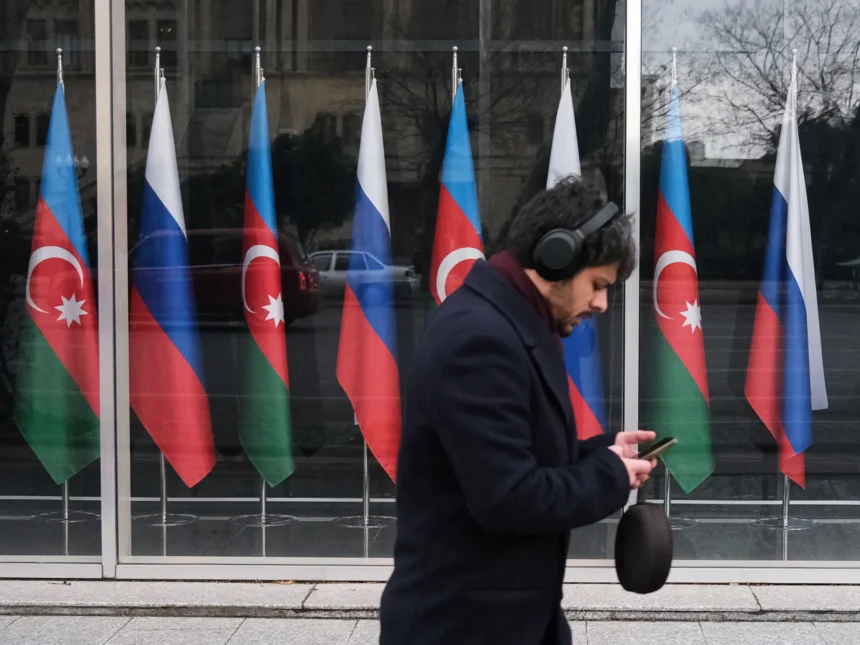
In remarks delivered in a combative tone, State Duma Deputy Lt. Gen. Andrey Gurulev accused Azerbaijan of “damaging relations” with Russia by supporting Ukraine.
“If Russian store shelves are missing goods from Azerbaijan, nothing will change for us, but it will change a lot for them,” Gurulev said. He added a veiled threat toward the Azerbaijani business community in Russia, warning of possible pressure against “local guys” engaged in trade.
The statement culminated in a clear allusion to potential military operations: “And if they don’t understand, then it can be done differently: ‘Special military operation’ is an elastic concept. Elastic along the entire border of the Russian Federation,” he said, implying such action could extend to Azerbaijan.
The comments come against the backdrop of deteriorating bilateral ties following the December 2024 downing of an Azerbaijani civilian aircraft by Russian air defenses, which killed 38 people and triggered a diplomatic rift.
Baku-based policy analyst Fuad Şahbazov told Defence Blog that Azerbaijan is well-positioned to deter or counter limited Russian military pressure.
“Azerbaijan today is well-positioned to deter or counter limited Russian military pressure, despite recent escalations in rhetoric and strained relations since the December 2024 downing of an Azerbaijani civilian aircraft by Russian air defenses, which killed 38 people and deepened the diplomatic rift,” Şahbazov said.
He noted that while there is no verified evidence of a formal Kremlin policy to launch direct military action, Azerbaijan fields a modern and capable force of about 128,000 active personnel and 300,000 reserves. Its arsenal includes advanced drones such as the Bayraktar TB2 and Israeli Hermes series, modernized fighter aircraft including MiG-29s and Su-25s, JF-17 Block III jets on order, and a wide range of artillery and missile systems, including the BM-30 Smerch.
The country also maintains a modest Caspian Sea naval force and a growing domestic defense industry. Partnerships with Turkey and Israel provide additional strategic depth and technology transfer advantages.
“With Russia militarily overstretched in Ukraine and facing resource constraints, a full-scale invasion of Azerbaijan is unlikely due to the high military, political, and diplomatic costs,” Şahbazov explained. “However, hybrid tactics such as cyber operations, political pressure, and localized border incidents remain possible.”
He concluded that Azerbaijan’s modernized forces, robust alliances, and favorable regional dynamics make it resilient against most plausible scenarios of armed aggression from Moscow. The main risks, he warned, lie in sustained political, economic, and informational pressure rather than conventional warfare.
The exchange underscores a growing risk of rhetorical and hybrid confrontation in the South Caucasus, a region already marked by complex security dynamics, overlapping alliances, and the broader reverberations of the war in Ukraine.
Dylan Malyasov