Given the short break between events, it may seem that Brussels is just squeezing the work done in the US capital. But is it so simple for Europe to perform the role of a clerk?
Yes, the Old World depends a lot on America, especially against the background of a sharp increase in security threats during the Ukraine war.
On the other hand, it would be strange if Brussels acted solely at the request of Washington, with no attempt to play a unique role in the Caucasus normalization. However, one can go even further in one’s thoughts and wonder whether Washington truly became the locomotive of the latest acceleration of negotiations, or whether the impetus came from somewhere completely different, such as Baku…
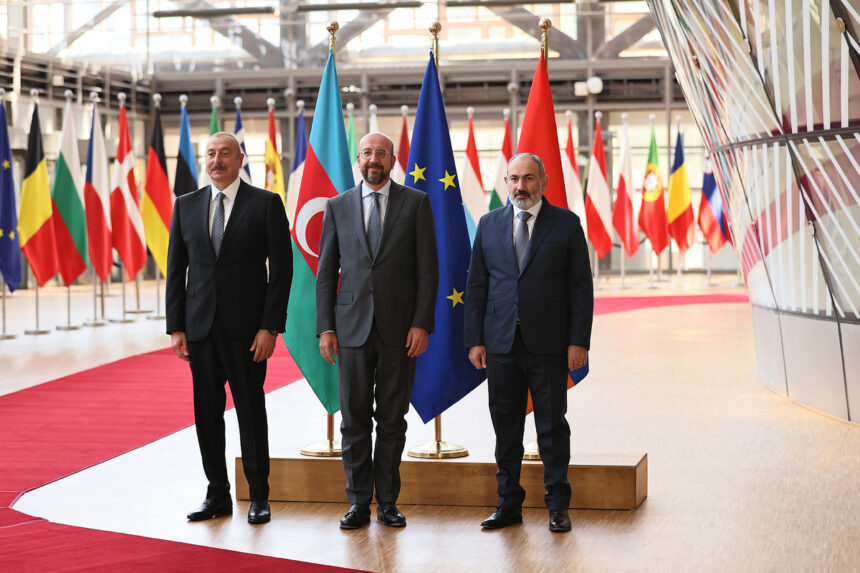
EU Council President Charles Michel’s final statement says a lot. But, contrary to established rules, let us begin with what was not said. Specifically, the Lachin road. It is worth recalling the hysteria that compassionate defenders of Armenians created in the West in response to the alleged blockade of Armenians in Karabakh and the European Parliament’s formidable resolution. Suddenly, there is no mention of a “humanitarian catastrophe” in a completely new document. Again, a due share of the credit must be given to the establishment of a border checkpoint in Lachin. After all, although the control of the Lachin road by Azerbaijani eco-activists was legitimate from all sides, Armenia presented it to the world community as “legal arbitrariness” due to its public, that is, non-state nature. And now, after Azerbaijan has realised its sovereign right to establish a border checkpoint, this act has legal parameters that cannot be challenged in any way.
This altered reality forced the mediators to abandon their zealous pursuit of a special status for Armenians in Karabakh. The phrase Michel used to describe Armenians’ living conditions in Karabakh deserves attention: ” to engage in developing a positive agenda with the aim of guaranteeing the rights and security of this population, in close cooperation with the international community”. If, after reading this sentence, one still has doubts about its meaning due to some ambiguity in the wording, the following phrase clarifies everything: ” I also raised the need for a transparent and constructive dialogue between Baku and this population.” The EU president thus pointed to the only possible format of dialogue – “between Baku and this (Armenian – ed.) population”, actually narrowing the role of the international community to cooperate in the development of a “positive agenda”, and not participate in this dialogue.
At the same time, the EU Council president for the first time announced the size of the countries within which they should recognize each other’s territorial integrity. 29,800 square kilometres of Armenia and 86,600 square kilometres of Azerbaijan, which automatically includes the territory of Karabakh. And then, for the first time, the EU publicly denied the separatist entity any legal personality, calling the territory of Azerbaijan under the Russian peacekeepers’ temporary control “the former Nagorno Karabakh Autonomous Oblast”.
All of this implies that, as we have repeatedly stated, Azerbaijan takes a proactive role in the negotiations, changing the situation on the ground and using this to solidify a new reality on the diplomatic plane. Furthermore, with its policy, particularly the installation of the border checkpoint, Azerbaijan has begun a kind of negotiation countdown. If we were threatened to drag negotiations on indefinitely before, now that Azerbaijan has taken basic steps toward reintegrating the Armenian population of the Karabakh region, signing a peace treaty has become an urgent need for mediators, first to save face and maintain the image of facilitators, and second, to avoid losing dividends.
As we can see, the most recent escalation on the conditional border in May, which lasted several days with varying degrees of intensity, had no effect on Brussels’ objectivity. Perhaps Yerevan anticipated that official Baku would decline the meeting. President Ilham Aliyev, on the other hand, has demonstrated his commitment to peace and stated his intention to visit. Could [Armenian Prime Minister Nikol] Pashinyan have failed to arrive? No. The Armenian prime minister has reached the end of his patience. He already allowed himself to disrupt the meeting in Brussels last December, offended by Azerbaijan’s staunch opposition to France’s participation. As a result of the repeated demarche, we believe the Armenian prime minister would have become a non-handshake person in Europe.
This brings us to another critical point. The formation of the Brussels format without the participation of third countries, including France, the European co-chair of the former Minsk Group, has become a significant success of Azerbaijani diplomacy. Even if we assume that the positions of Paris and Brussels were initially close, as Macron probably hoped, the fact of direct moderation imposes a special duty on the EU and its president personally – to be objective. Ordinary human ambition is also important here:
For Michel, the Armenian-Azerbaijani normalisation is an excellent opportunity to remind Paris that the EU is more than just France and that its president is far from a protégé of the Elysee Palace. Furthermore, despite having a French surname, Michel is still a Belgian, which means that his personal ambition is a reason to be proud of his country, whose capital is also the main city of united Europe.
And one more thing about Belgium as an important EU member. Unlike France, this country is not burdened by ideologised constructions and is accustomed to viewing everything through the lens of business expediency, which is undoubtedly projected onto European Union policy. Given that this expediency does not yet contradict the principles of justice and international law (as in Azerbaijan’s case), Brussels has all the cards it needs to pursue a policy independent of Paris. With the constructive position of another EU giant, Germany, we can assert a certain isolation of France in the process of Azerbaijani-Armenian negotiations. Of course, when discussing economic feasibility, it is necessary to recall the strategic level of the EU-Azerbaijani partnership, which is based on the increasing importance of Azerbaijani hydrocarbon imports for Europe. We have already stated that because Brussels is the European capital, energy security issues in Southern and Eastern Europe (the countries in these regions buy Azerbaijani gas) are more acute than in France, which gets its gas from other sources.
Of course, Washington’s pressure should be factored in. Brussels appears to be fulfilling his desire to expedite the parties’ reconciliation, but it is possible that it will add a new agenda. In complete accordance with the logic of the countdown and competition for the peacemaker’s laurels… It is also worth noting that Michel did not mention the expected date of signing the peace treaty, but instead presented the public with a rather busy and time-stretched calendar of meetings: in July – again in Brussels, in June and October – on the sidelines of the summits of the European Political Community in Chisinau and Granada. Such a stretched structure is probably needed both to give Pashinyan time to prepare his public for peace and not to show excessive zeal in carrying out Washington’s instructions and to emphasise the importance of the European platform and strengthening its weight.
And we will conclude our review with an item from the outcomes of the Brussels negotiations concerning the unblocking of communications with and through Nakhchivan. A moment that, it appears to us, sheds light on the overall context of the negotiation process drama. Indeed, this indicates the Old World’s keen interest in the Zangazur corridor. It is no secret that almost the only point of the Trilateral Statement (after, of course, the introduction of peacekeepers), in the implementation of which Moscow was urgently interested, was just the opening of the Zangazur corridor with the latter’s control by the Russian Federal Security Service. It is more than obvious that such a scenario did not particularly appeal to the United States, which traditionally leads a policy of removing Russia from global Eurasian communication projects. If we take into account that the corridor will become an important link in the diversification of cargo traffic from Asia to Europe (we are talking about the “Middle Corridor”), then the EU is also interested in launching it as soon as possible – of course, without Russian participation.
And if earlier, in the absence of certainty in the real basis of the negotiation process, the West had no particular reason to fit in for a separate solution to the corridor issue, now that Baku has cut off any opportunity for Armenia to interfere in the processes in the Armenian community of Karabakh by installing a CHECKPOINT in the Lachin district, it is very important for Brussels to sort out the contradictions that still remain. And here Baku conducted a masterful combination, apparently not pedalling this topic especially, but patiently waiting for the fight of the intermediary countries for leadership in establishing peace in the South Caucasus.
Baku is in a win-win situation. Even if the Brussels agreements are shelved, the very fact that they have fixed and legitimised a qualitatively new negotiating status quo is beyond any doubt a major victory for Azerbaijani diplomacy. Now any rollback of Armenia from this position will look like a malicious breakdown of agreements and will spoil not only the negotiation but also this country’s humanitarian image.
The hopes of the Armenian revanchists are now entirely turned to Moscow. What can Moscow do for Armenia? The question, it seems to us, should be put differently – what can Russia do to preserve its interests in the South Caucasus? This is a topic for a separate study, but it seems to us that, first of all, Russia should maintain partnership and even allied relations with Azerbaijan.
Pashinyan recently made a strange statement, saying that he is afraid to imagine what will happen to Armenia if Russia loses the war. Taking into account the eccentric manner of veiling his desires with ambiguous rhetoric, it seems more likely that Pashinyan is not afraid of defeat, but of Russia’s victory. Russia’s defeat will allow him to create a branch of Europe on 29,800 square kilometres (Armenia may even be admitted to the EU) and present it to his people as the “final victory of democracy in Armenia”, for which it was worth sacrificing “miatsum [unification of Karabakh and Armenia]”. Any mission will be completed. With Russia’s victory, the Armenians will see neither “miatsum” nor Europe. Pashinyan’s mission will fail with all the consequences that follow him.
Let us summarize our material with a slightly different version of an idea that has already been mentioned: Baku, pursuing a firm policy, is already seeking a just peace for itself with the help of intermediaries.
Murad Abiyev
Caliber.Az