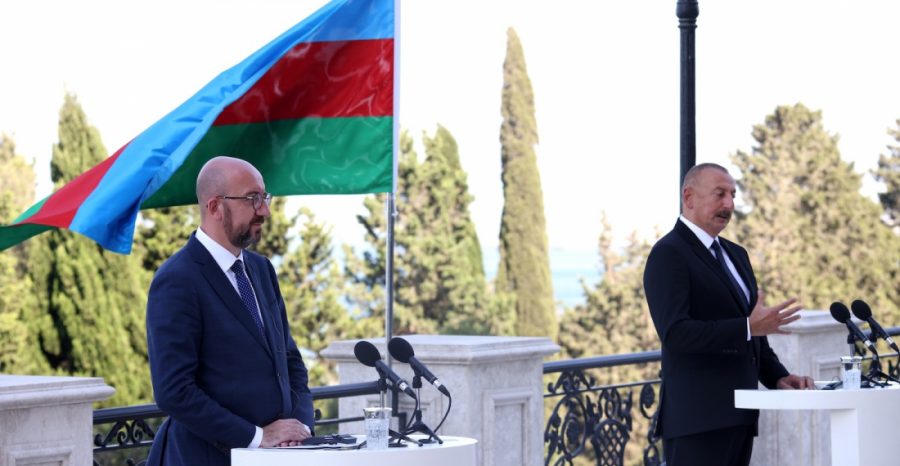
The European Union is one of the major international players in the South Caucasus with an extensive bilateral agenda with the countries of the region (Armenia, Azerbaijan, and Georgia). The relations between the EU and the regional states have significant potential thanks to the new opportunities created by the liberation of the occupied Azerbaijani territories and the initiatives to unblock regional transportation links. The latest visit by the European Council President Charles Michel to the region (July 17-19) and his meetings with the leaders of the three countries reaffirmed the will of the sides to promote bilateral relations further. For Azerbaijan, the EU is a major export market and important partner in the country’s foreign policy. Azerbaijan, therefore, welcomes the EU’s policy to engage more actively with the countries of the South Caucasus. Baku, however, voices a number of concerns regarding the EU policies towards the region in general, and towards Azerbaijan in particular.
Above all, Baku expects the European Union to consistently uphold the same principles the Union prioritises in its engagement with other post-Soviet states (eg Baltic States, Moldova and Ukraine) in its approach to the South Caucasus. Herein, Baku stresses the importance of the recognition of the territorial integrity of the regional countries, inviolability of the internationally recognised borders and the condemnation of any attempts to put those borders under question. While the EU has demonstrated strong opposition against the occupation of Georgia’s breakaway regions, it has refused to pursue similar policies toward the Azerbaijani territories occupied by Armenia during 1992-2020.
Based on this principle, the EU should play a more active role in the post-conflict peace process between Baku and Yerevan and should encourage the sides to sign a peace treaty recognising each other’s internationally-recognised territorial integrity. Towards this end, Azerbaijan expects the political support from the EU in the demarcation and delimitation of its state borders with Armenia. Yerevan should be persuaded and if necessary pressured by its European partners to launch negotiations on the demarcation of state borders with Baku through international mediation. The reluctance of some European states, particularly France, to recognise the post-war realities and the attempts to make Azerbaijan’s sovereignty over the Karabakh region subject to international negotiations are helpful neither for peace in the South Caucasus nor for the EU’s image in the region.
Azerbaijan has experienced similar double standards not only in terms of its territorial conflict with Armenia but also in other areas. For example, in its recent aid package for the Eastern Partnership countries – which was confirmed during President Michel’s regional tour – the EU allocated substantially less aid for Azerbaijan (less than 200 million euros) than Georgia (3.9 billion euros) and Armenia (2.6 billion euros). The EU has failed to provide a convincing explanation for this discrepancy, which raised questions about the true nature and objectives of the investment package.
In the areas addressed by the aid package, the EU has rightfully focused on connectivity projects in the region, which would not only provide better conditions for Europe-Asia connectivity but also make important contributions to the economic development at the local level. Substantial investments have been allocated for building roads, bridges and other transportation projects in Armenia and Georgia. However, Azerbaijan was largely kept out of this package for unknown reasons. Indeed, having long played a leading role in the promotion and implementation of the regional transportation projects (roads, railways, ports and so on) which now constitute parts of the Europe-Asia Middle Corridor, Azerbaijan should have received, at least an equal amount of financial support for its ongoing projects, including for the Zangezur corridor project.
Considering that Zangezur corridor, when realised, will cut the length of Middle Corridor significantly, the EU’s reluctance to support its construction does not serve the interests of the concerned countries in South Caucasus and Europe. It is worth mentioning that a decade ago, when Azerbaijan embarked on the construction of the Baku-Tbilisi-Kars railroad, the EU advocated building the rail link through Armenia. In 2014, an EU funded study by International Alert examined the reconstruction of Kars-Nakhichevan-Meghri-Baku railroad – basically the Zangezur corridor – and found it not only advantageous for the economies of Armenia and Azerbaijan but also for the trade between Europe and Asia.
Azerbaijan finds it truly disappointing that the demining process in the recently liberated territories, which is one of the most challenging and costly elements of the post-war reconstruction works, was not properly addressed by the EU’s aid package either. Although the demining of the liberated territories is extremely necessary for rehabilitation of the region and quick return of more than 700,000 people to their homelands, the EU has not included it amongst the priorities of the assistance programme.
Nor does the EU pay necessary attention to the environmental problems in the South Caucasus – which is at odds with the Union’s larger policies to tackle climate change. In this respect, it is unfortunate that Brussels has yet to react to the pollution of Azerbaijani rivers by the companies operated in the Armenian territories. For example, recent reports about the pollution of the transboundary (Armenia-Azerbaijan) Okchuchay River in its Armenia section with industrial waste caused great environmental concerns in Azerbaijan. The revelation that one of biggest companies operating in the region and polluting the Okchuchay River until 2019 was German caused anger and frustration in Azerbaijan. Unfortunately, neither the EU nor the major non-governmental institutions of Europe have yet to react to the calls of the Azerbaijanis, even though environmental protection tops the EU agenda at home. Nor has the EU, in its investment package to Armenia, addressed the concerns about the Metsamor Nuclear Power Plant of Armenia which poses considerable risks to the people and environment of the region.
Azerbaijan believes that the EU should play more active role in the South Caucasus region, should more closely engage with the regional countries and assist the resolution of local interstate disputes including those concerning the environmental protection in the region. However, it is equally important for the EU to maintain balance in its relations with the regional countries, condition any financial assistance to the local states to their respect to neighbours’ territorial integrity and encourage the sides to seize the peace opportunity offered by the resolution of the Karabakh conflict.
Dr Vasif Huseynov, a Senior Advisor at the Center of Analysis of International Relations (AIR Center) and Adjunct Lecturer at Khazar University in Baku, Azerbaijan.
KarabakhSpace.eu