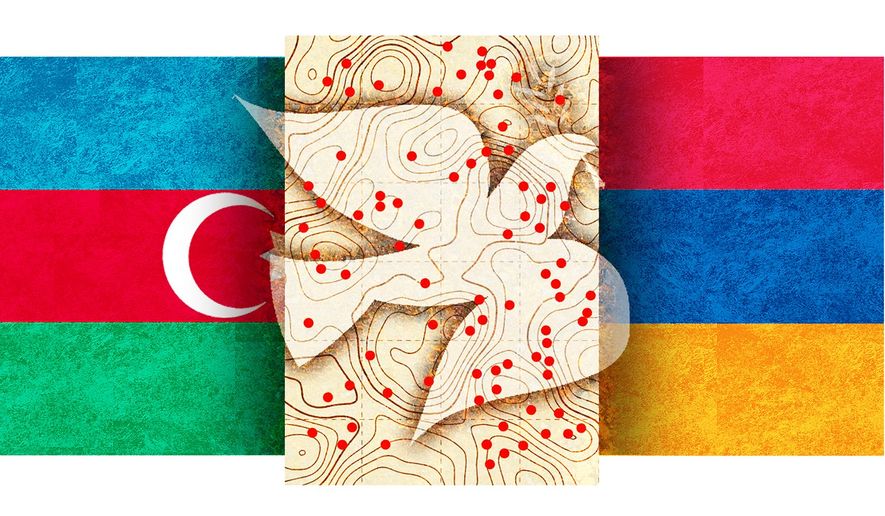
On March 13, the foreign ministers of Azerbaijan and Armenia simultaneously announced that they reached an agreement on the text of the ongoing peace agreement between the two countries, which means that Armenia has accepted the last two demands put forward by Azerbaijan in the context of the draft peace agreement.
Azerbaijan called for changes to two articles of the 17-article text. First, the removal of the EU monitoring mission on the Armenian-Azerbaijani border. Second, the submission of a joint application to the OSCE in order to terminate the mandate of the Minsk Group, which was established to address the long-standing Karabakh issue.
Azerbaijan is waiting for concrete steps
However, reaching an agreement on the peace text does not necessarily mean that it will be signed soon. In fact, a statement from the Ministry of Foreign Affairs of Azerbaijan clarified that for the peace agreement to be signed, changes need to be made to the Constitution of Armenia, and a joint application must be submitted to terminate the Minsk Group’s mandate. Additionally, the ministry emphasized Azerbaijan’s readiness to continue bilateral dialogue on these and other issues related to the normalization process between the two countries, indicating that other key aspects of normalization must also be resolved alongside the two primary concerns.
The signing of the peace agreement has long been a subject of discussion among experts and politicians in Azerbaijan. These issues are frequently raised by Azerbaijani President Ilham Aliyev as well. Key points include the opening of the Zangezur Corridor, preparing the Armenian community for peace, the return of the West Azerbaijanis who were forcibly expelled from Armenia, the disarmament of Armenia’s border areas with Azerbaijan, an apology for the massacres and genocide committed by Armenia during the occupation, and the payment of compensation for the occupation.
Although Armenia has stated that it is ready to join Azerbaijan in applying for the dissolution of the Minsk Group, it maintains that the EU mission will remain on the border until after the peace agreement is signed. However, this does not mean that Azerbaijan’s demand has been fully met, as the Azerbaijani side expects concrete steps from Armenia in this regard before the peace agreement can be signed.
Revisionism and armament pose a threat
While Armenian Prime Minister Nikol Pashinyan sent messages of peace, between March 16 and 21, the Armenian army violated the ceasefire on the border multiple times. The militarization of Armenia, a country with a history of aggression and where revisionist demands remain on the agenda, poses a threat to regional peace. After the Second Karabakh War, military advisers from France and the US were assigned to the Armenian army, and joint exercises were conducted. Before the 2020 war, Armenia’s military budget was $700 million. However, the Armenian parliament approved a military budget of $1.708 billion for 2025, a threefold increase since the Second Karabakh War. With national debt amounting to 60% of its GDP, Armenia has allocated 30% of its 2025 budget to military expenditures, making up 6% of the country’s GDP. This budget increase was accompanied by the purchase of offensive weapons from countries like France and India.
The ongoing presence of revisionist demands continues to shape Armenia’s military strategy. This was evident during the 35th Congress of the Dashnaksutyun (ARF) held on Feb. 25, 2025 in Yerevan, Armenia’s capital, where the strategic priorities of the ARF for the coming period were outlined. These priorities included securing international legal and political guarantees, along with other fundamental rights, to ensure the collective return of Karabakh Armenians; promoting national integration around the “liberation” agenda for Karabakh; restoring territorial integrity in line with the spirit of the Declaration of Independence; strengthening the Armenian army, defense, and security systems; bolstering the organizational strength of the Armenian diaspora; pursuing the international recognition of the so-called Armenian Genocide; and demanding compensation. Although the ARF is not currently in power, the Pashinyan administration’s approval for the ARF to hold a congress in Yerevan and the growing influence of the ARF in shaping Armenian society’s goals represents a serious threat to regional peace.
Armenia’s denialist policy is an obstacle to normalization
On the other hand, the Armenian government continues to deny basic human rights and its responsibilities under international agreements concerning the Zangezur Corridor and the right of return for Western Azerbaijanis.
The Azerbaijani side is nearing completion of the portion of the Zangezur Corridor within its territory. The Kars-Nakhchivan railway line, which forms the Turkish part of the Zangezur Corridor, has already been tendered, and construction is set to begin soon. However, Armenia remains opposed to this issue. In his most recent statements to Turkish press representatives, Pashinyan declared that the Zangezur Corridor agreement is unacceptable from Armenia’s perspective. Meanwhile, Pashinyan’s alternative “Crossroads for Peace” project, proposed as a substitute for the Zangezur Corridor, faces a deadlock, as it lacks the support of Azerbaijan and Türkiye.
The persistence of revisionist demands in Armenia, coupled with military escalation, severely hampers the normalization process between the Armenian and Azerbaijani peoples. Historical precedent suggests that unilateral peace efforts have previously led to renewed conflict. During the 70-year Soviet period, while Azerbaijanis sought to normalize relations with Armenians, revisionist factions within Armenia established secret organizations and raised funds to claim Karabakh and Nakhchivan. This contributed to the outbreak of the First Karabakh War. Therefore, the unilateral attempts at normalization during the Soviet era did not prevent conflict but instead led to a new war. To prevent further conflict and achieve genuine peace in the present, normalization must be a bilateral process. The Armenian government must take responsibility for preparing its people for peace.
Perhaps the most crucial aspect of normalization between the two societies is the return of Azerbaijanis expelled from Armenia to their homeland. Between 1987 and 1990, the community of 300,000 West Azerbaijanis, who were forced to leave Armenia, issued a statement outlining that for genuine peace to be achieved, Armenia must fulfill several key tasks. One of these tasks was “creating conditions for West Azerbaijanis to return to their homes in a safe and dignified manner, for the establishment of lasting peace and justice.” However, to date, the Pashinyan administration has consistently rejected these demands and ignored the desires of the 300,000 people seeking to return to their homeland.
One of the biggest obstacles to peace remains the current constitution of Armenia. The Pashinyan administration has indicated that a referendum on this issue will likely take place in 2026 or 2027. This suggests that signing the peace agreement before this date is highly unlikely.
To sum up, the Armenian side, which occupied Azerbaijani lands for 30 years and sought to maintain the status quo in the region after the Second Karabakh War, bears responsibility for the accumulation of the issues mentioned above. Having lost all its leverage, the Armenian administration now seeks to present itself as the “party that desires peace.” However, it was Azerbaijan that agreed upon the peace text. A peace agreement alone will not be sufficient to bring lasting peace to the region, as not all conditions for its signing have been met. For genuine peace to be achieved, it is crucial that the Azerbaijan-Türkiye partnership, which has reshaped the geopolitical landscape of the South Caucasus since 2020, continues, and that Armenia takes concrete steps on the still-contested issues.
Cavid Veliyev is a board member of the Baku-based think tank Center of Analysis of International Relations.