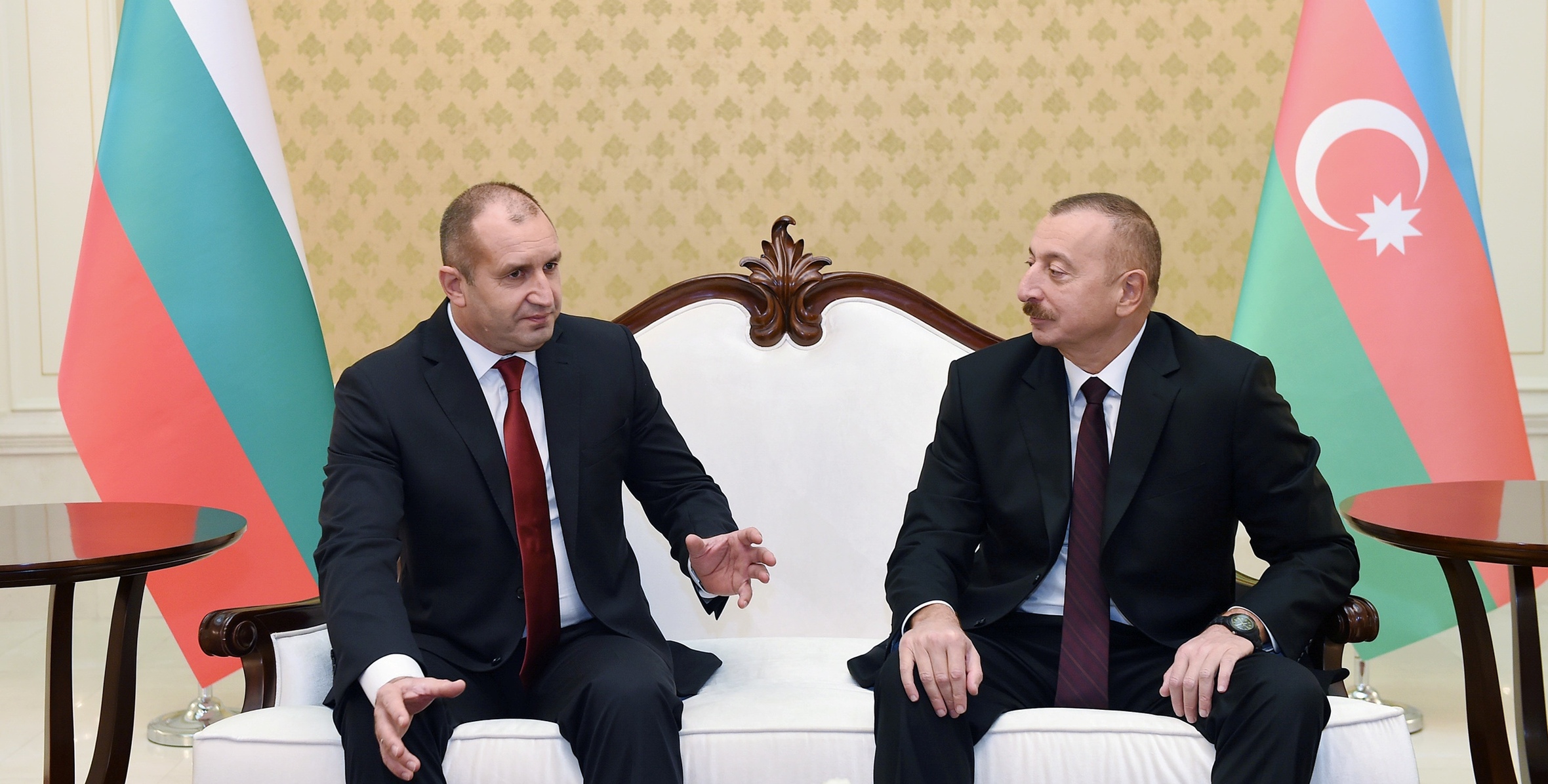
Furthermore, the agendas of both presidents were energy-related, and both leaders returned satisfied with Azerbaijan in this regard.
However, Azerbaijan-Bulgarian relations cover many areas beyond energy, as seen in the following agreements signed between the two countries during Rudev’s visit: “Joint Declaration on Strengthening the Strategic Partnership between the Republic of Azerbaijan and the Republic of Bulgaria”; “Code Share Agreement between Azerbaijan Airlines CJSC and Bulgaria Air JSC”; “Memorandum of Understanding between the Ministry of Digital Development and Transport of the Republic of Azerbaijan and the Ministry of Innovation and Growth of the Republic of Bulgaria on cooperation in the field of technological innovation”; “Memorandum of Understanding between State Oil Company of Azerbaijan Republic and Asarel Investment EAD”.
Political Relations
According to Azerbaijan’s Ministry of Foreign Affairs, 74 agreements were made between the Republic of Azerbaijan and the Republic of Bulgaria prior to this visit. Azerbaijan and Bulgaria signed a friendship and cooperation agreement on June 29, 1995, and a joint declaration on strategic partnership on March 4, 2015, in Sofia.
The declaration of strategic partnership signed by the two countries in Sofia in 2015, prior to the latest visit, establishes the fundamental characteristics of their relations. This declaration addresses relations in four categories. Politics; defense-security; commerce,economics,energy; science, education, and culture.
Bulgaria was an important strategic partner for Azerbaijan since it supported resolving the Karabakh issue within the context of Azerbaijani territorial integrity. This topic, which was a red line for Azerbaijan at the time, helped to strengthen bilateral cooperation in other areas. According to the declaration, a strategic dialogue was established at the foreign minister level to enhance political relations between the two countries, with meetings held in 2018 and 2022. Preparations were underway for a third strategic dialogue meeting in Baku in 2024, but it was postponed due to the rescheduling of the Bulgarian Foreign Minister’s visit.
However, some Bulgarian parliament members occasionally supported the separatists in Karabakh, leading to political disagreements between the two countries. During Azerbaijan’s anti-terrorist operation in Karabakh in 2023, the Bulgarian Foreign Ministry issued a statement supporting Azerbaijan’s sovereignty in Karabakh, while largely aligning with the EU’s position on resolving the issue. Despite these issues, no political crisis emerged between the two countries. On December 1, 2023, political consultations were held in Sofia between the Ministries of Foreign Affairs of Bulgaria and Azerbaijan at the level of Deputy Ministers. During the consultations, they discussed new geopolitical and economic realities, developments in bilateral relations, intentions to update the Joint Declaration on Strategic Partnership, and efforts to improve regional and European energy security through diversification of energy supplies.
Energy Relations
Since the emergence of the Southern Gas Corridor, Eastern European countries have shown increased interest in Azerbaijani natural gas. The Shah Deniz Stage 2 project, which is delivering natural gas directly from Azerbaijan to Europe, plays a pivotal role in this development. In this context, Bulgaria joined the Shah Deniz Consortium, the source of the Southern Gas Corridor, on September 19, 2013. Initially, it was agreed that Bulgaria would purchase 1 billion cubic meters of natural gas annually, but this amount was later increased to 1.5 billion cubic meters during latest visit.
The Trans Adriatic Pipeline (TAP) was chosen in 2013 to transmit Azerbaijani natural gas to Europe, with plans to connect this gas to Bulgaria via the Greece-Bulgaria interconnector (IGB). Despite delays in constructing the IGB, Azerbaijan began supplying gas to Bulgaria at the beginning of 2021 through the Kulata-Sidirokastro delivery point on the existing Bulgaria-Greece pipeline, which has a capacity of 10 million cubic meters of gas per day. As a result, Bulgaria received over 270 million cubic meters of gas in 2021. The completion and operation of the Interconnector Greece-Bulgaria (IGB) Pipeline were celebrated in Sofia on October 1, 2022. The combination of this new route and the commissioning of the IGB pipeline enabled Azerbaijan to supply a total of 600 million cubic meters of gas to Bulgaria in 2022.
The energy agreement signed between Azerbaijan and the EU in 2022 facilitated an increase in the amount of Azerbaijani gas exported to Europe. On December 31, 2022, Russia decreed that ‘unfriendly’ foreign buyers could not pay for gas in dollars or euros, leading Poland and Bulgaria to refuse payments in rubles. Historically, Bulgaria had been almost entirely dependent on Gazprom for its gas supply, with annual imports of three billion cubic meters from Russia covering nearly 90 percent of its demand. Moscow halted gas supplies to both countries in April after the Bulgarian government refused to comply with the payment terms. Since then, Bulgaria has been seeking alternative sources, such as Azerbaijani gas and LNG from the United States, to meet its needs. In 2023, 1.25 billion cubic meters of Azerbaijani gas were transported to the Bulgarian market. The plan is to export 1.5 billion cubic meters of Azerbaijani gas to Bulgaria by the end of 2024, which would account for approximately 50 percent of Bulgaria’s total gas consumption.
Bulgaria as Transit country for Azerbaijan Natural Gas
At the same time, Bulgaria has become an important gas transit country for Eastern European nations. Azerbaijani gas is currently exported from Bulgaria to other neighboring countries, with the number of these countries expected to increase in the coming years. The Southern Gas Corridor (SGC) project significantly influenced Bulgaria’s decision to construct the Interconnector Greece-Bulgaria (IGB) pipeline, facilitating a connection to this gas corridor. Additionally, Bulgaria is considering the possibility of transiting Azerbaijani gas through its territory to other European countries.
On July 18, 2017, SOCAR and Bulgartransgaz signed a Memorandum of Understanding (MoU) that outlined opportunities for cooperation between the two companies. The MoU focused on creating additional natural gas supply routes through Bulgaria to other markets in Southeast Europe, SOCAR’s participation in the Balkan Gas Hub, and the transit of additional volumes of natural gas from the Southern Gas Corridor beyond those agreed upon in 2013 with the Shah Deniz consortium.
On April 25, 2023, a Memorandum of Understanding (MoU) was signed in Sofia, Bulgaria, to foster cooperation between the gas transmission system operators from Bulgaria (Bulgartransgaz EAD), Romania (Transgaz S.A.), Hungary (FGSZ Ltd.), Slovakia (EUSTREAM), and the State Oil Company of the Azerbaijan Republic (SOCAR). This MoU addresses the Solidarity Ring (STRING) joint initiative, supported by the European Commission, which aims to enhance the security of natural gas supplies for the European Union and the Central and South-Eastern European regions. The Solidarity Ring initiative seeks to upgrade the transmission network systems of Bulgaria, Romania, Hungary, and Slovakia to facilitate additional gas deliveries from alternative sources, such as Azerbaijan, for European customers.
Cooperation between Azerbaijan and Bulgaria in the field of green energy is a notable area of focus. During the Bulgarian President’s recent visit, the parties discussed the concept of a green energy cable. According to Azerbaijan’s Economy Minister Mikayil Jabbarov, Bulgaria is interested in the project of supplying green energy produced in Azerbaijan to the European Union through Georgia. It is known that Azerbaijan has a green energy capacity of 200 GW. Azerbaijan also has concrete agreements with some European countries in the field of green energy. Notably, the Agreement on Strategic Partnership between the Governments of Azerbaijan, Georgia, Romania, and Hungary in the field of Development and Transmission of Green Energy was signed on December 17, 2022, in Bucharest.
Bulgaria and Middle Corridor
Cooperation between Bulgaria and Azerbaijan in the field of transportation was a key issue discussed in both the signed agreements and the meetings between the leaders of the two countries. Additionally, the Baku-Tbilisi-Kars railway project, which has seen its capacity increased from 1 million tons to 5 million tons with Azerbaijani investment, presents new opportunities for enhancing this cooperation.
The Bulgarian side has expressed interest in participating in the development of the Trans-Caspian International Transport Corridor, also known as the ‘Middle Corridor.’ In the current geopolitical situation, this corridor offers significant opportunities for enhancing trade between Europe and Asia through the Caspian and Black Seas.
Even before the Russia-Ukraine war, Bulgaria began to show interest in the Central Corridor in 2018. In response to a question about the Trans-Caspian transport corridor, Bulgarian Transport Minister Ivaylo Moskovski stated that Bulgaria could become a bridge for Chinese cargo, thereby opening the “New Silk Road” (One Belt One Road Initiative) to Central and Western Europe. After the Russia-Ukraine war, the importance of the Middle Corridor increased significantly, making it a priority issue for Bulgaria.
On April 28, 2023, Secretary General of the TITR Association, Gaidar Abdikerimov, announced that Bulgaria, along with Singapore and Lithuania, would join the Trans-Caspian International Transport Route (TITR). In May 2023, Bulgarian Deputy Prime Minister and Minister of Transport and Communications Hristo Aleksiev proposed hosting a ministerial meeting to advance the development of the Trans-Caspian International Transport Route, also known as the Middle Corridor, during a meeting with ambassadors from Azerbaijan, Georgia, and Kazakhstan. Bulgaria is keen to include the Black Sea ports of Varna and Burgas in this route, which is essential for providing a strategic alternative to the logistical corridor through Russia that has been blocked by the war in Ukraine. According to the Bulgarian Transport Minister, these two ports have idle capacities and are very well connected to the Bulgarian rail and road network.
As a result, during the Bulgarian President’s visit to Azerbaijan, the two countries strengthened their relations and enhanced their strategic cooperation. Although energy currently remains a priority in their bilateral relations, the cooperation extends beyond just energy. It encompasses multiple areas, opening new opportunities for both countries. These relations not only increase Azerbaijan’s influence in the Eastern European energy market and European politics but also enable Bulgaria to diversify its energy resources and become a transit country for Eastern European nations.
Dr. Cavid Veliev is the head of a department at the AIR Center.