Azerbaijani President Ilham Aliyev’s trip to Moscow on April 22 may not have seemed significant by itself but becomes much more so when viewed in a broader context. Notably, the visit came less than a week after Russia announced it would withdraw its “peacekeeping” mission in Karabakh. But just as tellingly, Aliyev traveled to the Russian capital only two weeks after a highly publicized trilateral meeting involving the United States, the European Union, and Armenia, which many observers suggested marked a turning point in Yerevan’s relationship with the West and the possibility of Armenia distancing itself from Russia. It remains to be seen to what degree those predictions come to pass.
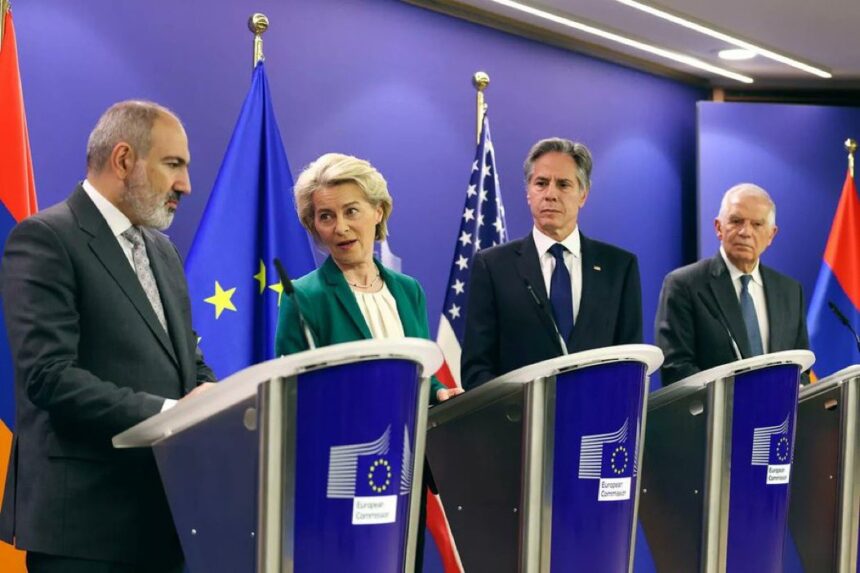
Undoubtedly, Moscow was displeased with the high-level April 4 trilateral meeting in Brussels, where Armenian Prime Minister Nikol Pashinyan held talks with European Commission President Ursula von der Leyen, EU High Representative Josep Borrell, US Secretary of State Antony Blinken, and United States Agency for International Development (USAID) Administrator Samantha Power. And the fact that it coincided with the North Atlantic Treaty Organization’s (NATO) 75th anniversary celebrations surely intensified the Kremlin’s frustration. Baku’s reaction before and after the meeting mirrored that of Moscow’s. Despite receiving dual assurances in phone calls from Brussels and Washington a day prior, Azerbaijan contended that its exclusion from the US-EU-Armenia talks would hinder the Azerbaijani-Armenian peace process. Unofficial government-linked media went as far as suggesting that the trilateral meeting transcended political and economic cooperation, alleging that the West was readying military support to Armenia. Iran, another influential player in the South Caucasus, expressed its own, albeit less overtly critical, dissatisfaction, asserting that regional matters should be resolved within the framework of the 3+3 format (comprising Armenia, Azerbaijan, Georgia, Russia, Iran, and Turkey). Though, should Azerbaijan’s assertions regarding military collaboration materialize, Iran’s opposition to Western involvement in the region will likely harden.
Deteriorating Russian-Armenian ties
The EU and US officials’ sit-down with Pashinyan reciprocated the Armenian government’s noteworthy shift toward the West in recent months. That apparent Armenian reorientation dates back at least to the 2020 Second Karabakh War, which ended with Azerbaijan’s victory over Armenian forces but during which time Russia — Armenia’s primary strategic ally — remained ostensibly neutral and did not militarily intervene. Moreover, when the Azerbaijani army seized a number of key positions within Armenia’s sovereign territory a year later and then regained control of the majority of the Armenian-populated territories located within the remaining parts of Karabakh in 2023, Russia also did not lift a finger. Moscow’s failure to act resulted in a deterioration of its relations with Yerevan. As one of the first major steps, Armenia declared a freeze on its participation in the Moscow-led regional alliance, the Collective Security Treaty Organization (CSTO). More recently, Armenian leaders have called for the withdrawal of Russian Federal Security Service (FSB) border guard forces from Yerevan’s Zvartnots airport. One ruling party parliamentarian went even further, implying that the Russian military base in Gyumri should be closed “when time comes.”
Though its Russian ally’s disengagement was a major factor in Armenia’s shift toward the West, so were the series of recent Georgian advancements toward EU membership. On Dec. 14, 2023, the European Council officially granted candidate status to Georgia. Observing Georgia’s complicated yet incremental movement along the path of European integration, the Armenian leadership chose to follow suit, emphasizing shared values with the West and expressing an openness to aligning more closely with its South Caucasus neighbors.
Strategic importance of the South Caucasus
The EU-US-Armenia trilateral meeting must also be considered in the context of the South Caucasus as a strategic transregional corridor. Notably, in addition to providing Armenia with 270 million euros in grants, the Western partners in Brussels pledged that Armenia would play a crucial role in the Black Sea Submarine Cable Project, scheduled to become operational in 2029. This 3-gigawatt, high-voltage electricity transmission line is a key element of the EU’s broader Global Gateway Initiative, aimed in part at countering China’s Belt and Road Initiative. The project’s launch, in December 2022, was attended by leaders from Azerbaijan, Georgia, Romania, and Hungary, initially focusing on linking the electricity systems of these countries.
Once operational, the submarine electricity cable will certainly contribute to much-needed diversification of Armenia’s energy supply. But Yerevan must also take some serious short-term steps to reduce its dependence on Russia. Unlike Georgia, Armenia has been unable to import natural gas Azerbaijan due to the multi-decade conflict between two countries. Consequently, this has led to Armenia’s increasing reliance on Russia not only in terms of gas imports but also because it has progressively granted Russian Gazprom ever greater control over the country’s domestic pipeline infrastructure as payment in kind for its mounting debts. Today, Russia fully owns Armenia’s domestic natural gas infrastructure, including the transportation and distribution networks. A successful completion of peace talks with Azerbaijan could offer an opening for Armenia to be able to diversify away from Russian gas by finally being able to purchase volumes from its eastern neighbor.
Armenia also relies on Russian nuclear technology for 25% of its power generation from Metsamor Nuclear Power Plant. According to recent reports, Armenia and Russia agreed to modernize the existing Metsamor Nuclear Power Plant to extend its lifespan until 2036; though the two sides are also exploring the possibility of building a new Rosatom-designed VVR 1200 reactor unit at this facility or elsewhere. Due to safety concerns, Metsamor’s continued operation has long been a bone of contention between Yerevan and the EU. One alternative is partnering with French or American companies to build smaller, modular reactors. The recent trilateral meeting may contribute to the realization of the latter.
Challenges ahead in escaping Russia’s orbit
Clearly, Armenia will not find it easy to substantially reduce its ties to Russia. As noted above, the country is overwhelmingly reliant on Russian energy. Moreover, Russian state-owned companies continue to dominate the Armenian economy, and the country formally remains a member of the Russian-led Eurasian Economic Union (EEU). Furthermore, heated political rhetoric aside, the lease on Russia’s military base in Armenia does not expire until 2044, Russian FSB agents are present on Armenia’s borders with Turkey and Azerbaijan, and Armenia remains a treaty member of the CSTO.
Azerbaijan at a crossroads
Still, the South Caucasus region is undoubtedly experiencing significant geopolitical shifts. The Second Karabakh War and subsequent peace negotiations between Armenia and Azerbaijan, alongside Georgia’s gradual if not always direct movement toward the West, have catalyzed developments in the area. A successful Westward reorientation by Armenia could further accelerate these wider processes. If realized, two South Caucasus states would be joining the Western community, presenting Baku with a critical decision: to align with Russia or the West. Yet Baku does not view these two processes as incompatible.
Until now, Azerbaijan has cultivated relations with the West primarily through its gas exports to Europe, offering an alternative to Russian supplies. At the same time, however, Baku has managed to prevent this issue from affecting its relationship with Moscow. Additionally, Baku has skillfully avoided antagonizing Moscow despite its firm support for Ukraine’s territorial integrity. This diplomatic approach is emblematic of Azerbaijan’s broader dedication to foreign policy multi-vectorism. Alongside maintaining working relations with Russia and a strategic partnership with Turkey, Baku has also established strong ties with Israel, Pakistan, and more recently, with Arab Gulf states. In recent times, Azerbaijan has also made efforts to strengthen political and economic connections with Central Asian states, offering itself as a key link in a transcontinental, east-west transport corridor.
Until now, the West has largely overlooked internal developments in Azerbaijan, but this stance may soon shift. Recent events such as arrests of journalists, the authorities’ suppression of Western-backed non-governmental organizations (NGOs), and Europe’s increasing capacity to import liquefied natural gas (LNG) instead of having to rely on piped volumes from suppliers like Azerbaijan could prompt a change in attitude. There are already initial signs of such a shift. On April 22, two US lawmakers introduced a draft bill, similar to the Magnitsky Act, proposing sanctions against Azerbaijani government officials for alleged ethnic cleansing of Armenians from Karabakh as well as for the arrests of journalists and local activists. Although the possibility of the draft bill becoming law remains low, it could potentially lead to a proliferation of similar draft laws in the US and Europe, turning Azerbaijan into a pariah state akin to Russia.
Conclusion
Even as their political relationship has frayed, removing Armenia from Russia’s economic orbit will be a challenging endeavor — but the transition has clearly commenced. That said, Yerevan will find it incredibly difficult to navigate the intricate network of relationships with its neighbors while simultaneously reducing its dependence on Russia. Despite the ineffectiveness of the CSTO, amid Russia’s war in Ukraine, Armenia has been able to capitalize on the advantages of membership in the EEU, which played a significant role in Armenia’s robust growth trend from 2022 to 2023. At present, the West does not provide a viable alternative to this scenario.
The integration of the whole of the South Caucasus into Europe’s sphere of influence poses even more considerable challenges for both the United States and the European Union. A key consideration for the West will be to remain mindful of actions that could alienate any of the South Caucasus countries during this process. The successful integration of the region into the European community will heavily rely on reducing its economic and, especially, energy dependence on Russia. Thus, to achieve this, the West may find greatest success by promoting energy projects aimed at enhancing connectivity among all three South Caucasus republics.
Rauf Mammadov is a Non-Resident Scholar at MEI, focusing on issues of energy security, global energy industry trends, as well as energy relations between the Middle East, Central Asia, and South Caucasus.