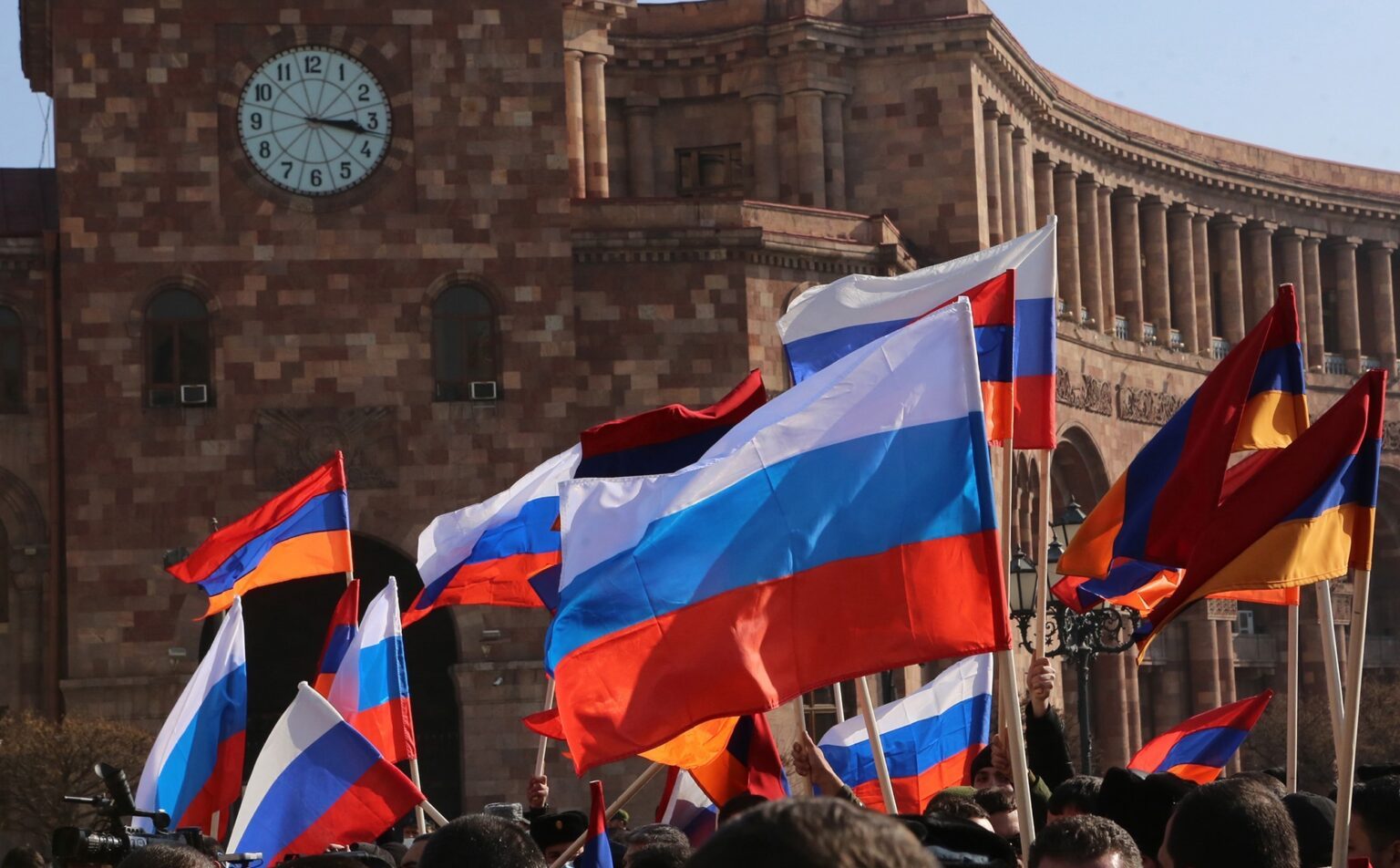
Russia has supplied most of Armenia’s military equipment, including during the First and Second Karabakh Wars, reinforcing Armenia’s dependence on Russian military support. Despite efforts to diversify its military relations, including with France and the European Union, Armenia remains deeply tied to Russia through extensive military, economic, and geopolitical connections. This dependence is likely to persist, shaping Armenia’s international relations and military strategies into the future.
BACKGROUND: Armenia’s military dependence on Russia dates back to the collapse of the Soviet Union, under which it had the legal status of the highest-level administrative division as a “union-republic.” After 1991, the newly independent Republic of Armenia inherited Soviet-era equipment and continued to maintain close ties with Russia. Confirming its reliance on Russian military assistance, Armenia joined the Russian-led CSTO in 1992. The relationship deepened in the early 1990s, during the First Karabakh War with Azerbaijan, as Russia gave the Republic of Armenia’s army crucial military support to consolidate its advances on occupied Azerbaijani territory. Since then, Russia has provided Armenia with most of its military equipment, as well as significant financial aid and logistical assistance. Between 2011 and 2020, Russia was the primary source of Armenia’s military supplies. The Stockholm International Peace Research Institute reported that Russia provided no less than 94 percent of Armenia’s arms imports during this period. Armored personnel carriers, air defense systems, multiple rocket launchers, and tanks were among the weapons systems delivered. Armenia utilized all these weapons against Azerbaijan during the Second Karabakh War in late 2020. In exchange, Armenia has consistently shown strong diplomatic support for Russia on key international matters, including the illegal annexation of Crimea. Although Armenia has occasionally accused Russia of neglect, the overall evidence indicates a long-standing strategic partnership. The 1997 Treaty of Friendship, Cooperation, and Mutual Assistance between the two nations, which exists independently of their collaboration within the CSTO, officially established their military alliance. On the economic side, Armenia has been a member of the Russian-led Eurasian Economic Union (EAEU) since January 2015. Russian armed forces continue to operate the 102nd Military Base at Gyumri, first established 70 years ago. The agreement on the base’s operations has been extended multiple times. In 2010 an interstate treaty provided for its continued operation until 2044. Under the terms of the treaty, neither Armenia nor Russia can terminate the agreement by itself; both parties must agree. The Gyumri military base currently hosts 3,000 Russian soldiers, while five miles from central Yerevan – at Erebuni Airport – another air base is home to a squadron of attack helicopters. In 2019, after a 2018 meeting with Russian President Vladimir Putin, Pashinyan sent a mission to Syria, officially for humanitarian reasons, though it included military personnel. In May 2021, Pashinyan initiated two deployments from the Gyumri base into southern Armenia, specifically targeting the Syunik region. This area lies between Azerbaijan’s main territory and its exclave, Nakhchivan, and encompasses the land strip sometimes referred to as the “Zangezur corridor.”
IMPLICATIONS: Despite claims that Russia abandoned Armenia before the Second Karabakh War, evidence suggests continued support. After the July 2020 clashes that led up to the war in the fall, there were reports of nine Russian flights delivering military supplies to Armenia. This flight activity intensified as the war approached, and overall Russia transported 510 tons of war materiel to Armenia. When Azerbaijan’s President Ilham Aliyev expressed misgivings to President Vladimir Putin about these shipments, Russia’s Defense Minister Sergei Shoigu claimed that the cargo was intended for construction activities at the Gyumri base. This explanation was skeptically received in Azerbaijan, particularly after the surprise and dismay following the earlier Russian deliveries to Armenia. A significant illustration of this close military cooperation was the attendance by Armenia’s former defense minister, Arshak Karapetyan, at an August 2021 military exhibition in Moscow. Karapetyan met there Dmitry Shugayev, the Director of the Russian Federal Service for Military-Technical Cooperation, and Alexander Mikheyev, the Director of Rosoboronexport. These meetings covered the full range of Armenian-Russian military-technical cooperation, reflecting the enduring and comprehensive nature of their bilateral military alliance. In 2020, Iskander surface-to-surface missiles, with a range of 300 kilometers and forming a crucial part of Armenia’s arsenal, were reportedly used to strike Azerbaijani territory far behind the front lines during the Second Karabakh War. These missiles also targeted the historically, culturally, and strategically significant city of Shusha, which Armenian forces had occupied. Russia routinely sells its military systems to Armenia at the domestic Russian price, rather than at the higher international price set for foreign buyers. To facilitate this, Moscow generally offers low-interest loans to Yerevan. Since 2020, it has provided at least US$ 300 million in such loans to help Armenia replenish its military arsenal. Discussions are continually ongoing to increase this amount further. Moreover, the Russian FSB’s Border Guard Service is responsible for overseeing most of Armenia’s international borders. Additionally, Russia has been incorporating Armenian armed forces into its Southern Military District. This reorganization includes the creation of joint Russian-Armenian ground forces. The air defense systems of the two countries have been unified for some time. Russia is responsible for maintaining the security of Armenian airspace. Armenia’s relationship with Russia has only deepened over the past three decades. Its dependence extends far beyond its involvement in the CSTO and EAEU and its comprehensive bilateral treaty. Russian state companies have a significant presence across the Armenian economy. They control important sectors such as transportation, where the Armenian state railroad company is entirely owned by its Russian counterpart; the energy sector, where one Russian state trust owns Armenia’s gas distribution system and another oversees the Metsamor nuclear power plant; and the banking sector, where Russian financial institutions are overwhelmingly dominant.
CONCLUSIONS: Armenia appears to be exploring options to decrease its reliance Russian military support and modernize its forces, but its strategic partnership with Russia is a cornerstone of the country’s post-Soviet identity. The partnership, marked by extensive military collaboration, geopolitical alignment, and economic and security dependence, plays a crucial role in shaping Armenia’s international relations and military strategy, despite signs that Yerevan is seeking to diversify its alliances and broaden its strategic options. Thus, despite receiving the European Union Mission in Armenia (EUMA) to monitor the border situation, and despite signing an arms deal with France to acquire radar systems and other equipment from French manufacturers Thales and Safran, Armenia’s strategic choices have placed it firmly under Russian dominance. Efforts by the EU and its members, particularly France, to extend their influence in Armenia for their own purposes, have not diminished Yerevan’s subservience to Moscow, which – as described above – influences almost every facet of the country’s life. Even the declared intention to leave the CSTO at some indefinite time in the future will not affect the bilateral military treaty with Russia that will remain in force, until 2044 unless both sides agree to abandon it. France and other powers, including the U.S., should focus on Armenia’s genuine security concerns rather than exploiting it for geopolitical purposes. Unfortunately their current strategies, often driven by radical irredentist Armenian interest groups that continue to focus on Karabakh, often exacerbate divisions in the South Caucasus rather than bring stability. But using Armenia and its conflict with Azerbaijan to further their own strategic interests will only fuel ongoing conflict and deepen mistrust, jeopardizing Armenia’s long-term security and diminishing the chances for lasting peace in the region.
Robert M. Cutler was for many years a senior researcher at the Institute of European, Russian and Eurasian Studies, Carleton University, and is a past Fellow of the Canadian International Council.