As a result of three major earthquakes in total, tens of thousands of people have lost their lives. In response to this devastating series of earthquakes, the Turkish government issued a level-four alarm, calling for international assistance. According to (, 88 countries have sent aid and helped directly in the field (Trtworld,com, February 7). North Atlantic Treaty Organization (NATO) Secretary-General Jens Stoltenberg, who visited Turkey in the wake of the disaster, described it as the most violent earthquake ever faced by a NATO member.
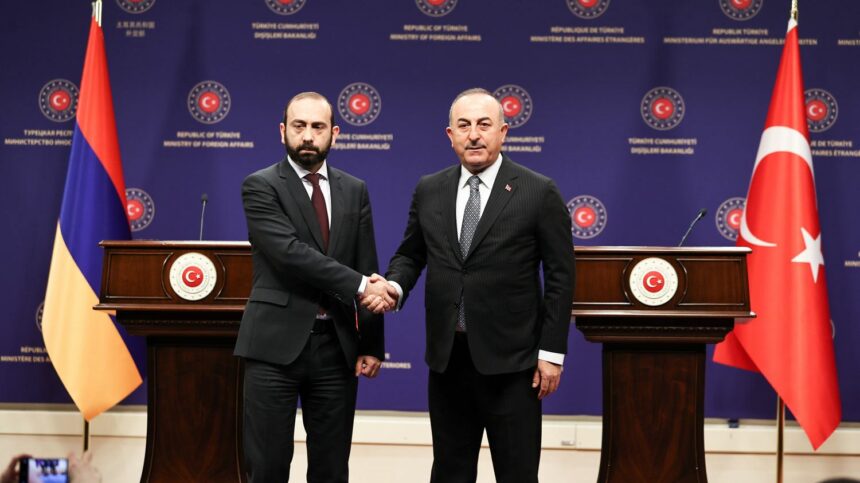
Azerbaijan was the first state ally to send support to Turkey. Furthermore, messages of condolences, rescue teams and support sent by countries such as Greece and Israel, which traditionally have political conflicts with Turkey, were welcomed by Ankara and Turkish society. Going along with this humanitarian spirit, both a rescue team and other aid were sent from neighboring Armenia. Armenian Prime Minister Nikol Pashinyan called Turkish President Recep Tayyip Erdogan directly to express his condolences, while Armenian Foreign Minister Ararat Mirzoyan visited Turkey on February 15 to meet with his counterpart, Cavusoglu (Daily Sabah, February 15).
All these developments took place amid a wider normalization process between Ankara and Yerevan with the aim of opening their shared borders and establishing diplomatic relations. In fact, the Margara bridge on the border between the two countries, which had been closed for 30 years, was opened for the Armenian aid coming to Turkey (Aa.com.tr, February 11). This led to demands from Yerevan that the border remain completely open. After their meeting on February 15, once the second delivery of aid had passed through Margara, Mirzoyan and Cavusoglu released important messages on bilateral relations and regional normalization. In this, it was revealed that the parties had decided to jointly repair the historic Silk Road bridge (Apa.az, February 15).
Mirzoyan also reaffirmed Yerevan’s willingness to establish diplomatic relations with Ankara and its support for the full opening of the border between Turkey and Armenia. While Cavusoglu stated that progress in the normalization of relations between Armenia and Turkey, as well as Azerbaijan, will contribute to peace and prosperity in the region, he stipulated that the signing of a peace agreement between Yerevan and Baku was a central condition before opening the Turkish border with Armenia. Therefore, once again (see EDM, November 2, 2022), while the Armenian side is adamant that the borders be opened, the Turkish government is more concerned with wider normalization throughout the South Caucasus (Daily Sabah, March 15, 2022).
At almost every opportunity, Turkish officials declare that they are sincere about the normalization of relations with Armenia (Daily Sabah, January 15), and important steps are indeed being taken to achieve this goal. Roads and bridges have been repaired for the opening of the border between the two countries. Furthermore, on January 1, the joint decision was made for bilateral cargo transportation to resume (Apa.az, February 15).
The Turkish side believes that what happened between the two countries following the earthquakes is part of a mutual trust-building process between Ankara and Yerevan. Conflicts between the two sides on the eve of World War I and in the Karabakh wars caused deep mistrust between both countries’ societies, which persists to this day. In fact, according to the results of the “Turkey Trends 2022” public survey conducted by the Global Academy, with the contributions of a group of independent Turkish academics, 52.6 percent of participants considered Armenia an enemy (Globacademy.org, January 17). In the same survey, only 20 percent of respondents wanted the normalization of relations with Armenia, while 60.2 percent still opposed it. According to the survey’s results, Armenia was the last country—behind the United States, Egypt, the United Arab Emirates, Greece, Syria, South Africa, Israel and the Republic of Cyprus—with which respondents wanted to normalize relations.
These results came even after the end of the Second Karabakh War, the continuation of the normalization process between Ankara and Yerevan over the past year and mutual positive messages emanating from both countries. Naturally, this mistrust must be eliminated before the borders can be opened and diplomatic relations are established. According to the results of the same survey, Azerbaijan ranked first among Turkey’s allies, with an approval rating of 54.8 percent. The signing of a peace agreement between Baku and Yerevan, with the mutual respect for territorial integrity, will reduce insecurity in Turkey and accelerate normalization with Armenia (Globacademy.org, January 17).
Although negotiations continue for a final peace treaty between Azerbaijan and Armenia, an official agreement has yet to be reached. Recently, at the Munich Security Conference, these negotiations continued as facilitated by US Secretary of State Anthony Blinken. Azerbaijani President Ilham Aliyev stated that, for the first time, Azerbaijan has officially proposed to put checkpoints on both sides of the Zangezur Corridor and Lachin road (Apa.az, February 18). That way, if controls are established on both the Azerbaijani and Armenian sides, Russian peacekeeping forces may not be needed on either side.
Aliyev added that it is unacceptable that “any claims be made in relation to Karabakh” in the prospective agreement (Apa.az, February 18). Moreover, in Munich, the Azerbaijani president insisted that he will be not speak with Russian oligarch Ruben Vardanyan but rather that talks would be held with local Armenians. After the meeting in Munich, Vardanyan, Arayik Harutyunyan and Sergey Ghazaryan urgently traveled to Moscow. Partially as a result of Azerbaijan’s objections, Vardanyan was dismissed and replaced with Gurgen Nersisyan, the former “chief prosecutor” in the de facto separatist Karabakh region (News.az, February 23).
Therefore, while some positive developments are present in the Azerbaijani–Armenian peace process, which is critical to the Turkish–Armenian normalization process, real results have yet to be achieved.
In short, the borders between Turkey and Armenia are ready to be opened, and the remaining legal procedure is close to completion. However, two major obstacles remain to full normalization between the two sides: mutual distrust between their societies and the lack of a lasting resolution for peace between Azerbaijan and Armenia.
Cavid Veliyev