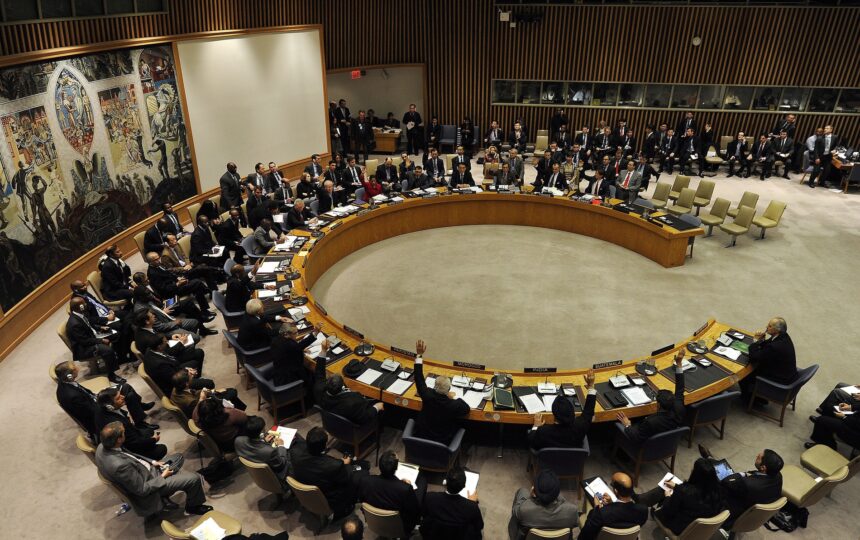
We shall leave aside whether the offices and corridors of the skyscraper on the East River will recall that Armenia ignored four resolutions of the UN Security Council on Karabakh for more than a quarter of a century. It hardly makes sense to say for the umpteenth time that there is no “humanitarian crisis” in Karabakh and that it is the sovereign right of any country to protect its borders. Finally, there is the fact of Azerbaijan’s proposal to use the Aghdam-Khankendi road. And if the Khankendi separatists do not want to use this road, it is their decision and their responsibility for the consequences. Including humanitarian ones.
But there is yet another side to this issue. Namely, the position of the member states of the UN Security Council. First and foremost, its permanent members with the right of veto. And especially those who take on the role of mediators in the post-war settlement of the situation between Baku and Yerevan. And those who, as recent events show, do not seem to remember very well that the first requirements for mediators are neutrality and objectivity. Most importantly, their behavior in a sensitive issue such as respect for Azerbaijan’s borders, sovereignty and territorial integrity will have a direct impact on bilateral relations.
Now, point by point.
If an anti-Azerbaijani document is somehow passed in the UN Security Council, Baku will draw relevant conclusions and respond appropriately. In this case, the Washington negotiating track, on which American diplomacy pinned serious hopes, will simply be buried. As, indeed, will any role of the West in resolving the situation. Moreover, the US positions in Azerbaijan will be undermined. They have already been badly damaged recently. Rest assured that Baku carefully reads unofficial “State Department” messages that are diligently presented by David Ignatius on the pages of The Washington Post. And the fact that he is really Ignatosian only partially explains the situation. As does his affectionate friendship with Ruben Vardanyan. The Washington Post is not a publication where Rubik Vardanyan’s friends can publish as many as three anti-Azerbaijani articles in a week simply because they feel like it. And if now the United States also gives a go-ahead to the Armenian order in the UN Security Council, there is no doubt that Baku will draw conclusions that Washington will hardly like. It may sound harsh, but a partner willing to betray and stab you in the back at any moment cannot be considered that valuable and reliable. And the US, frankly speaking, in recent years has too often betrayed its partners. Pakistan has a lot to say about this. Saudi Arabia also has its own scores to settle with the US. And most importantly, both the Azerbaijani and the international community could see what kind of game Washington is playing today regarding Türkiye. That includes incomprehensible flirtation with Kurdish groups in Syria and Iraq, the fact that Gülen, the mastermind and organizer of the 2016 attempted coup in Türkiye, is still in the United States, the strange games around the delivery of F-16 aircrafts to Ankara, and Türkiye’s withdrawal from the F-35 program. Officially, the reason for this decision was Türkiye’s purchase of S-300 air defense systems from Russia. But for some reason, the United States “forgot” that they had refused to deliver their Patriot systems to Türkiye.
It is Ukraine that is now facing the oddities of American policy. Ukraine is being urged, unofficially but increasingly insistently, to start negotiations and make peace: in other words, to share territories with Russia. This is exactly what Ukrainian Foreign Minister Dmytro Kuleba said the day before. According to him, “A difficult autumn awaits Ukraine,” because “voices are growing in different countries of the world that problems [persist] and that negotiations are needed.” As Kuleba noted, “this is not coming from officials, but these voices are getting louder”.
We should also keep in mind that if Russia joins in such games, organizing a kind of conspiracy with the West against Azerbaijan’s interests in the UN Security Council, the same will apply to Moscow’s mediatory role, especially since Azerbaijan has plenty of questions for the Russian Federation. That includes the strange behavior of Russian peacekeepers in Karabakh, recent statements of the Russian Foreign Ministry, which caused understandable bewilderment in Baku, and much more. Diplomacy does not react to everything, but it does not forget anything.
And Baku will not forget the actions of representatives of certain countries in the UN Security Council. Baku will draw conclusions.