During World War I, Britain promised to support the Armenians’ quest for independence. However, as Lord York noted in his speech in the House of Commons, the problem was that there were no Armenian populations in the areas London planned to incorporate into an Armenian state.
Prominent Azerbaijani writer and statesman Yusif Vezir Chamanzaminli, commenting on the stance of the great powers on the “Armenian question,” wrote: “Since the last century, the Armenians’ appeals in the name of Christianity and religious solidarity were met with promises and pleasant words from Europeans, but the issue remained unresolved. It became clear that the British fleet could not occupy Mount Ararat; Bismarck refused to trade one bone of a German soldier for all the Armenians, and the Russians were thinking not of saving the Armenians but of seizing Armenia.”
Chamanzaminli noted that the hypothetical Armenian state was supposed to occupy a vast territory washed by the Black, Mediterranean, and Caspian Seas.
In the early 20th-century book by Russian author I.N. Kanadeev, “Sketches of Transcaucasian Life,” there is a map of the “Armenian world” encompassing all of the Transcaucasus and the Asian part of Turkey.
Overall, the plans to create an Armenian state in the early 20th century covered a significant portion of the South Caucasus, Asia Minor, and the northwestern regions of Iran (South Azerbaijan). These plans were actively supported by several great powers, including Britain, France, and Russia.
When Armenian gangs unleashed terror against the Muslim population after Russia’s invasion of northern Iran, Iranian author A. Kasravi questioned what motivated Christians, who had always lived in harmony with Muslims, to take up arms and shed the blood of their compatriots as soon as foreign troops entered the country.
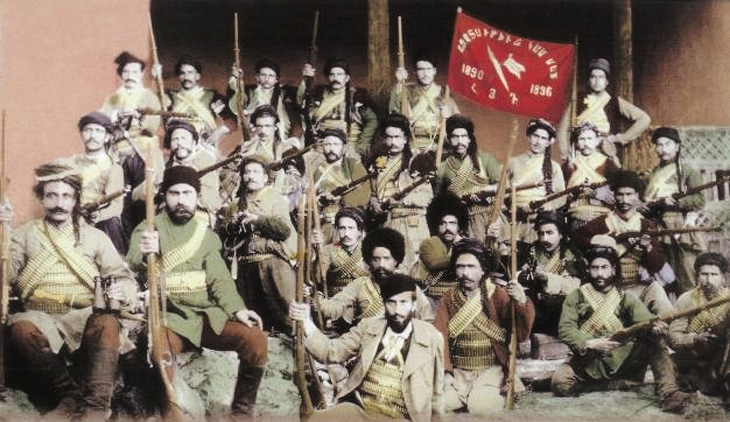
Viceroy of the Caucasus I.I. Vorontsov-Dashkov, known for his pro-Armenian sympathies, admitted in his report to Emperor Nicholas II that the Armenian party “Dashnaktsutyun” aimed to create areas in the region populated only by Armenians, thereby laying the groundwork for demands for Armenian autonomy.
Ottoman historian Hussein Pasha, in his book “The History of Armenian Unrest,” noted that the “Gnchak” committee, established in 1887 by Caucasian Armenians Avetis Nazarbekov and Marian Vardanyan, aimed first to proclaim “Turkish Armenia” and then unite it with “Russian Armenia” and “Persian Armenia” to create an independent Armenian state.
In 1907, the Russian and British empires signed an agreement dividing Iran into spheres of influence. According to this document, the southern part of the country was occupied by British troops, and the northern part by Russian forces. Although Iran declared its neutrality at the start of World War I, its territory became a theater of operations on the Caucasian front between the warring powers—Britain and Russia on one side, and the Ottoman Empire on the other.
The ruling Qajar dynasty in Iran was unable to protect the country. Furthermore, part of the Shah’s entourage served Britain, another part served Russia, and Shah Ahmed himself believed that Germany would prevail.
After the October Revolution of 1917 in Petrograd, Russian troops left Iran. Under these conditions, the British command formed units of Armenians and Assyrians from the Azerbaijani cities of Salmas and Urmia under Russian and French officers to fill the vacuum on the Caucasian front.
The overall command of these forces was carried out by the Armenian Aga Petros, with political leadership by Assyrian leader Bunyamin Marshinun. These forces marched from Salmas to Urmia, where they massacred local Azerbaijanis. Armenians broke into their homes, looted, and killed, sparing neither women, children, nor the elderly. According to some reports, 500 homes were burned to the ground.
During these tragic days, the city received no help from Tehran nor from the governor of Azerbaijan and crown prince Mohammed Hasan Mirza Qajar, who was in Tabriz.
As A. Kasravi wrote, only in one day did Armenian militants kill 10,000 people. Mass pogroms of Azerbaijanis also took place in the cities of Maku and Khoy.
In May 1918, 5,000 Armenian militants, led by the notorious Dashnak commander Andranik Ozanyan, attacked Khoy but faced fierce resistance from the city’s residents. Learning of the approaching Ottoman troops, Andranik chose to retreat. Crossing the Araz, he carried out massacres of Azerbaijanis in Nakhchivan and Karabakh.
Seyid Jafar Pishevari, a prominent figure in the Azerbaijani movement in Iran, wrote in his article “The Fate of the First Soviet Government in Baku,” dedicated to the bloody events of March 1918, “I saw with my own eyes the atrocities of the Dashnaks, saw them killing and burning the bodies of countless innocent people, especially Iranians not involved in the events, in caravanserais. It was a terrible, repulsive action. The crimes of the Dashnaks, driven solely by hatred and enmity, gripped the hearts of everyone.”
It should be noted that the Baku Council, led by Bolsheviks and Dashnaks headed by S. Shaumyan, was responsible for the mass killings of Azerbaijanis not only in Northern but also in Southern Azerbaijan.
By the decree of the Military Revolutionary Committee of the Baku Council, military-revolutionary committees were created in Russian military units stationed along the front line from the Caspian to the Black Sea—in the cities of Anzali, Urmia, Julfa, at the Shakhtakhti station, near Lake Van, in the cities of Erzurum, Erzincan, Sarikamis, and Trabzon.
Bolsheviks, including many Armenians, also conducted active propaganda in Russian military units stationed in Tabriz, Qazvin, Sepheran, Dilman, Salmas, and other cities in South Azerbaijan.
This propaganda resulted in the indifferent attitude of Russian soldiers to the pogroms of Azerbaijanis and, in some cases, their active participation in the brutal massacres of peaceful people in the South Azerbaijani cities of Urmia, Khoy, Salmas, and several cities and villages of Northern Azerbaijan.
Subsequently, several books and articles were published in Iran about the mass killings of Azerbaijanis by Armenian nationalists in the 20th century. In this context, the books by Samed Sardarinia, “The Genocide of Muslims on Both Sides of the Araz,” “Yerevan was a Muslim City,” and “Karabakh in the Stream of History,” should be noted.
As can be seen, history repeats itself—Armenian nationalist groups, with the support and patronage of certain influential circles of the great powers, continued to pursue a policy of seizure and Armenization of the lands of neighboring peoples.
V. Abishov
Based on materials from the magazine IRS Heritage