On March 15, the ninth trilateral meeting of Turkey, Azerbaijan, and Georgia was held in Baku. At the meeting, the three countries discussed current areas of cooperation and outlined steps for the strengthening of their relations within the trilateral format. The Georgian Foreign Ministry emphasised the importance of developing economic relations, as well as international energy and transport projects in which the three countries participate.
This troika was born partly as a response to Russian-Armenian alliance in 1990-2000s. Armenia was in conflict with Azerbaijan and occupied one fifth of its territory. Iran and Russia backed Armenia. Georgia had strained relations with Russia which culminated in the 2008 Russian invasion and occupation of the two breakaway territories—Abkhazia and South Ossetia.
Azerbaijan, having close ties with Turkey, promoted stronger ties within the troika as a balance act against the Armenian-Russian-Iranian axis.
A changing geopolitical landscape
Meanwhile, the geopolitical situation in the Southern Caucasus has fundamentally changed. In 2020, Azerbaijan re-took most of its territory that had been occupied by Armenia. Since 2022, Russia’s army is fighting in Ukraine and unable to support Armenian territorial claims towards the Karabakh region of Azerbaijan. These two developments have provided greater opportunity for the South Caucasus to undertake a geopolitical alignment.
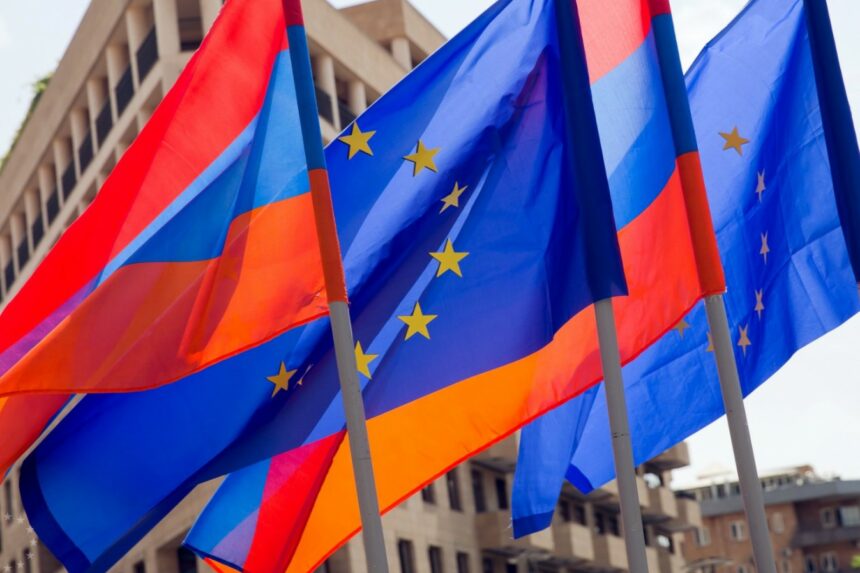
Armenian Prime Minister Nikol Pashinyan is trying to cut Armenia’s ties with Russia while taking steps towards integration with Europe. This will not be easy as his predecessors who ran Armenia for two decades, the so-called pro-Russian ‘Karabakh Clan’, enmeshed the country very closely with Russia. Borders are always a sensitive question for a country’s sovereignty and therefore it is irregular that Armenia is the only country in the world where a foreign country (in this case Russia) manages and guards its borders.
It will be difficult for Armenia to escape Russia’s grasp as Russian dictator Vladimir Putin is not known for allowing countries to slip away, as Ukraine is finding out. Armenia is a member of two Russian-led organisations, the CSTO (Collective Security Treaty Organisation) and Eurasian Economic Union. While the CSTO was set up by Putin’s predecessor in the early 1990s, the Eurasian Economic Union is Putin’s showcase baby that was always meant to be an alternative to the European Union (EU).
Ending border disputes
More importantly, Pashinyan needs to take concrete steps to show that his rhetoric in support of European integration is not all hot air and without substance. Rather than reinventing the wheel, Pashinyan must simply to follow what post-communist countries in Central and Eastern Europe did in the 1990s.
Central and Eastern Europe took key two steps that Pashinyan should follow.
The first was that Central and Eastern European leaders understood that ‘returning to Europe’, and then joining NATO and the EU, could only be possible if they dropped territorial claims against one another and accepted the borders inherited from when they were part (either directly or indirectly) of the Soviet empire.
The South Caucasus is not unique in countries harbouring territorial claims as there are many potential territorial conflicts in Central and Eastern Europe. Hungary, for example, could lay claim to parts of Slovakia and Romania where large numbers of Hungarians live. Hungary could use similar irredentist rhetoric towards the Romanian region of Transylvania in the same manner as Armenian nationalists do towards the Azerbaijani region of Karabakh. Poland could lay claim to the Ukrainian region of Galicia or Germany to the Polish region of Silesia and Russian region of eastern Prussia.
The Central and Eastern European countries filed these territorial disputes into their history books and instead prioritised European integration. If Pashinyan is truly serious about his country’s European integration, Armenia should not keep dragging its heels, as it has for three years, and sign a peace treaty with Azerbaijan. The basis for this must be for both countries to respect each other’s territorial integrity and recognise the former Soviet republican boundary as international borders. A peace treaty with Azerbaijan would lead to Armenia’s normalisation of relations with Turkey with whom relations have been frozen for three decades.
Regional integration
The second step Pashinyan should take is to support regional integration because this sends a signal Armenia stands for reconciliation, normalisation of relations with neighbours and enhanced cooperation in the political, economic, trade, energy and security dimensions.
Azerbaijan in 2022 suggested the creation of a trilateral South Caucasian platform with Armenia and Georgia. Then Georgian Prime Minister Irakli Garibashvili positively responded to the initiative. Pashinyan expressed no enthusiasm for regional cooperation, not understanding that European integration was undertaken in conjuction with regional integration.
Let’s recall that the EU itself grew out of the European Coal and Steel Community. In the 1990s, Central-Eastern Europeans created the Weimar Triangle and Visegrad Group to build regional cooperation.
The Weimar Triangle was created as far back as 1991, the year the USSR disintegrated, by France, Germany, and Poland. The Weimar Triangle met on February 24, the second anniversary of Russia’s full-scale invasion of Ukraine to state their common support for European integration and common stance against the Russian threat to Europe. On March 15, the Weimar Triangle met again to iron out differences over their common relations with the US and coordinate common policies on militarily and financially supporting Ukraine in its war against Russia’s invasion.
The Visegrad Group was also founded in 1991 by Poland, the Czech Republic, Slovakia, and Hungary to coordinate their approach to escaping from the communist past and Soviet empire and integrating into NATO and the EU. The Visegrad Group supported Ukraine, although it never became a member. With membership of NATO and the EU achieved in the early 2000s, the Visegrad Group has become less active and with, populist nationalists in power in Hungary and Slovakia, less active.
Pashinyan should emulate the regional integration initiatives undertaken by Central and Eastern Europeans since 1991 by joining existing frameworks. It is self-defeating for Armenia to ignore regional initiatives such as the recently held Trilateral meeting of Turkey, Azerbaijan, and Georgia.
Time to show commitment
The EU will only take Armenia’s rhetoric for European integration seriously when Pashinyan shows his country is committed to the territory integrity of states and supportive of regional cooperation in the political, economic, trade, energy and security dimensions.
While reducing Armenia’s integration with Russia, Pashinyan should show his commitment to moving away from Eurasia by increasing his country’s presence and activity within regional frameworks such as the Trilateral meeting which has just been held.
We should support Armenia’s movement away from Eurasia towards Europe. But the first and most important steps need to be taken by Armenia.
Prime Minister Pashinyan, the ball is in your court.
Taras Kuzio, National University of Kyiv Mohyla Academy