However, the end of the conflict following the Second Karabakh War opened a new chapter for the region, as the warring parties could finally focus on regional economic integration by supporting connectivity projects. To this end, the trilateral statement of the Armenian, Azerbaijani, and Russian leaders signed on November 10 illustrated the post-war development of the South Caucasus. Since that time, Armenia and Azerbaijan have been engaged in peace talks, and especially, the opening of transportation routes, border demarcation and delimitation process, trade opportunities etc., were among the key topics for negotiations.
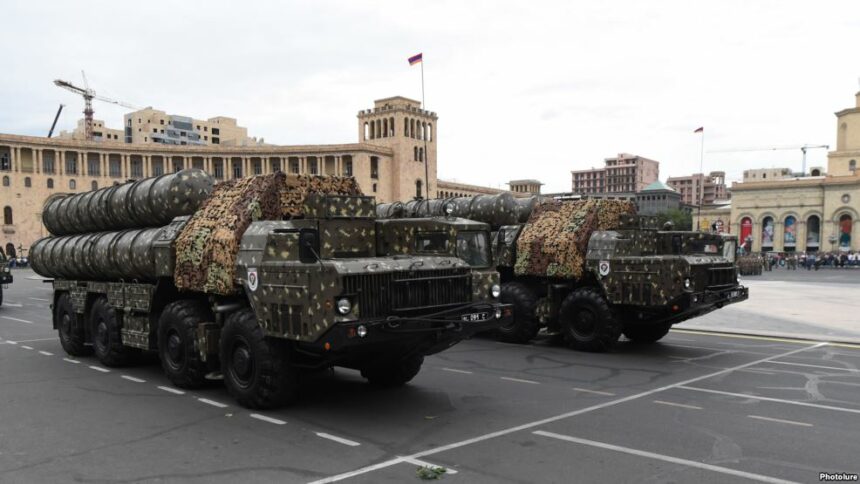
Unfortunately, due to the position of the Armenian government, a final peace agreement between Armenia and Azerbaijan could not be signed yet, and on the contrary, Yerevan engaged in arms race by collaborating with France, India and Greece. It is worth noting that before the end of the war between two South Caucasus countries, Armenia spent a large number of financial sources to the military needs. For example, in 2021, Yerevan allocated about $600 million from the state budget for military purposes, and in 2022, the country increased military spendings by more than 10%, reaching $750 million. Armenia’s 2023 national budget called for a record $1.28 billion in military expenditures, and this number was around by 46% increase of military expenditures in compare with a year ago.
In 2024, the Armenian government even increased the defense budget and allocated 557 billion drams (approximately $1.37 billion). So, country’s defense budget is stated to correspond to more than 17% of overall public spending. It illustrates that Armenia increased its 2024 defense budget by 6 percent compared to its 2023 expenditures (527 billion drams, approximately $1.3 billion). In comparison to 2020, Armenian defense spending is expected to increase by 81% in 2024, accounting for more than 17% of the total state budget. These numbers clearly show that the military spendings from the Armenian budget is high as a share of GDP, and after the Second Karabakh War Yerevan lost or have damaged military equipment worth billions of dollars, and without a final peace treaty, the post-war years will be used to buy new weapons and equipment.
Having this in mind, the first question arises why Yerevan increases sharply its military spendings and engages in arms race in the region? The second question is why Yerevan chooses France and India instead of its traditional ally Moscow for arms supplies? Answering to these questions, it should be underlined that the Second Karabakh War and the ongoing Russia-Ukraine war changed the geopolitical landscape in Eurasia. Despite close economic and security ties with Moscow, Russia is unable to supply Yerevan with the promised weaponry. At the same time, trade turnover between Armenia and Russia for 9 months of 2023 increased by 43.5% and amounted to $4.4 bln. Also, the share of the Russian ruble in settlements between companies of Armenia and Russia in 2023 reached 90.3%.
Statistics show that Armenia was quick to take advantage of the sweeping sanctions imposed following the Russian invasion of Ukraine, re-exporting second-hand cars, consumer electronics and other goods manufactured in Western countries and their allies to Russia. This explains why its exports to Russia tripled in 2022 and doubled in January-August 2023. Noteworthy to mention that Russia is Armenia’s leading trading partner, and Armenian companies help Moscow to evade Western sanctions.
Coming to the point of arms races in the region, the Armenian government under Prime Minister Nikol Pashinian, established a strategic partnership with France and India. Paris and New Delhi actively supply arms to Yerevan, which can trigger a new escalation in the region. Especially, relations between Paris and Yerevan have entered a new stage as French President Emmanuel Macron blamed openly Azerbaijan, making unfounded accusations against Baku, manifesting a unilateral support for Armenia. Also Paris-Yerevan defense cooperation includes a variety of military assistance deals with Armenia, especially providing armored vehicles, arms, equipment and munitions, as well as improving air-defense capabilities. According to the Ambassador Extraordinary and Plenipotentiary of France to Armenia, Olivier Decottignies, “Armenia-France long-term cooperation, including cooperation in the field of defense, it is not only about military procurement, which is of course important but also about training, including the training of senior Armenian officers”. Moreover, talking about the Armenia-Iran relations, the French Ambassador emphasized that “We disagree with Iran on many issues but we agree on Armenia issue”. This statement clearly reflects the biased and one-sided position towards Azerbaijan. Iran and Armenia are strategic partners in the region, and closes ties between these states are being supported by one of NATO’s founding member countries – France.
Another major arms deliveries from India to Armenia, including Indian-developed anti-drone system, the Akash Air Defense System, Pinaka rocket system and India’s Advanced Towed Artillery Gun Systems (ATAGS) push the region towards a more intense and complex arms race. Especially, the Indian-made Pinaka weapon system is an important component of the offensive operations. Moreover, India creates air corridor to Armenia through Iran for strategically important exports. Such corridor will increase Indian arms exports to Armenia. As many Armenian experts argue, “the only route for delivery of Indian arms to Armenia is through the territory and airspace of Iran. It is not possible to deliver weapons in any other way today. Therefore, Iran’s role remains significant in the context of restoring Armenia’s military potential”. Of course, Indian military cargo via Iran will adversely affect the Iran-Azerbaijan relations. Such developments will only destabilize the region and prevent future peace talks between two South Caucasus nations. Paris-New Delhi-Yerevan triangle aims to change the security dynamics of the South Caucasus, which will only add growing uncertainty to the future peace talks between Armenia and Azerbaijan.
Armenia and Azerbaijan could achieve a durable peace in the region if Baku and Yerevan engaged in the tet-a-tet negotiations to solve all disputes and jointly decide on the future of bilateral relations. The involvement of external actors in the negotiation process gave a positive impulse to the Armenia-Azerbaijan peace talks, however, the tet-a-tet talks could add more value to the peace process. In the end, durable peace between the two South Caucasus countries holds significant economic benefits for the whole region. Firstly, it will create new opportunities for economic development, regional integration, and increased connectivity. Secondly, Armenia would reduce military expenditures, which present a greater proportion of its public budget. Last but not least, peace in the region would prevent a dangerous arms race between the two countries which could lead to new war. Armenia and its allies should support not arms race but a peace race to advance the peace process and achieve a durable peace.
Shahmar Hajiyev, Senior Advisor, Center of Analysis of International Relations.