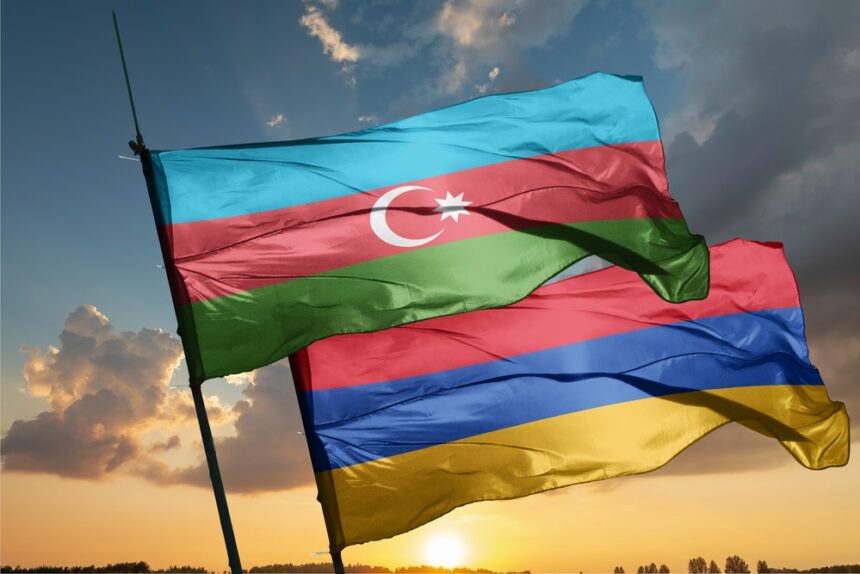
The year 2024 saw a shift away from external mediation in the Armenia–Azerbaijan conflict, to direct bilateral negotiations. Despite widespread expectations of a finalized peace treaty by the end of 2024, no agreement was signed. This reflects a strategic decision to avoid an interim settlement that could entrench unresolved provisions. Constitutional ambiguities in Armenia and bilateral territorial adjustments continue to shape the negotiation dynamics, raising questions about whether this diplomatic model will consolidate into a stable framework or remain in flux.
BACKGROUND: Since the 1994 Bishkek Protocol froze the conflict between Azerbaijan and Armenia over Nagorno-Karabakh in a fragile ceasefire regime under Russian sponsorship, mediation models had consistently prioritized multilateral equilibrium over durable resolution. The OSCE Minsk Group—formalized in December 1994 with the three co-chairs France, Russia, and the U.S.—institutionalized this status quo. In this diplomatic environment, negotiations served as an instrument for conflict management rather than conflict termination. The April 2016 Four-Day War briefly upended that architecture, demonstrating the latent instability embedded of the frozen-conflict model. Four and a half years later, the 2020 Second Karabakh War fundamentally restructured the region’s power balance. It rendered obsolete the externally imposed frameworks that had governed negotiations since the collapse of the Soviet Union.
The outcome of the 2020 war was the restoration of Azerbaijan’s control over the previously Armenian-occupied regions around the territory of the former (Soviet-era) Nagorno-Karabakh Autonomous Oblast. The Russian-brokered ceasefire of November 10, 2020, set the stage for a negotiation dynamic predicated on asymmetrical positioning. Armenia’s formal recognition of Azerbaijan’s territorial integrity in October 2022 (a move reportedly taken despite Kremlin opposition) implicitly signalled a shift that was not widely acknowledged at the time. Specifically, multilateral mediation lost its functional rationale; a new phase of direct engagement emerged. The replacement of Minsk Group arbitration, beginning with face-to-face negotiations in Brussels (May 2022), Prague (October 2022), and Munich (February 2023), was the logical conclusion of this trajectory.
The October 2022 Prague meeting marked the first sustained round of direct talks without the Minsk Group’s mediation. It encapsulated the recalibration of the regional conflict-resolution paradigm. The Armenia–Azerbaijan peace process has entered a structurally distinct phase, as direct bilateral diplomacy has replaced externally mediated negotiations. This is not merely a procedural transition. It is a fundamental shift in the conflict’s geopolitical management. For nearly three decades, external actors—principally Russia, the U.S., and the EU—had dictated the diplomatic framework while regional players remained constrained by inherited institutional architectures, notably the defunct OSCE Minsk Group.
IMPLICATIONS: The failure to finalize a peace treaty in 2024, despite reports that 90 percent of the agreement had been drafted, is not due to any diplomatic shortcoming. Rather, it represents a strategic recalibration. The logic behind avoiding an interim settlement is evident in historical analogues. For example, while the 1995 Dayton Accords successfully concluded the Bosnian War, institutionalized ethnic partitions persist as a structural impediment to governance nearly three decades later. To take another example, the 2015 Minsk II Agreement, designed to create a transitional settlement for the then-Donbas conflict, wound up embedding unresolved territorial issues in the political fabric. This subsequently facilitated Russia’s full-scale invasion of Ukraine in February 2022.
The deliberate avoidance of a prematurely finalized Armenia–Azerbaijan treaty suggests an awareness of these precedents. By declining to entrench provisions that might later serve as triggers of an unresolved structural conflict, the diplomatic system moves toward a “stable equilibrium” to replace the “local equilibrium” of the temporary cessation of hostilities. The elimination of substantive third-party mediation reinforces this shift.
Since October 2022, all consequential negotiations have been conducted bilaterally. External actors now function as logistical facilitators rather than as substantive arbiters. This pattern is comparable with, for example, the 1979 Egypt–Israel Peace Treaty, which—despite U.S. facilitation at Camp David—was fundamentally structured around direct negotiation and which has shown durability for over four decades. It contrasts with the 1993 Oslo Accords, which relied upon external assurances and ambiguous transitional mechanisms, and which collapsed amid shifting geopolitical realities. The Armenia–Azerbaijan framework thus increasingly resembles the former model, with bilateralization reinforcing sustainability. However, asymmetries within the process remain pronounced.
Azerbaijan has consistently employed a “position-setting” strategy, articulating clear demands and advancing specific legal-political objectives. This was evident in President Ilham Aliyev’s remarks at the February 2024 Munich Security Conference, where he characterized the negotiation process as a “one-sided dialogue” in which Azerbaijan proposes terms while Armenia refrains from active counter-positioning. This dynamic was illustrated also by the February 2024 withdrawal of Armenian forces from four Azerbaijani villages (Baghanis-Ayrum, Ashaghi Askipara, Kheyrimli, and Gizilhajili). This withdrawal was executed without a formalized reciprocal agreement, creating the perception that Azerbaijani proposals, rather than structured bilateral compromise, are the driving force in the conflict-resolution process.
The trial of Ruben Vardanyan, a key former figure in the Karabakh administration, further underscores Azerbaijan’s strategy of consolidating its post-2020 advantage through legal and political mechanisms. Vardanyan, arrested in September 2023 following Azerbaijan’s military operation in Karabakh, has been charged with financing terrorism and illegally crossing Azerbaijan’s border. His prosecution reflects a broader pattern of post-conflict legal adjudication, where Azerbaijan is systematically dismantling the institutional remnants of the former Karabakh authority while reinforcing its sovereignty claims over the region.
This judicial dimension introduces new considerations for the negotiation process. While Armenia has distanced itself from former Karabakh leadership figures, the trial raises concerns over how legal precedents set by Azerbaijan’s courts could influence broader diplomatic calculations. Precedents from post-war trials in Bosnia and Kosovo demonstrate that such cases can serve as mechanisms of conflict closure or as sources of prolonged diplomatic friction, depending on how they are leveraged within ongoing negotiations. Whether the trial is seen as a necessary legal process or as a strategic assertion of power will shape both Armenian domestic discourse and international perceptions of Azerbaijan’s post-war governance model.
An unresolved question about Armenia’s constitution remains a central point of contention. The constitution’s preamble makes reference to the 1990 Armenian Declaration of Independence, which in turn invokes the 1989 Soviet-era decision on the then–Nagorno-Karabakh, implicitly sustaining a legal framework that conflicts with Armenia’s 2022 diplomatic commitments. While Armenia contends that a treaty provision will supersede domestic law, Azerbaijan cites historical precedents in which Armenian legal rulings activated dormant constitutional clauses to justify policy reversals.
For example, the 2003 Armenian Supreme Court decision permitting Robert Kocharyan’s candidacy for president, despite constitutional residency requirements, exemplifies this phenomenon. Kocharyan, who had never officially resided in the Republic of Armenia prior to independence, was deemed eligible based on his prior residence in Nagorno-Karabakh during the Soviet and early post-Soviet period. This precedent reinforces Azerbaijan’s concerns regarding the durability of Armenian legal commitments, particularly given the requirement for a national referendum to amend the constitutional preamble—an event that will not take place before late 2026.
Historically, such delays have introduced windows of instability, where unforeseen political shifts disrupt anticipated diplomatic trajectories. The postponement of Palestinian legislative elections following the Oslo Accords, for example, contributed to the erosion of transitional governance structures, leading to subsequent escalations. The Armenia–Azerbaijan process now faces a comparable timeline-dependent risk, where protracted legal ambiguity could generate new friction points before formalized resolution mechanisms are enacted.
CONCLUSIONS: The bilateralization of diplomacy in the South Caucasus challenges the post-Soviet convention of externally managed equilibrium but has not yet cohered into a stable system. Whether the region consolidates into a sustainable post-conflict order or re-enters a phase of mediated arbitration depends not only on the resolution of uncertainties over the Armenian constitution, but also on unresolved territorial demarcations and the strategic recalibrations of external actors. The next 24 months will likely determine the trajectory of this diplomatic framework. Events between now and the end of 2026 will establish whether bilateral statecraft becomes institutionalized or whether it remains only an intermediary phase before external actors (not just Russia but also the EU and Iran) again seek to reassert dominant influence.
Robert M. Cutler was for many years a senior research fellow at the Institute of European, Russian and Eurasian Studies, Carleton University, and is a past fellow of the Canadian International Council.
cacianalyst.org