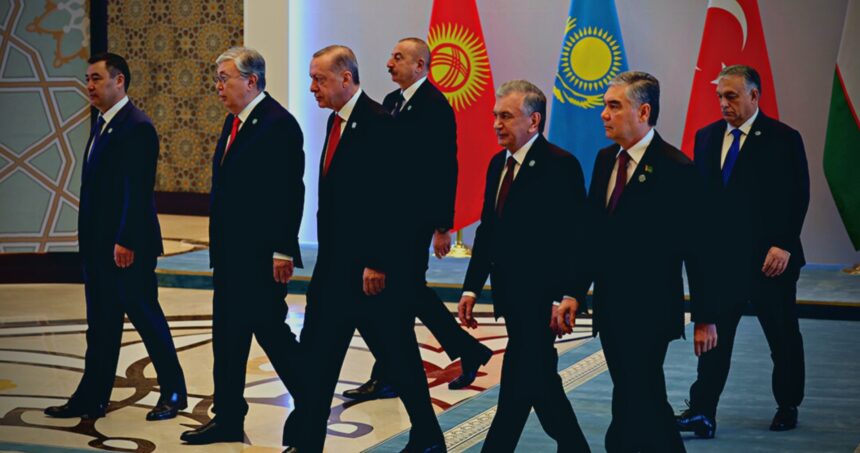
The Organisation of Turkic States (OTS) is one of the main foreign policy initiatives of Azerbaijan. In his swearing-in ceremony in February 2024 Azerbaijani President Ilham Aliyev described the OTS as the main international organisation for Azerbaijan and announced that Baku’s future foreign policy goal would be focused on making the OTS one of the main international organisations in the world. Engagement with the Central Asian Turkic states is strategically significant in Azerbaijan’s foreign policy. First and foremost, the ongoing geopolitical turmoil in the neighbourhood leaves Azerbaijan as a vital link on a geographical route for Central Asian states bypassing both Russia and China in their engagement with the external world. The issue of economic diversification, particularly in the form of the diversification of energy routes, makes Azerbaijan a strategic route for Kazakhstan to export its oil to Western and world markets without using the existing traditional route through Russia. Kazakhstan and Azerbaijan’s state oil companies, KazMunayGas and SOCAR, signed an agreement in March 2024 on a gradual increase in the transit of Kazakh oil via Azerbaijan. Azerbaijan expressed willingness to increase receipt of Kazakh oil to 2.2 million tonnes annually. The usage of Azerbaijani energy pipelines, in particular the Baku-Supsa and Baku-Tbilisi-Ceyhan oil pipelines, has become a strategic necessity for Kazakhstan to export its oil to world markets. Oil shipment via Azerbaijan will gradually grow to 16.5 million barrels a year, double the 2023 figure. Azerbaijan’s recent participation in Central Asian summits as well as the joint summits and meetings of Central Asian states and the Gulf countries GCC is also a new trend in its foreign policy and highlights the strategic importance of Baku for Turkic states. The areas of cooperation are huge and cover strategically important topics such as logistics, trade, energy routes, and economic and security aspects. Considering that the US, Germany and UK have rapidly increased their engagement with the Central Asian Turkic states since the Russia-Ukraine war, and that the US and Germany have institutionalised their engagements in the format of 5+1, Azerbaijan’s strategic role for these countries is also growing.
With the restoration of Azerbaijan’s territorial integrity and sovereignty President Ilham Aliyev made integration with the Turkic states a national priority. Amidst the Russia-Ukraine war and geopolitical confrontation between the West and Russia, and US and China Azerbaijan seeks to stay out of this global struggle and reduce its negative impacts in a region where security is already being affected. The OTS has traditionally focused on culture, transportation and logistics. President Ilham Aliyev proposed expanding OTS cooperation to include military, defence and defence industry matters, which reflects a proactive approach in Azerbaijan’s foreign policy in the midst of the increasing global and regional security issues. Colonel Rich Outzen (Ret) identifies five regional security dynamics that accelerate military defence integration and cooperation between the Turkic states. They are the economic and technological development in the Turkish defence industry which has enabled Turkey to become one of the leading nations in the production and export of UAVs, with drones as the brand defining product; Turkish military capacity with a professional military that can provide training, education, doctrine and military equipment to the countries that are seeking to diversify from Russia’s traditional role in these areas. In addition, Russia’s aggressive foreign policy in its neighbourhood, which can be seen in its support for Armenian irredentism against Azerbaijan, its war in Georgia in 2008 and ongoing war against Ukraine, the generational change in Turkic states since 1991, the USA’s withdrawal from Afghanistan in 2021, and disagreements among the CSTO states such as border disputes and Russia-Ukraine war are all factors shaping the view that no external power or military alliance can be a reliable security guarantor and that the Turkic states will have to step up joint security efforts to face security challenges.
According to Cavid Veliyev, following the liberation of Azerbaijani land from Armenian occupation, Azerbaijan has become a target country for Western organisations mainly driven by an orientalist and selective approach to the principle of territorial integrity and sovereignty of states. As a result, Western institutions have lost credibility in the eyes of Azerbaijani society. The OTS, however, has emerged as a crucial ally of Azerbaijan. Its support for the restoration of Azerbaijan’s territorial integrity and sovereignty over the occupied lands has not gone unnoticed by the Azerbaijani public.
President Aliyev’s proposal to bolster defence and military cooperation among the member states builds on the Astana Declaration, approved by the heads of state at the 10th Summit of the Organization of Turkic States on 3 November 2023, which commits to joint efforts in fighting terrorism, drug trafficking, separatism etc. The Turkic states face many of the same security threats – Russia as an aggressive and unpredictable neighbour, the rise of assertiveness in China’s foreign policy, the Taliban’s return to power in Afghanistan, US attempts to project its confrontation with China onto geo-economic projects such as the Belt and Road in the region, terrorism, particularly the rise of fundamentalism in neighbouring Tajikistan, and separatism. The countries share their vision of joining efforts to face these security risks. Turkic states are represented in two different security organisations, with Turkey being a NATO member, and Kazakhstan and the Kyrgyz Republic being members of the Russia-led CSTO. Azerbaijan and Uzbekistan are not members of either military bloc. Although Azerbaijan is a neutral country as a NAM member, it has strong relations with NATO and participates in NATO programs. It took part in the peacekeeping contingent in NATO missions in Kosovo, Afghanistan and Iraq. Baku also has close security ties with CSTO members such as Kazakhstan. In addition, Azerbaijan has a military alliance with Turkey, enhanced by the 2021 Shusha Declaration on Allied Relations between the Republic of Azerbaijan and the Republic of Turkey. The declaration highlights mutual security commitments such as strengthening the defence capability and military security, conducting joint Turkish-Azerbaijani military exercises and training, increasing the interaction and interoperability of the armed forces, joint weapons production on the basis of modern technology, holding joint meetings of the security councils on national security issues on a regular basis etc. If the territorial integrity and sovereignty of either state is violated, the parties will hold joint consultations and coordinate their political, diplomatic and more importantly military efforts to eliminate the threat or acts of aggression. With the recent change in the geopolitical landscape in the South Caucasus region, the Shusha Declaration is the embodiment of the emerging Azerbaijani-Turkish tandem as the decisive military-economic factor shaping regional developments and security architecture.
The Organisation of Turkic States covers a vast geostrategic geography with substantial natural and human resources. It has close to 170 million inhabitants with the potential for this number to increase to 250 million by 2050, and the potential to produce GDP worth 2 trillion USD. The significance of the Turkic states has increased following Russia’s invasion of Ukraine, as Europe’s trade routes with China passing via Russian territory become insecure geopolitically.
Previously known as the Turkic Council, the alliance was founded in 2009 in Azerbaijan’s Nakhchivan region. Since then it has grown into a fully fledged international organisation, with several institutions – the General Secretariat in Istanbul, the Turkic Academy in Astana, the Turkic Cultural Foundation in Baku, as well as several other entities such as an OTS representative office in Budapest. Its concrete projects include the establishment of an investment fund, integration and ease of customs procedures, and the promotion of the Middle Corridor between Europe and China via the South Caucasus and Central Asia, also known as the Trans Caspian trade route. Increasing investments to ensure intra-regional connectivity with well developed infrastructure projects among the member states are one of its aims.
Rufat Ahmadzada is a graduate of City, University of London. His research area covers the South Caucasus and Iran. The views expressed in this article are those of the author and do not necessarily reflect TGP’s editorial stance.