Overland trade and transit across the Eurasian landmass has been a primary driver of economic activity and political development for more than two millennia. In the modern era, the dependency on overland trade across Eurasia has been reduced by the growing importance of seaborne trade. However, geopolitical events are placing a renewed focus on overland trade.
With international sanctions hitting Russia and Iran, many countries are looking for better trade and transit routes between Europe and Asia. There is only one viable option for east-west trade on the Eurasian landmass that bypasses Russia and Iran: the Trans-Caspian International Transport Route, commonly referred to as the Middle Corridor.
The Middle Corridor transits through the South Caucasus, over the Caspian Sea, and into Central Asia following routes that were once the primary means of regional trade dating back to the Silk Road. The stretch of the route east of the Caspian Sea, in Central Asia, is predominantly in Kazakhstan, Uzbekistan, and Turkmenistan. Other than the need for increased investment in transport infrastructure, this section of the Middle Corridor is mostly problem free.
However, the section in the South Caucuses, to the west of the Caspian Sea, has several challenges. Russia, and to a lesser extent Iran, maintain a degree of influence in the South Caucasus. Both discourage use of the Middle Corridor because it takes business away from them. Frozen conflicts in Georgia, and the uncertainty in the peace process between Azerbaijan and Armenia, also remain a deterrent to investment.
A glance at a map shows that of the 5,000-kilometer span from the Barents Sea to the Arabian Sea, there is an opening of only about 190 kilometers for transport that bypasses Russia and Iran. This is called the Ganja Gap, named after the historic Silk Road city of Ganja in what is now Azerbaijan. Three major oil and gas pipelines that bypass Russia and Iran pass through the Ganja Gap, along with a motorway, an important rail connection, and fiber optic cables.
The Ganja Gap is one of the most important trade choke points in the world. Unlike others around the world that are well known such as the Strait of Hormuz, the Malacca Strait, or Bab Al-Mandab, the Ganja Gap exists because of geopolitics rather than topography. If Europe had cordial relations with Russia and Iran, the Ganja Gap would not carry the same amount of importance as it does.
Recent geopolitical events have made the use of the Middle Corridor even more attractive. Since Russia’s invasion of Ukraine in February 2022, use of the Middle Corridor has increased. In 2022, container traffic increased by a third from the year before. For the first time, Kazakhstan is exporting uranium and crude oil to global markets through the Middle Corridor to bypass Russia. In addition, as the Houthis continue to disrupt shipping in the Red Sea, there will be more interest in using the Middle Corridor to move goods east to west on the Eurasian landmass. While the Middle Corridor will never be able to compete with the volume of cargo that can be moved by sea, with the right investments its capacity can be dramatically increased.
It is therefore not surprising that international actors are keeping a close eye on developments there. At the Global Gateway Investors Forum in Brussels last week, European Trade Commissioner Valdis Dombrovskis said the EU would commit 10 billion euros in support of investments to improve transport connectivity in the Middle Corridor. Elsewhere, the US assistant secretary of state for Europe and Eurasia, James O’Brien, signaled that Washington might be willing to work with the bloc on bringing some of these investments in the Middle Corridor to fruition.
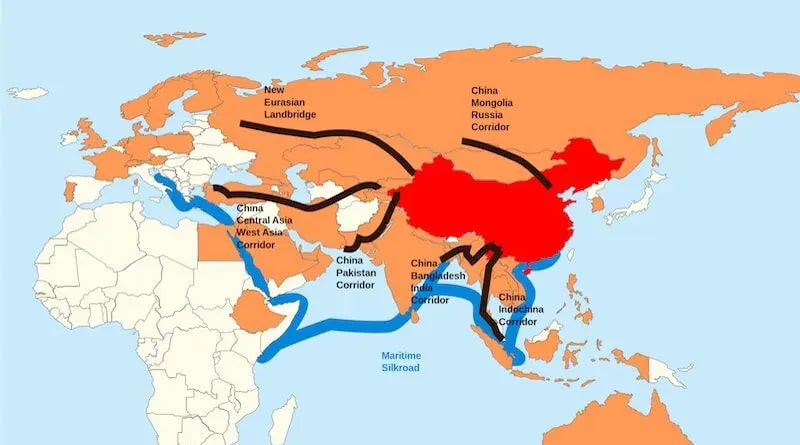
China also sees economic and trade opportunities through the Middle Corridor to complement its Belt and Road Initiative. For China, the advantages are twofold. The Middle Corridor can be another method to export products to European markets, but it can also be an important way to import natural resources from Central Asia.
The Gulf states have also seen the potential of the Middle Corridor. Saudi Arabia has invested billions of dollars in infrastructure projects in Uzbekistan and Kazakhstan. The latter has also pledged to boost this trade with the UAE with the goal of reaching an annual turnover of $1 billion. UAE president Sheikh Mohamed bin Zayed Al-Nahyan paid a visit last month to Azerbaijan, where the Emiratis already have major investments. UAE companies have also invested in energy projects in the Caspian Sea region.
One day the Gulf states could even be connected to the Middle Corridor by rail. Türkiye has proposed an ambitious project called the Dry Canal corridor, to link Iraq’s southern Gulf coast to Turkish ports on the Mediterranean by 2038. If the proposed Gulf Railway connecting the six GCC states by rail ever becomes a reality, the possibilities are great. In theory, it would be possible for goods to be transported by rail from the Gulf to markets along the Middle Corridor, via the Dry Canal corridor.
The use of the Middle Corridor is not without its challenges. Since it bypasses both Russia and Iran, it is not surprising that Moscow and Tehran pursue regional policies that discourage, or at least limit, its use.
However, this should not be a deterrent. The global economy is dependent on reliable, speedy and affordable transportation. As events in the Red Sea have shown, the more trade routes available for use, the better. The importance of the Middle Corridor will continue to grow.
Luke Coffey is a senior fellow at the Hudson Institute.