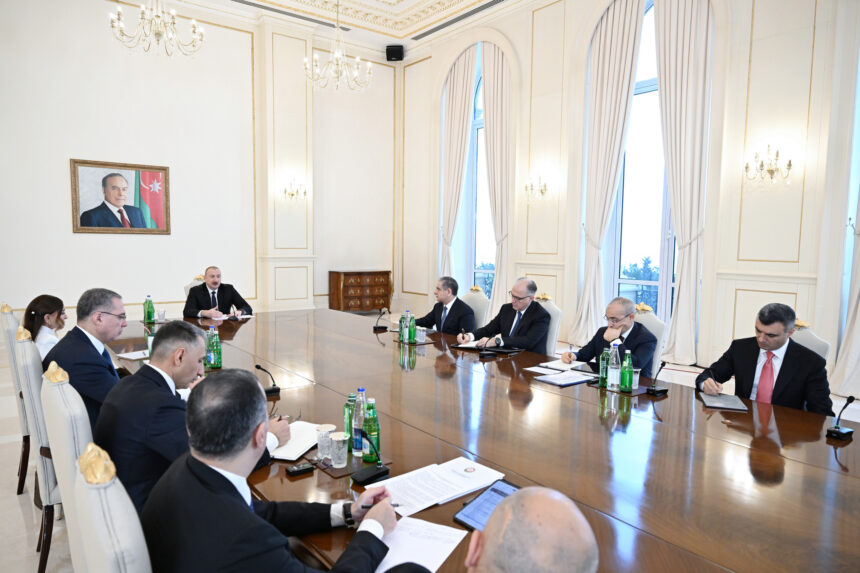
President of the Republic of Azerbaijan Ilham Aliyev chaired a meeting dedicated to the unified action plan titled “Azerbaijan’s New Digital Architecture,” outlining key priorities for the country’s digital transformation, including artificial intelligence, data center development, expansion of fiber-optic infrastructure, and stronger coordination among state institutions.
Addressing the meeting, the head of state emphasized that digital development will be one of the main drivers of long-term economic growth. According to him, global trends clearly demonstrate that the application of artificial intelligence, the establishment of data centers, and large-scale digitalization of public administration will determine countries’ competitiveness in the coming decades. The president instructed that the digital agenda be placed among the government’s top strategic priorities.
Aliyev noted that Azerbaijan has several advantages enabling an accelerated technological transition, including its strategic geographic location between Asia and Europe, well-developed transport and energy infrastructure, and decades of experience implementing major international projects. In the future, he said, energy and transport corridors should also evolve into digital corridors through the expansion of fiber-optic networks. He added that a project to lay a fiber-optic cable connecting Azerbaijan with the eastern shores of the Caspian Sea is nearing completion, strengthening the country’s digital connectivity with eastern markets.
The president also highlighted the energy dimension of digital transformation. Over the past two decades, Azerbaijan’s power generation capacity has reached approximately 10,000 megawatts, with around 2,000 megawatts currently unused — a key resource for hosting data centers and developing AI infrastructure. At the same time, he stressed that growing domestic electricity demand must be taken into account amid industrial expansion and rising output in the non-oil sector, which grew by about 8 percent in January.
During the meeting, Aliyev called for centralized coordination of digital projects and closer cooperation between state bodies. The Ministry of Digital Development and Transport was instructed to prepare a comprehensive action plan within a short timeframe. Each state agency, he said, should designate officials responsible for digitalization, artificial intelligence, and cybersecurity.
One of the key decisions announced was the consolidation of public e-services onto the “mygov” platform. The president stated that fragmented applications developed by different agencies should gradually be integrated into a single service hub to simplify citizens’ interaction with the state.
Special attention was given to workforce development and the integration of artificial intelligence into public administration. Aliyev stressed that the education system must adapt to new technological demands and that AI tools could assist civil servants in daily operations and decision-making processes.
Cybersecurity and cooperation with leading international technology companies were also highlighted among the priorities. The president referred to the recently signed Strategic Partnership Charter between Azerbaijan and the United States, which includes cooperation in digitalization, AI, and data center development, while also noting strategic partnership frameworks with several European Union member states and China.
Following the meeting, Aliyev instructed relevant institutions to finalize a concrete and operational action plan aimed at accelerating the development of the digital economy and reinforcing Azerbaijan’s ambition to become a technological hub at the crossroads of Europe and Asia.