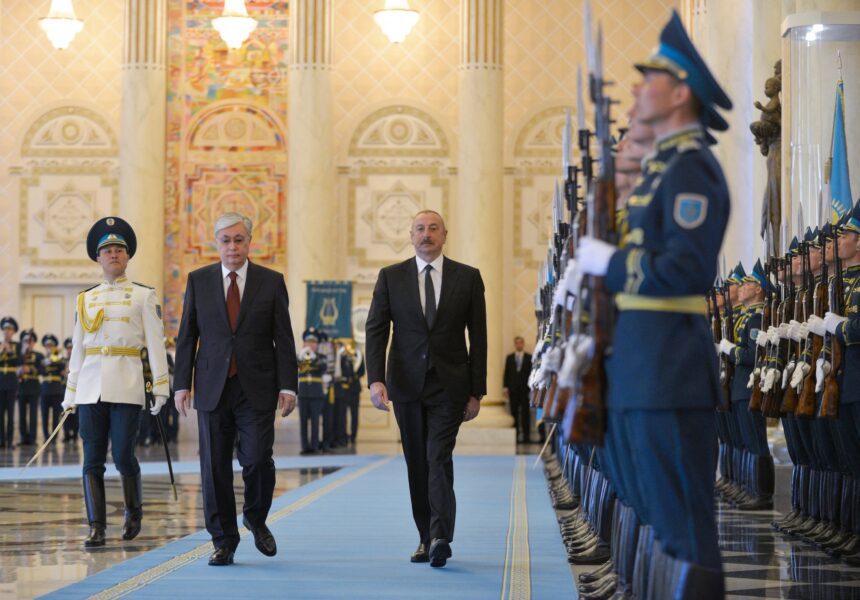
Azerbaijani President Ilham Aliyev’s state visit to Kazakhstan this week highlights the deepening strategic alignment between the two Caspian neighbors. Both are united by a drive to reshape Eurasia’s transport map through the Middle Corridor — a trans-Caspian route linking Central Asia to Europe — and its politically sensitive South Caucasus extension, the Zangezur Corridor.
The meeting comes amid renewed optimism following the August 2025 U.S.-brokered declaration between Armenia and Azerbaijan. The accord envisions a transit route linking mainland Azerbaijan with its Nakhchivan exclave via a roughly 20-32 km stretch of Armenia’s Syunik region. Under the framework, the United States would receive exclusive long-term development rights for infrastructure (railways, pipelines, fibre-optic cables) on that corridor — while Armenia retains full territorial sovereignty and the route operates under Armenian law.
U.S. President Donald Trump, who hosted the White House summit that produced the deal, said: “Thirty-five years they fought, and now they’re friends and they’re going to be friends for a long time.” The project is also know as the “Trump Route for International Peace and Prosperity” (TRIPP),
From Framework to Reality
TRIPP remains far from implementation: Armenia and Azerbaijan still must ratify the agreement as a binding treaty, finalize the terms of U.S. development rights, and attract major investment for rail, energy and digital networks. Meanwhile, peace between the two remains fragile.
Resistance from Iran, wary of being bypassed, and Russia, whose influence has waned since the war in Ukraine, complicates progress. Turkey’s backing, as a champion of trans-Turkic connectivity, will be crucial. Whether the “peace route” becomes operational or stalls as another geopolitical mirage depends on political consensus and sustained stability.
A Trans-Caspian Lifeline
For Aliyev and President Kassym-Jomart Tokayev, these uncertainties strengthen the case for deeper transport cooperation. During the visit, the two leaders will focus on transport integration, energy transit, and digital infrastructure, with attention to coordination among the Aktau, Kuryk, and Baku ports, building on existing MoUs and ongoing Middle Corridor initiatives. Discussions will also cover customs digitization and rail interoperability along the Trans-Caspian International Transport Route (TITR).
Although the Zangezur Corridor is not formally on the agenda, diplomats in both capitals suggest it looms large behind the logistics talks. For Kazakhstan, a functioning Zangezur link would tighten its connection to Turkish and European markets, reducing dependence on routes that traverse Russian or Iranian territory. For Azerbaijan, it would complete the east–west chain that underpins Baku’s Middle Corridor strategy — linking the Caspian directly to the Mediterranean through a unified Turkic transport system.
For Kazakhstan, the Middle Corridor represents a strategic alternative to disrupted Russian transport routes, preserving the continuity of its westward trade and reinforcing its role as a key Eurasian transit state. The route—linking Kazakhstan across the Caspian Sea to Azerbaijan, and continuing through Georgia and Turkey—provides access to European markets while reducing dependence on northern pathways. For Azerbaijan, it consolidates its position as a central hub connecting the Turkic world to global trade networks.
Presidents Kassym-Jomart Tokayev and Ilham Aliyev have both framed the Middle Corridor as a cornerstone of regional connectivity and stability. Tokayev emphasized Kazakhstan’s commitment to expand the route’s capacity, noting that “4.5 million tons of cargo were transported along this route last year … we aim to reach 10 million tons in the near future” (AzerNews). Aliyev described the corridor as playing a “key role in ensuring stable and efficient connectivity between Azerbaijan and Kazakhstan,” underlining Baku’s ambition to serve as a central hub connecting the Turkic world to global markets.
The Zangezur Link
Though absent from the official program, the Zangezur Corridor — the planned route through southern Armenia — remains the missing link in the east–west transport chain from Ankara to Almaty. For Kazakhstan, the project would shorten supply lines and enhance predictability across politically sensitive regions. As Farid Shafiyev, Chairman of the Baku-based Center of Analysis of International Relations (AIR Center), writes in the Times of Central Asia, Central Asian states “have long sought secure, diversified links to Europe,” especially as “Russia’s war has made northern routes through its territory unreliable.” By connecting to the Caucasus network through Azerbaijan, Kazakhstan and its neighbors would gain a more stable and direct path to European markets.
The project remains delicate, with Armenian Prime Minister Nikol Pashinyan calling the agreement “a significant milestone in Armenia–Azerbaijan relations,” and affirming that new transport links will function “based on the principles of sovereignty, territorial integrity, and jurisdiction.” Azerbaijan, meanwhile, continues to push for unimpeded passage linking its mainland with Nakhchivan. The U.S. role as developer and facilitator under the TRIPP framework adds a new geopolitical layer, expanding Washington’s influence in a region watched closely by Moscow and Tehran.
Strategic Calculus and the Turkic Energy Nexus
The Aliyev–Tokayev partnership is driven by expanding energy ties and shared Turkic integration goals. Kazakhstan is routing more oil through Azerbaijani pipelines and ports, diversifying beyond its northern links. Baku solidifies its role as a Caspian–Black Sea hub, with both states advancing cooperation in a region where Moscow remains an influential actor.
Both leaders coordinate through the Organization of Turkic States (OTS) to harmonize customs, tariffs, and multimodal logistics — turning corridor development into a vehicle for collective economic resilience.
For Azerbaijan, cooperation with Kazakhstan solidifies its role as the South Caucasus’s connectivity leader and bridge between Asia and Europe. For Kazakhstan, it adds redundancy to trade routes and reduces dependence on Russian infrastructure constrained by sanctions.
Yet corridor diplomacy remains sensitive. Iran fears exclusion, Russia resists diminished influence, and Western powers see an opportunity to anchor the South Caucasus in a rules-based framework. The interplay of these interests will shape Eurasia’s emerging trade map.
Looking Ahead
As Aliyev and Tokayev meet, the convergence of energy, transport, and diplomacy signals a wider realignment across the Caspian basin. The Middle Corridor — and its southern extension through Armenia — is more than a logistics project: it is a test of whether regional actors, backed by global powers, can transcend old conflicts to build a new architecture of cooperation.
If successful, the Aliev–Tokayev partnership could position the Caspian as a bridge rather than a boundary — a step toward a more connected Eurasia. If legal ambiguities or geopolitical rivalries persist, corridor diplomacy may remain a vision deferred — another missed opportunity at the crossroads of continents.