

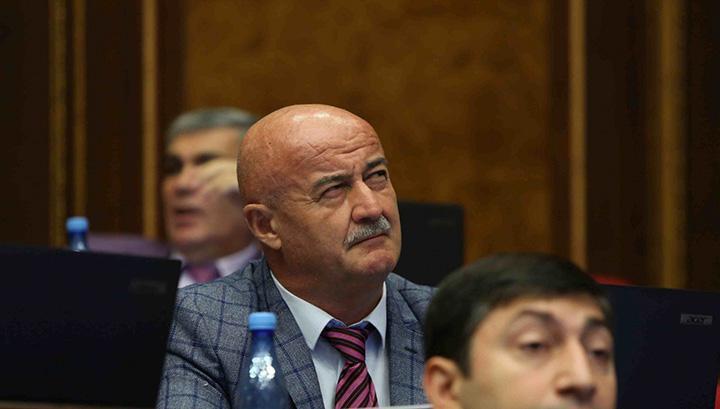
“In the eyes of the international community, Armenia has become the occupier,” Hovik Aghazaryan, an MP from Armenia’s ruling Civil Contract party, told the press. According to Aghazaryan, the former authorities, who “signed the ceasefire document after the first Karabakh war as a party to the conflict”, are to blame for this perception of Armenia in the world. This, the MP believes, “is what subsequently created problems for Armenia”.
On the surface, the Armenian MP’s statement may seem like something of a revelation, even with a certain tinge of remorse for the atrocities committed by his compatriots, but in reality the Armenian side is once again resorting to hypocrisy in an attempt to justify itself. But, as we know, a hypocrite’s remorse is hypocrisy in itself.
It would be funny, but, alas, after 30 years of occupation, it is disgusting to see how after the fall of 2020 many political and public figures in Armenia suddenly started using in their speeches words alien to their nation, such as “resolution” and “international law”. One wonders if Aghazaryan would have remembered international law if not for the Second Karabakh War. Certainly not: it was after the defeat in the 44-day war that the Armenian side began to show signs of ostensible prudence.
Suffice it to recall the provocative and self-assured statements made by the “revolutionary” military-political leadership of Armenia as they spoke of their determination to seize new Azerbaijani territories. It was not until after their crushing defeat that the Armenians began to acknowledge, through gritted teeth, the fights they had lost over the course of the war.
For three decades, Armenia ignored UN Security Council resolutions demanding an immediate withdrawal of its armed forces from the occupied lands of Azerbaijan. But the UN demands were ignored: the occupying country was not going to follow the international law. Only after Baku resolved the problem in a drastic way, by military means, the Armenian side immediately began to show its faux adherence to international law.
The flawed Armenian ideology has only one argument, inherent in all nationalist theories, to justify the terrible crimes committed by the bearers of such a worldview. It is their own view of history, which, they are convinced, has for centuries revolved only around their nation, the main nation of the world. Everything else is just a means to an end, namely the conquest of the lands given to them by this very history and all kinds of boons. This folkloric-philosophical theory has been inculcated not only in the minds of Armenians, but also in politics and the way of life of the country and the people.
The methods of implementation of the Armenian policy have been accurately described by the French lawyer Georges de Maleville, who noted that this propaganda machine employs three methods of Marxist dialectics: rewriting history, arguing a secret conspiracy of the oppressors of the Armenian people, and accusing the opponent persecuted in the name of morality, deliberately mistaking it for law. The mentioning of international law and UN resolutions by a member of the ruling party and other representatives of the Armenian political establishment is a new, post-war narrative of the Armenian propaganda machine aimed at hiding and camouflaging the aggressive nature of the state that occupied Azerbaijan’s territories. These crafty fabrications are primarily aimed at misinforming the international community. They are based on absurd inferences, fairy tales, falsifications and hypocrisy, just like everything pertaining to the “great Armenianism”.
Regardless of contextual rhetoric, the true goals of Armenianism have always boiled down to the revival of the myth of a “greater Armenia” and to claims on the lands of its neighbors. This is what determines the perception of external realities by representatives of this nation and the behavior of current Armenian public figures in these realities. The artificially created national legend of the “special mission” of Armenians and the claims towards the outside world based on the “long-suffering people” narrative continue to dominate in the inflamed minds of the nation and hinder the natural alternative of recognizing international law as the only true mechanism of the modern world order. This is why the appeals of some representatives of the Armenian government, focused on the idea of recognition of international law, are generally received by the public with hostility and branded as betrayal: they contradict the political folklore of Armenianism.
This statement by Aghazaryan, who, like the rest of the current Armenian government, is still trapped in this mythology, is aimed at shaping a positive image of Armenia, not at denying the established Armenian paradigm.
Huseyn Safarov
Translated from Caliber.Az











