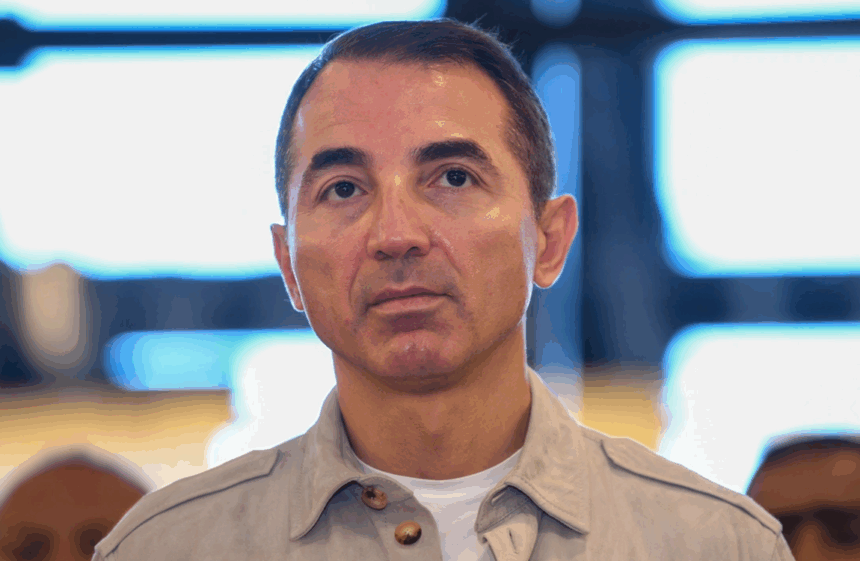
“Ahmadzade’s special ties to Russia are further evidenced by his closeness to Lukoil’s owner, Vagit Alekperov,” wrote political analyst Nurani in an article for Minval.az. We are publishing the article in its English translation.
The arrest of Adnan Ahmadzade, for obvious reasons, remains at the center of attention in Azerbaijan — and beyond. Official information on what exactly the former SOCAR vice president is being accused of has not yet been made public. Leaked details, however, have fueled the most far-fetched speculations.
Yet too many signs point to a familiar pattern. Around Azerbaijani oil, a fierce battle is unfolding — one that is both reputational and informational.
Strictly speaking, the information war against Azerbaijan’s oil projects has been ongoing since the very first day Baku began speaking about signing contracts with foreign oil companies. Hard as it may be to believe today, in the mid-1990s many “experts” seriously claimed that there were no longer any commercially attractive oil fields left in the Azerbaijani sector of the Caspian Sea. To be fair, these claims were made not by petroleum specialists — who already understood that the Caspian’s potential was far from exhausted and that Baku knew it better than anyone in the world, and that BP, AMOCO, and Statoil executives were hardly amateurs — but by political analysts. They spread the narrative enthusiastically. At times it bordered on the absurd. Russia’s Zvezda TV channel even edited out references to Baku’s oil, including the famous footage of Hitler being presented with a cake shaped like the Maiden Tower, from Roman Karmen’s documentary series The Unknown War. This, despite the fact that during World War II Baku supplied 70–80% of the oil and up to 90% of the petroleum products needed by the Soviet front. And of course, countless voices insisted that the Baku–Tbilisi–Ceyhan pipeline would never be built, that it was a “non-viable political project.” Needless to say, those forecasts collapsed spectacularly. The oil was found, the pipeline was built, and supertankers now load in Ceyhan.
Later, once the contracts had been signed, the tone shifted slightly. Commentators now claimed that reserves in the “contract fields” would last 10, maybe 20 years at most, and that this “oil boom” was fleeting and not worth attaching long-term plans to. Again, the experts were proven wrong — Azerbaijani oil reserves will last at least a century. More importantly, demand for hydrocarbons is unlikely to disappear over that time, despite climate change and the rise of renewables.
Now a new narrative is in circulation. Some European — particularly German — media outlets, together with members of the “liberal scene,” allege that Russian hydrocarbons are being sold on the market disguised as Azerbaijani. Pulling off such a trick with oil is extremely difficult: specialists know well that crude from different fields and countries varies in composition, and its origin is not hard to identify. With gas, such technologies do not exist. That is why a new wave of “fake news” is spreading: Azerbaijan has supposedly agreed to buy gas from Russia, meaning the gas delivered to Europe is not Azerbaijani but Russian! The fact that Azerbaijani imports from Russia amount to less than 1% of the volumes exported to Europe is conveniently ignored. Or rather, the hope is that if this is not mentioned, nobody will notice.
Unsurprisingly, the usual chorus of pseudo-human-rights activists has joined in, chanting the tired slogan: “How can you buy hydrocarbons from Azerbaijan, where human rights are violated?” In countries like France, attempts were even made to question energy cooperation with Baku under the pretext of a mythical “blockade of Nagorno-Karabakh.” Some French Armenian lobbyists went so far as to claim they would rather “freeze with Armenians than buy gas from Azerbaijan.” As expected, the hysteria led nowhere. After all, on an individual level, consumers cannot choose whether they are heated by Azerbaijani, Algerian, Russian, or any other gas.
This is by no means a full list of attempts to unleash an “information war” against Azerbaijani hydrocarbons. The reasons are clear. Azerbaijan has avoided playing the games of mixing oil and gas with politics. But hydrocarbons remain strategic raw materials. For those who use them as instruments of blackmail and pressure — and who funnel hydrocarbon revenues into bribing local politicians — Azerbaijan’s entry into the European energy market is deeply unwelcome. Hence the war against our oil and gas, increasingly fought as a “war without rules.” Now that Azerbaijan has restored its territorial integrity and turned the page on the Karabakh conflict, cutting pipelines by military means is no longer an option. But the information war, the attempts to inflict reputational damage, will continue — especially if accomplices can be found inside the country.
Adnan Ahmadzade, it now appears, was one such accomplice. He was known not only for his legitimate commercial activities in the oil sector but also for shadow schemes involving exports of raw materials from sanctioned countries. According to media reports, he used offshore companies to funnel Iranian oil onto world markets disguised as other countries’ products, earning hundreds of millions of dollars in the process.
After the start of Russia’s war against Ukraine in 2022 and the introduction of sanctions, Ahmadzade expanded this business. He built a network of offshore firms and, using falsified certificates, began moving Russian oil into Europe. Reports also linked him to shipments of Libyan and Russian oil through a Malta-based company, which became the subject of investigations in the EU and UK. Similar probes are ongoing in Albania, where 22,500 tons of Russian crude were recently seized.
Ahmadzade’s special ties to Russia are further evidenced by his closeness to Lukoil’s owner, Vagit Alekperov. Ahmadzade attended Alekperov’s birthday celebration in Bodrum and even had Alekperov’s $108 million superyacht Galactica Super Nova registered in his own name.
This was not merely a matter of personal illicit business. Increasingly, both experts and the Azerbaijani public believe that Ahmadzade, having fallen under Russian intelligence influence, effectively betrayed his own country. Above all, he inflicted damage on Azerbaijan’s oil industry and market transparency. According to expert estimates, contamination caused the price of Azeri Light crude to fall from $75 to $68.31 per barrel — a drop of $6.69. That translated into a $2.01 billion loss in export revenues. Needless to say, this is about more than just money; it is a blow to Azerbaijan’s reputation. And let us be realistic: Ahmadzade, no novice in the field, could not have been unaware of what he was doing. He was playing for high stakes.
His arrest dealt a major blow to the network of influence he had built, including media resources. It was a classic Kremlin influence scheme, first devised by Karen Brutents, a senior Soviet official who oversaw the Communist Party’s foreign operations in the late Soviet period: Moscow would let trusted figures profit from oil deals, and in return they would promote Russian influence. Today, however, the arrest of Adnan Ahmadzade stands as a symbol of the collapse of yet another attempt to play the role of a “state within a state.” By now, the lesson should be clear: in Azerbaijan, such games do not work.