Other than Norway, Azerbaijan is amongst the most plausible sources for increased European imports of natural gas in the near future. Therefore, it is little surprise that on April 25, its President Ilham Aliyev attended the signing of a Memorandum of Understanding (MoU) by the State Oil Company of the Azerbaijani Republic (SOCAR) with the transmission system operations (TSOs) of Bulgaria, Hungary, Romania and Slovakia.
The new MoU follows the signature, between Azerbaijan and the European Union, of an MoU last July to double imports of Azerbaijani natural gas to at least 20 billion cubic metres per year (bcm/y) by 2027. This joint initiative of SOCAR with the gas companies of the other countries concerned, would offer them up to 9.5 bcm/y of additional natural-gas transmission capacity.
In 2021, Azerbaijan supplied the EU with 8.2 bcm of gas (out of 19 bcm total exports), a figure that increased by almost half to nearly 12.5 bcm (out of 24 bcm total exports) in 2022. Figures for 2023 are expected to be at least as large as that and, according to the new MoU, should grow to deliveries of 20 bcm/y to Europe by 2027 to match the figure put forward in last year’s MoU.
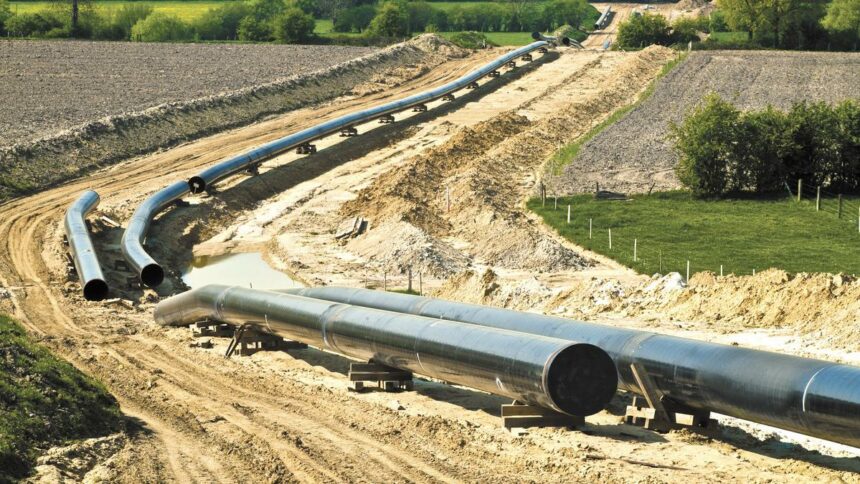
The new gas-supply MoU seeks also to use the Trans-Balkan Pipeline (TBP) in south-to-north “reverse flow” as the primary conduit for gas deliveries to the countries concerned, now that Russia’s Gazprom has ceased to use the pipeline. The agreement is a further step toward the diversification of sources and routes of energy supply in Central and Eastern Europe, reducing the vulnerability of the countries concerned to supply disruptions and price fluctuations.
The TBP runs from Istanbul through Bulgaria and Romania before connecting with a Ukrainian pipeline at Orlovka, about 280 kilometres (km) west of the Black Sea port of Odessa. It also includes a domestic branch within Bulgaria before this branch ends in the capital Sofia. Its estimated maximum capacity is 27 bcm/y, but following the inauguration of the TurkStream Pipeline under the Black Sea from Russia to Turkey in 2020, the north-to-south volume of TBP throughput fell to as low as 1-2 bcm/y.
In the context of this ongoing expansion into the region’s gas-distribution network, President Aliyev has also declared Azerbaijan’s readiness for significant investment into Albania’s infrastructure and distribution network. At present, Albania does not use any gas; however, it is planned to double the capacity of the TAP, a component of the SGC that runs through Albania from Greece to Italy under the Adriatic Sea, within the next few years, from 10 bcm/y to 20 bcm/y. Albania could offtake gas from the SGC for domestic use before it enters the undersea pipeline.
The new sources of this Azerbaijani gas by 2027 will likely be: (1) more production from the established offshore Shah Deniz deposit, and additional production possibly from its Phase Three development; (2) the offshore Absheron deposit, of which the first phase will produce 1.5 bcm/y although Azerbaijan has not yet decided whether that will go to the domestic market or the international market; (3) the so-called “deep gas” from the established Azeri-Chirag-Gunashli deposit, an enormous gas-condensate field containing an estimated 300 bcm, and on which SOCAR is already actively working with BP; (4) possibly the offshore Umid and Babek deposits that SOCAR has partly developed by itself and for which it seeks international partners; and (5) the offshore Karabakh oil field, which is also a source of gas.
Increased efficiency in the domestic Azerbaijani gas distribution network will also reduce losses in transmission, making larger quantities available for export. Finally, Azerbaijan is planning to produce up to 5 bcm/y by 2027 through renewable technologies for domestic use, freeing up for export an equivalent amount of gas that is currently used for producing electricity at home.
Finally of note is the 1,195-km electricity-transmission cable from the South Caucasus to Europe, announced at the end of last year, originally with a capacity of 1 gigawatt (GW). It is of interest to estimate the amount of natural gas equivalent for this power generation and transmission. At a load of 1 GW, the cable would transmit 8.76 terawatt-hours per year (TWh/y) if it operated at maximum efficiency without interruption. However, this never happens in real-world applications. In the case of long-distance undersea transmission from wind-generated electricity, a load factor of approximately 0.55 would be a good first estimate, particularly given the intermittency of wind power and the inherent limits on battery storage.
Such a long-distance subsea electricity cable would also lose approximately 7 percent of its capacity in the process of transmission. In addition, gas-fired power plants do not operate with absolute efficiency either: typically their efficiency is approximately 60 percent. Consequently, doing all the maths with all appropriate and necessary conversions, we find that the realistic amount of natural-gas equivalent to the electricity-transmission cable is 2.4 bcm/y. For this, the EU declared its readiness to invest no less than US$2.2 billion.
It has since been announced that the cable may be implemented as transmitting three to four times as much as originally planned. Costs would correspondingly increase, although there would be certain economies of scale. If we assume that the implementation is a cable of 3.5 GW, and that the cost will be 2.75 times the original estimate, then that makes the calculation of the cable’s cost to be US$6.1 billion for the equivalent of 8.4 bcm/y of natural gas.
For the sake of comparison, the TANAP pipeline, when originally built, cost US$8 billion (down from the original estimate of US$10-11 billion) for the transmission of 16 bcm/y of natural gas. The upgrade from 16 to eventually 32 bcm/y is expected to cost only US$4 billion; thus TANAP would in the end cost US$12 billion (a bit less than twice the cost of the long-distance subsea electric cable) for 31 bcm/y (a bit less than four times the cable’s natural-gas electricity-generation equivalent). This figure does not include infrastructure improvements (which are already under way) to other segments of the SGP or additional resource development, but it gives a first-glance comparative estimate of the trade-offs involved.
The geo-economic impact of these European agreements with Azerbaijan will produce significant and wide-ranging effects in the medium and long term. The first and most immediate will be the enhancement of regional co-operation, including the sharing of expertise. The second will involve decreased dependency of Southeast Europe on gas from Russia, which is especially significant for countries such as Bulgaria (and Slovakia) that have heretofore been heavily dependent on Gazprom. The new arrangement will thus mitigate the risk of supply disruptions and price manipulation, and also through fostering greater competition among suppliers.
Third is the expansion of the Southern Gas Corridor (SGC) and the extension of its network, which will encourage further investments in related infrastructure projects, such as the expansion of gas storage facilities and interconnector pipelines. Fourth is the MoU’s general and specific support for the ensemble of the EU’s energy policy objectives: the already-mentioned goals of diversification, market integration, and competition. A fifth significant and longer-term effect of the MoU will be to increase the potential for further gas-project development and production from existing fields in Azerbaijan’s offshore, stimulating economic growth and national and regional prosperity. To summarize, all these deals will lead to a more robust and resilient energy network, benefiting regional geopolitical stability not just in the South Caucasus but also in Southeast Europe.
Robert M. Cutler earned his doctorate at The University of Michigan after receiving two Bachelor’s degrees from the Massachusetts Institute of Technology.