By using this site, you agree to the Privacy Policy and Terms of Use.
Accept
Azemedia new logo
  • Home
  • Opinion
  • News
    • Economy
    • Energy
    • Climate and Ecology
  • Diaspora
  • Interview
  • Science
  • Logistics-Transport
  • History
  • Defense
Aze.MediaAze.Media
Font ResizerAa
Search
  • News
  • Economy
  • Climate and Ecology
  • Energy
  • Opinion
  • Culture
  • Gender
  • Interview
  • Science
  • Logistics-Transport
  • History
  • Defense
  • Karabakh
  • Diaspora
  • Who we are
Follow US
© 2021 Aze.Media – Daily Digest
Aze.Media > History > A monumental 3,800-year-old warrior kurgan discovered in Azerbaijan
History

A monumental 3,800-year-old warrior kurgan discovered in Azerbaijan

The success of the excavation is also educational. Participants included students and faculty from Baku State University, ADA University, and regional institutions, along with local museum staff and history teachers.

AzeMedia
By AzeMedia Published July 16, 2025 8.1k Views 6 Min Read
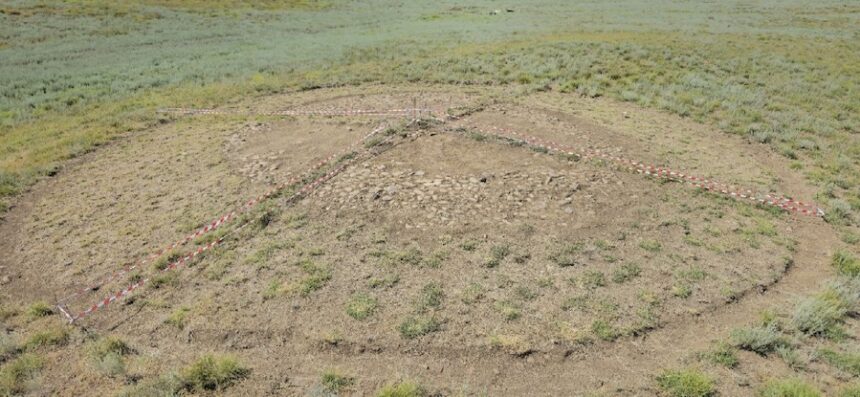
Panoramic view of the ancient kurgan site

A monumental discovery has emerged from the windswept plains of Ceyranchol in western Azerbaijan: a 3,800-year-old Middle Bronze Age kurgan, believed to be the burial site of a towering warrior, has been unearthed during the “Scientific-Archaeological Excavations and Summer School-5 at Keshikchidagh” project.

This groundbreaking excavation is part of a long-standing joint initiative between the Cultural Heritage Protection, Development and Restoration Service under the Ministry of Culture of the Republic of Azerbaijan and the Institute of Archaeology and Anthropology of ANAS (Azerbaijan National Academy of Sciences).

Now in its fifth year, the project has become one of the country’s premier archaeological summer schools, drawing nearly 2,000 participants and producing discoveries that are reshaping understandings of early civilization in the South Caucasus.
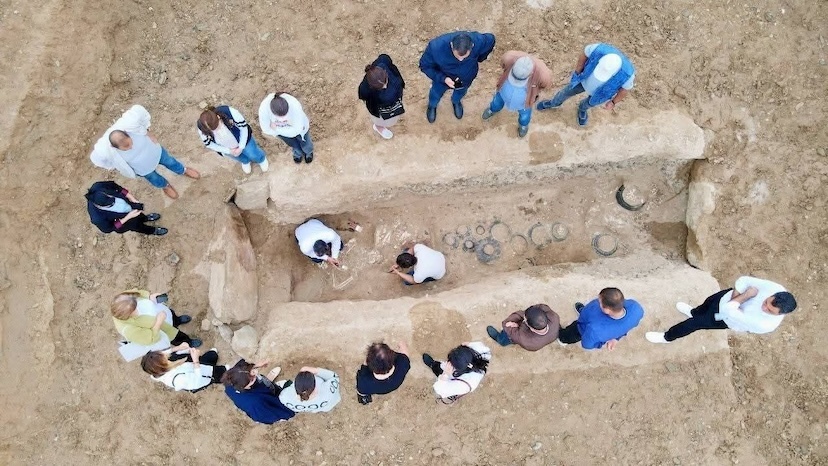
Aerial view of the team excavating the burial sectionschambers of the site
Aerial view of the team excavating the burial sections/chambers of the site
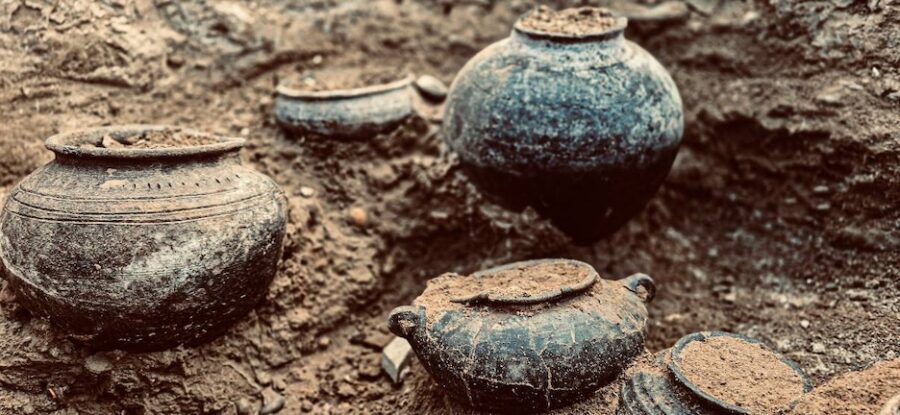
Ceramic ware associated with the burial.
Ceramic ware associated with the burial. Credit: Ministry of Culture of the Republic of Azerbaijan
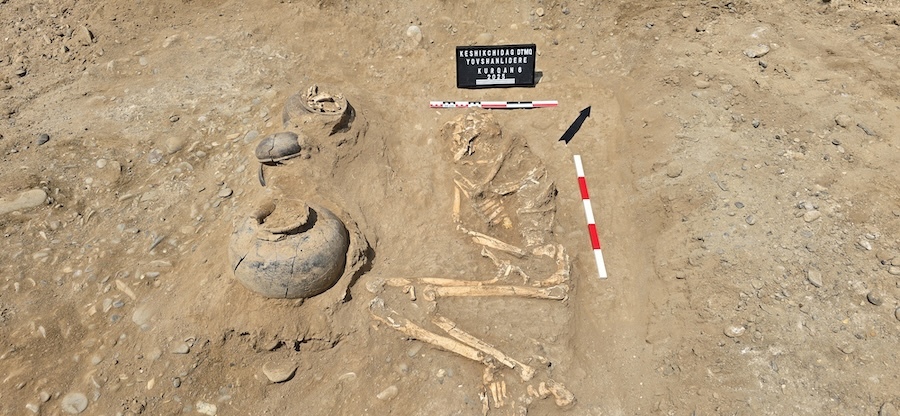
Skeletal remains of the burial with associated artifacts
Skeletal remains of the burial with associated artifacts. Credit: Ministry of Culture of the Republic of Azerbaijan
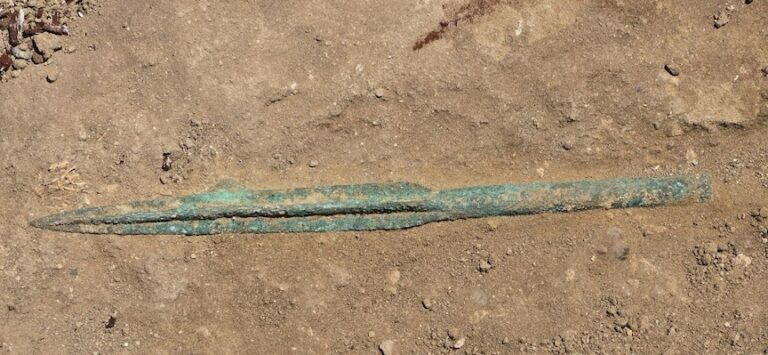
The bronze spearhead
The bronze spearhead. Credit: Ministry of Culture of the Republic of Azerbaijan

What is a Kurgan?

A kurgan is a type of ancient burial mound, often constructed by Eurasian nomadic cultures such as the Scythians, Sarmatians, and early Turkic peoples. These tombs typically contained the remains of warriors or high-ranking individuals, often accompanied by personal belongings, weapons, pottery, animals, and ritual offerings.

Kurgans are more than graves—they are ritual spaces reflecting beliefs in the afterlife, social structure, and spiritual symbolism.

The Yovşanlıdere Kurgans: Azerbaijan’s Bronze Age Legacy

The recent discovery was made in the Yovşanlıdere area of the Ceyranchol plain, a region now gaining international attention for its Middle Bronze Age kurgan cemeteries. Under the leadership of Dr. Shamil Najafov, a senior researcher at ANAS, a monumental kurgan measuring 28 meters in diameter and 2 meters in height was excavated.

At the heart of this burial mound, a richly furnished tomb was revealed. The burial chamber—2 meters wide, 6 meters long, and 3 meters deep—was divided into three symbolic sections: one for the human remains and weaponry, another for ceramic vessels, and a third intentionally left empty, possibly reflecting ritual beliefs about the soul’s journey in the afterlife.

The Warrior of Keshikchidagh

The remains belonged to an individual over 2 meters tall, laid in a semi-flexed position. Most notably, a rare four-pronged bronze spearhead was found in the warrior’s hand—an exceptional weapon type not only in Azerbaijan but across the entire South Caucasus.

Other grave goods included:

  • Bronze ankle adornments
  • Obsidian tools
  • Paste beads
  • Twelve elaborately decorated ceramic jugs, featuring white inlays and intricate motifs
  • Cooked animal bones (goat, horse, cow, and boar), likely as ritual food offerings

Above the tomb, 14 massive limestone slabs (each approx. 1 ton) were discovered, alongside a bull-shaped stone idol and a circular limestone seal—suggesting advanced concepts of spiritual symbolism and possibly early administrative control or property marking.

From Field to Science: Global Implications

Each artifact was graphically documented and professionally sketched in situ, while fragmented items were carefully restored on-site. The discovery of the “Keshikchidagh Kurgans”—a new term now entering academic discourse—marks a turning point in Azerbaijan’s archaeological scholarship.

Archaeological artifact restoration kits

The Director of the Institute of Archaeology and Anthropology, Associate Professor Farhad Guliyev, emphasized the importance of this site during a recent visit and highlighted the potential for international collaboration. Plans are underway for advanced scientific analysis, including:

  • Carbon-14 dating
  • Isotope studies
  • Metallography
  • Mineralogical composition tests

These studies aim to publish findings in leading archaeological journals, and a dedicated monograph featuring photographs, sketches, and detailed interpretations is currently in preparation.

Education and Heritage Combined

The success of the excavation is also educational. Participants included students and faculty from Baku State University, ADA University, and regional institutions, along with local museum staff and history teachers. The project is praised as a model for integrating academic research, heritage conservation, and public engagement.

The 3,800-year-old warrior’s kurgan in Keshikchidagh is not just a burial site—it’s a time capsule offering invaluable insights into the military technology, social structure, and ritual beliefs of the Middle Bronze Age South Caucasus. As this site continues to unfold its secrets, it firmly places Azerbaijan at the center of Eurasian archaeological scholarship.


Cropped resim 2021 03 09 201538

You Might Also Like

The story of a provocation – Who stood behind the events in Sumgait?

A tragedy that changed national consciousness

From Black January to sovereignty: lessons Azerbaijan cannot forget

Historian Rizvan Huseynov: Azerbaijan should learn from Kazakhstan’s experience

September 27: The day Azerbaijan shattered Yerevan’s dreams and changed the course of history

AzeMedia July 17, 2025 July 16, 2025

New articles

Screenshot
President Ilham Aliyev completely, directionally turned his country around – Steve Witkoff
News March 28, 2026
69c778d12350869c778d123509177468027369c778d12350669c778d123507
Azerbaijani oil price exceeds $124
News March 28, 2026
QJ9m9qaUTjKho4NQMQ4PTfRb7ykBAWVDMnL2UsSf
FAO offers Azerbaijan to develop five-year fisheries development plan
News March 28, 2026
577c9b7a tcxj78bkp11yulvvjs6gr
Türkiye and Azerbaijan sign media cooperation pact at STRATCOM summit
News March 28, 2026
Hebh8szaaaaquql
Hikmet Hajiyev attends meeting of assistants to heads of OTS
News March 27, 2026
1774618948147017258 1200x630
Foreign Ministers of Azerbaijan and Armenia hold telephone conversation
News March 27, 2026
17745979704581237642 1200x630
Another shipment of Russian humanitarian aid for Iran crosses the border
News March 27, 2026
Bigstock azerbaijani manat a business b 329741881 990x556
Paid services in Azerbaijan rise nearly 9%
News March 27, 2026
BGi9AMqMIbMwYcNq9KJhFhRcksaeqyd2lZDzfwYh
Azerbaijan bolsters role as regional aviation hub with National Airspace Strategy
Logistics-Transport March 27, 2026
433370
The Turkic world: The silent giant awakens
News March 27, 2026

You Might Also Like

фото

The story of a provocation – Who stood behind the events in Sumgait?

February 27, 2026 11 Min Read
1614066762 Feyyad Ana

A tragedy that changed national consciousness

February 25, 2026 8 Min Read
Basliksiz

From Black January to sovereignty: lessons Azerbaijan cannot forget

January 20, 2026 8 Min Read
гусейнов 1

Historian Rizvan Huseynov: Azerbaijan should learn from Kazakhstan’s experience

November 4, 2025 6 Min Read
Unnamed

September 27: The day Azerbaijan shattered Yerevan’s dreams and changed the course of history

September 27, 2025 9 Min Read
52 11

107th anniversary of the liberation of Baku from Bolshevik–Dashnak occupation

September 15, 2025 5 Min Read
Baku City View 1320x880

The history of Azerbaijan without Russian editing

September 4, 2025 10 Min Read
Hell

“In 1920, our independence was drowned in blood”

August 28, 2025 8 Min Read

Useful links

426082d1 a9e4 4ac5 95d4 4e84024eb314 pojkz91103g6zqfh8kiacu662b2tn9znit7ssu9ekg
Ab65ed96 2f4a 4220 91ac f70a6daaf659 pojkz67iflcc0wjkp1aencvsa5gq06ogif9cd0dl34
96e40a2b 5fed 4332 83c6 60e4a89fd4d0 pojkz836t9ewo4gue23nscepgx7gfkvx6okbbkasqo
759bde00 a375 4fa1 bedc f8e9580ceeca pq8mvb9kwubqf6bcadpkq5mz16nayr162k3j2084cg
aze-media-logo-ag1

We are a unique political and socio-cultural digest offering exclusive materials, translations from Azerbaijani media, and reprints of articles from around the world about Azerbaijan.

  • Privacy Policy
  • Terms and Conditions
  • Cookies Policy

Email: editor@aze.media

© 2021 Aze.Media – Daily Digest
aze-media-logo1 aze-media-logo-ag1
Welcome Back!

Sign in to your account

Lost your password?