Since the 1995 Srebrenica genocide, our women-led NGO has sought to unite our own Bosnian Muslim community with Serb Christians, as represented by Women in Black and other women-led anti-war campaign groups. Our joint aim is to reconcile as the first vital step toward making lasting peace possible. We now seek to share these hopes and dreams with our sisters and brothers in the Caucasus whose same journey has only just begun.
Making peace between Azerbaijani Muslims and Armenian Christians will not be easy. It requires will from both countries’ administrations and support for the process from the international community. Last year peace negotiations appeared to be progressing. This year, with talks stalled, it is debatable whether that will exist anymore.
Yet peace on paper, signed by politicians, is not where the foundational reconciliation of permanent peace begins. Nor does it begin with the justice of international tribunals. Governments or global institutions have vital roles to play. However, in our experience, reconciliation starts between communities of ordinary people and with those citizens’ recognition of great wrongs. We do not mean crimes of history perpetrated against ancestors long since passed, but those committed in more recent times whose victims are alive today. For while we can remember and account for the dead, we must reconcile with the living.
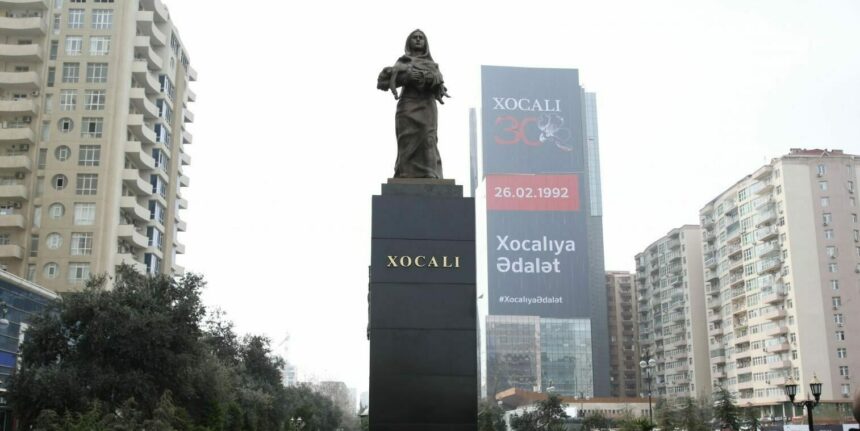
One of those wrongs was the Khojaly massacre, committed in the Caucasus 31 years ago, and whose living survivors we will meet in Azerbaijan last month. It was a mass murder committed in 1992, three years before Srebrenica, during the first of two wars waged between Armenia and Azerbaijan in only one generation. Over 600 Azeris fleeing the town of Khojaly in the Karabakh region of Azerbaijan were killed by the advancing Armenian forces. Whilst the victims included military personnel, the majority were civilians, including women and children.
The evidence for what occurred is stark, indisputable, and meticulously recorded at the time. Reuters reported from the scene that “Women and children had been scalped”, while of other victims, “Some had their heads cut off, and many had been burned.” Adding to corroborating reports from dozens more international journalists are thousands of pages of surviving witnesses’ testimony recorded in the following days and weeks. Human Rights Watch described a clear violation of international humanitarian law: evidence that civilian victims were shot while fleeing. Later, Armenian official sources claimed they had provided a “humanitarian corridor” for their safe passage. Yet none of the witnesses or survivors interviewed by HRW said they knew any of such provisions.
A similar depth of testimony exists for Srebrenica, a crime refuted by no one of credibility nowadays. Yet, extraordinarily, the reaction from modern-day Armenian politicians to the Khojaly massacre swings between denial and open admission. As recently as 2019, the country’s current prime minister described it as “a blatant lie” and “carried out by Azerbaijanis themselves”.In contradiction, a former president – today in opposition – said: “Before Khojaly, the Azerbaijanis thought that they were joking with us, they thought that the Armenians were people who could not raise their hand against the civilian population. We needed to put a stop to all that. And that’s what happened”.
It is understandable that politicians who have been in a state of war with their neighbours for three decades find it difficult to move on. This is where civil society can intervene. Just as we did in the Balkans, citizens should take a lead, opening a space for recognition and reconciliation upon which political leaders can build.
That is why Mothers of Srebrenica joined other human rights organisations and defenders and travelled to the venue of tragedy in Karabakh for this year’s Khojaly anniversary. The visit was part of the Recognize to Reconcile peace platform, established during a United Nations workshop in Geneva last year, with the specific aim of facilitating direct dialogue between Azerbaijanis and Armenians to overcome memories of conflict and jointly find a route to reconciliation and peace.
We wait for the accusations of bias to be levelled against us for visiting this commemoration. We predict we will be accused of becoming victims of one side’s campaign against the other. Why not call out the crimes committed by the other side, we will hear. These are the same accusations that were levelled at us in the Balkans for years. They are made by those everywhere unwilling to make the reconcilers’ journey to the truth.
Of course, both sides committed violence over the last 30 years. In the case of Khojaly – as with Srebrenica – one side was the perpetrator, the other the victim. For those who do not wish to see this or deny it entirely, there is a wilful blindness, a moral relativism toward the other side’s victims that is somehow lesser than the victimhood they attach to their own ethnicity and religion. This is not the way to reconciliation, let alone peace.
Similarly, for those in Azerbaijan who demand justice first, we say that whilst reconciliation is the less easy option, it allows people to move forward with the hope of unity. It also opens the potential for justice in the future.
The experience of the Balkans shows us that there is nothing more important than peace. To become permanent, it must permeate from civil society upwards; it cannot be imposed from the top. Reconciliation flows from the truth, and truth rises from below. And that truth, after the crimes of war, requires ordinary citizens from both sides meeting, talking, and remembering.
Munira Subašić, president of ‘Mothers of Srebrenica’ – Munira Subašić is a Bosnian citizen and president of Mothers of Srebrenica, a human rights NGO representing 6,000 survivors of the Srebrenica Genocide.