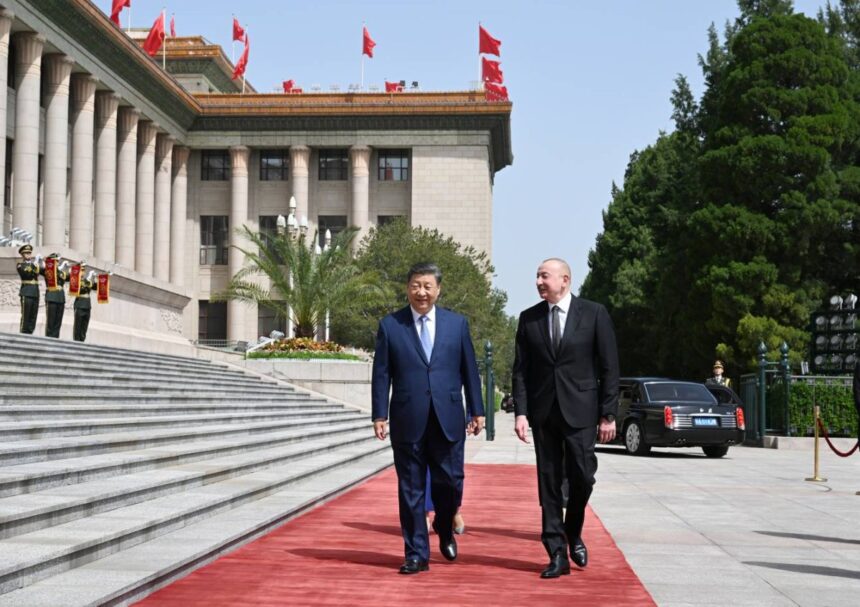
From April 22 to 24, 2025, Azerbaijani President Ilham Aliyev’s state visit to the People’s Republic of China marked a milestone in the evolving geopolitical landscape of Eurasia. Beyond the pageantry of formal receptions, banquets, and high-level meetings, the visit signified a turning point in Azerbaijan-China relations—anchored in the signing of the “Joint Statement on the Establishment of a Comprehensive Strategic Partnership.” This upgrade in bilateral ties not only affirms the strength of the current partnership but projects a shared vision for connectivity, energy transformation, and strategic balance in Eurasia. The visit’s broad scope, ranging from renewable energy and transportation to digital economy and cultural diplomacy, positions Azerbaijan as a rising hub in the emerging multipolar world and China as a committed partner in reshaping the contours of Eurasian integration.
China’s diplomatic lexicon reserves the designation of “Comprehensive Strategic Partnership” for countries with whom it shares high political trust, sustained policy coordination, and multifaceted cooperation across a broad spectrum of sectors. For Azerbaijan, this elevation reflects Beijing’s recognition of Baku’s growing geopolitical significance. Positioned at the intersection of Central Asia, the South Caucasus, and Europe, Azerbaijan offers China a stable, capable partner in a volatile but strategically vital region. For Azerbaijan, aligning with China represents a calculated move to diversify its foreign policy portfolio, amplify its strategic autonomy, and fortify its role as a key player in regional diplomacy and global logistics.
At the core of this partnership lies an intensified focus on connectivity. The visit resulted in the signing of an “Agreement on International Multimodal Transportation,” which commits both countries to collaborate on establishing efficient, secure, and high-capacity China–Europe–China Trans-Caspian express routes. These efforts aim to enhance customs clearance, improve cargo logistics, and reduce bottlenecks along the Middle Corridor—a trade route traversing China, Central Asia, the Caspian Sea, the South Caucasus, and onward to Europe. As the Northern Corridor through Russia faces geopolitical headwinds and the Southern route via Iran remains unreliable, the Middle Corridor is gaining strategic appeal. Azerbaijan, with its advanced infrastructure, strategic geography, and political stability, emerges as a pivotal node in this evolving trans-Eurasian corridor. Beijing’s recalibration of the Belt and Road Initiative (BRI) to prioritize the Middle Corridor reflects a shift toward diversified and resilient supply chains, where Azerbaijan stands out as a vital logistical and political partner.
One of the most transformative outcomes of the visit was the expansion of bilateral cooperation in renewable energy—a key pillar of Azerbaijan’s long-term strategy to become a regional “Green Energy Hub.” The agreements signed during the visit encompass a suite of groundbreaking energy projects. Chinese investment and technology—especially in grid modernization, smart energy, and battery storage—will play a crucial role in Azerbaijan’s green transition. This aligns with Baku’s national strategy, “Azerbaijan 2030: National Priorities for Socio-Economic Development,” which prioritizes sustainability, economic diversification, and innovation. By enabling these projects, China is not only advancing its global green technology footprint but also supporting a fellow developing country in reshaping its energy future. For Azerbaijan, this green partnership bolsters domestic resilience, reduces reliance on hydrocarbons, and opens up new export opportunities in electricity and carbon credit markets.
Beyond transport and energy, the visit laid the foundation for deeper cooperation in the digital economy, and smart governance. Agreements on investment cooperation in digital sectors, coupled with discussions on peaceful space exploration and satellite technology, suggest that the BRI is extending into the technological and digital domains. These partnerships open the door for the modernization of Azerbaijan’s public services, expansion of e-commerce, and acceleration of digital literacy. Such cooperation is especially timely as Azerbaijan continues its post-conflict reconstruction efforts in liberated territories and seeks to build technologically advanced, smart cities. Chinese expertise in digital infrastructure—from 5G and AI to e-governance—can serve as a catalyst for Azerbaijan’s tech-driven development ambitions.
The Azerbaijan-China partnership extends well beyond economics and energy. The visit underscored a shared commitment to regional multilateralism, with China expressing strong support for Azerbaijan’s chairmanship of the Conference on Interaction and Confidence-Building Measures in Asia (CICA). Azerbaijan’s emphasis on digital transformation, sustainable development, and inclusive regional dialogue within CICA resonates with China’s vision for regional governance frameworks that offer alternatives to Western-dominated institutions.
People-to-people ties also received a boost, with the signing of a mutual visa exemption agreement for ordinary passport holders—a move expected to increase tourism, educational exchange, and business travel. Agreements also covered cooperation in culture, media, education, justice, intellectual property, and the fight against terrorism and extremism. These developments reinforce the idea that the Azerbaijan-China partnership is no longer transactional or narrowly defined but instead systemic and multidimensional.
While the Comprehensive Strategic Partnership with China is a milestone, it should not be viewed in isolation. Azerbaijan’s foreign policy is rooted in a multi-vector approach that seeks to maximize national interest through diversified partnerships. Alongside growing ties with China, Baku remains deeply engaged with the European Union, Türkiye, Israel, and the broader Turkic world. Each of these relationships serves a distinct strategic function—from energy exports to defense cooperation and cultural diplomacy. What sets Azerbaijan apart is its ability to navigate these complex geopolitical waters with remarkable dexterity. The strengthening of ties with China does not imply a pivot away from the West or other regional actors; rather, it reflects a pragmatic, forward-looking strategy aimed at enhancing Azerbaijan’s global agency and economic resilience.
President Ilham Aliyev’s state visit to China was not merely a diplomatic milestone but a strategic inflection point. The elevation to a Comprehensive Strategic Partnership signals a long-term commitment to joint development, technological innovation, and regional stability. By aligning their respective national strategies and pooling their resources, Azerbaijan and China are shaping the architecture of a new Eurasia—one defined by diversified corridors, green growth, and digital integration.
As the tectonic plates of global power continue to shift, the Azerbaijan–China axis offers a compelling model of how small and mid-sized powers can assert agency, shape outcomes, and thrive within a multi-aligned world order. The true legacy of this partnership will unfold not just in diplomatic communiqués or project blueprints, but in the concrete transformation of Eurasian landscapes, economies, and connectivity systems.
Azerbaijan’s geostrategic position in the South Caucasus, coupled with its economic potential and historical and cultural affiliations with other Turkic states, underscores its pivotal role within the region and the framework of the Organization of Turkic States (OTS). Situated at the nexus of Europe and Asia, Azerbaijan’s proximity to significant energy producers and consumers has established it as a vital transit corridor for energy resources. This strategic positioning has not only reinforced Azerbaijan’s centrality in regional energy security but also facilitated avenues for collaboration and partnerships with neighboring states. In addition to its prominence in the energy sector, Azerbaijan has pursued economic diversification, fostering expertise in fields such as advanced technology, transportation, and tourism. These efforts have expanded the scope for economic cooperation and attracted investments among OTS member states, with particular emphasis on advancing trade and infrastructure development. Such initiatives exemplify Azerbaijan’s multifaceted approach to leveraging its geographic, economic, and diplomatic strengths to enhance regional integration and collaboration.
Since the onset of Russia’s full-scale invasion of Ukraine, the geopolitical landscape of the region has undergone significant shifts, reshaping strategic alliances, economic partnerships, and security dynamics. In this regard, Baku has adopted a proactive diplomatic approach to strengthen dialogue and regional interconnectedness with Central Asian countries. The Azerbaijani leadership has notably enhanced its engagement through direct, high-level interactions and the utilization of region-specific diplomatic frameworks. A pertinent example of this strategy is the series of official trips undertaken by incumbent President Ilham Aliyev to Uzbekistan in June and September 2022, followed by a visit to Kyrgyzstan in October of the same year. Against this backdrop, Aliyev’s latest state visit to Tashkent in August 2024 marked an unprecedented level in Azerbaijan-Uzbekistan bonds with respect to mutually beneficial geopolitical and economic alignment.
Therefore, these tangible steps have contributed to fostering closer ties between Azerbaijan and its Central Asian counterparts in regional affairs. During these high-level engagements, several significant agreements were formalized to advance bilateral cooperation in key sectors, including defense, transportation, agriculture, and trade. Among these, the Declaration on Deepening the Strategic Partnership and Building Up Comprehensive Cooperation between Azerbaijan and Uzbekistan (2022) stands out as a landmark agreement, aimed at strengthening allied relations and promoting long term collaboration across multiple domains. These systemic developments underscore Azerbaijan’s commitment to enhancing its role as a catalyst for regional cohesion and integration at all levels.
Furthermore, the official visit of President Ilham Aliyev to Astana in April 2023, marked a significant milestone in Azerbaijan’s diplomatic efforts, during which a joint statement and protocol were signed to establish a Supreme Interstate Council. Strengthening political and economic ties with Kazakhstan, a key Central Asian state, has increasingly become essential for Azerbaijan in various respects. The agreements reached during this high-level meeting encompassed a broad range of cooperation areas, with a particular emphasis on improving connectivity along the Middle Corridor as part of Azerbaijan’s broader export diversification strategy. In the context of Azerbaijan-Central Asia relations, Baku’s active and pragmatic foreign policy, along with its growing engagement with regional partners, plays a crucial role in the successful realization of interconnectivity initiatives. As the sole Turkic nation with direct geographical access to both Anatolia and Central Asia, Azerbaijan occupies a unique position in facilitating the realization of these interregional projects.
Azerbaijan has demonstrated a sustained commitment to enhancing the capacity of alternative overland transit corridors in recent years. The prevailing geo-economic uncertainties have further incentivized Baku to prioritize the strengthening of diplomatic and cooperative relations aimed at mitigating political, financial, regulatory, and logistical challenges that impede effective communication and connectivity among the key states of the Silk Road region. Simultaneously, in collaboration with its Turkic counterparts, Türkiye and Kazakhstan, Azerbaijani leadership has made substantial investments in the modernization and expansion of its transportation infrastructure. These government-backed efforts encompass the construction of new highways, railways, and ports, along with the upgrading of airports and aviation facilities, forming an integral part of a comprehensive and interconnected transportation network along the east-west dimension. Such initiatives underscore Azerbaijan’s strategic focus on establishing itself as a critical hub within the broader regional and global transit landscape.
Speaking of regionwide transportation projects, Azerbaijan has been recognized as a pioneer in initiating the construction of multi-purpose transportation infrastructure projects across the region, including the Baku-Tbilisi-Kars Railway (BTK), the Port of Baku, and the Alat Free Economic Zone (AFAZ). In particular, Baku has actively pursued policies and strategies aimed at enhancing regional connectivity and establishing a multifunctional logistics hub on the western shore of the Caspian Sea through the development of its maritime industry. Significant advancements have been made in the Caspian segment of multimodal transportation, highlighted by the establishment of the Trans-Caspian International Transport Route (TITR) and the development of modern port facilities in Aktau/Kuryk and Baku. Strategic investments in maritime capacities are expected to position Azerbaijan as a crucial link in the global trade network and to foster the growth of export-oriented industrial activities. The Azerbaijani government has implemented a combination of hard and soft infrastructure measures to optimize shipping routes between regions. The resulting increase in import-export traffic will enable littoral states to expand transshipment operations and enhance hinterland connectivity. This expansion is anticipated to play a vital role in revitalizing international trade both within the region and on a broader scale.
In addition to its multilateral diplomatic initiatives and extensive infrastructure projects, Baku has played an active role in fostering humanitarian assistance within the framework of the Organization of Turkic States. More specifically, following the devastating earthquake in Türkiye in February 2023, President Ilham Aliyev proposed convening the first-ever Extraordinary Summit of the Heads of State of the Organization of Turkic States, which took place in March 2023 in Ankara, Türkiye. Centered on the theme of “Disaster-Emergency Management and Humanitarian Assistance,” the summit was organized to mobilize support for the earthquake-affected regions in Türkiye. During the Ankara Summit, OTS leaders underscored the importance of coordinated regional responses to natural disasters and unveiled plans to establish mechanisms aimed at enhancing the efficiency and effectiveness of humanitarian aid delivery. This initiative reflected the organization’s commitment to strengthening solidarity among Turkic states and improving disaster resilience across the region. These initiatives also included the creation of a humanitarian aid coordination center and the establishment of emergency response funds. Humanitarian assistance appears to be emerging as a critical dimension of the OTS’s agenda, reflecting a commitment to addressing the needs of vulnerable populations within its member states. The provision of such aid not only underscores the bloc’s responsiveness to catastrophic events but also provides momentum for the development of more robust mechanisms for multilateral cooperation and coordination in crisis management. Overall, the implementation of joint humanitarian efforts among Turkic states highlights the increasing efficacy and cohesion of the OTS in addressing shared challenges.
Nevertheless, Azerbaijan’s proactive engagement within the OTS and its dedication to advancing the alliance’s objectives have significantly enhanced its strategic importance. The country has hosted several pivotal events and spearheaded initiatives, such as the establishment of the Turkic Academy and the development of the Turkic Council Youth Platform, which underscore its leadership role within the organization. Moreover, Baku’s robust diplomatic relations with key regional powers, including Iran and Russia, have bolstered its capacity to exert influence in regional affairs. These strong ties have enabled Azerbaijan to effectively advocate for the geostrategic priorities of the OTS, further solidifying its position as a critical actor in fostering regional cooperation and advancing shared goals and mutual interests.
Thus, Azerbaijan’s dynamic engagement within the Organization of Turkic States underscores its pivotal role in fostering unity, enhancing connectivity, and advancing shared objectives among Turkic nations. Leveraging its strategic geographic location, extensive economic initiatives, and cultural heritage, Azerbaijan has become a linchpin in regional cooperation. Its leadership in infrastructure development, energy transit, and humanitarian assistance demonstrates a multifaceted approach to addressing regional challenges while strengthening economic and political ties. By championing interconnectivity projects like the Middle Corridor and spearheading humanitarian initiatives, Azerbaijan has positioned itself as a catalyst for integration and stability in the Turkic world. As a bridge between Europe and Asia and a key member of the OTS, Azerbaijan continues to shape a collaborative and prosperous future for the Turkic states, reinforcing its role as a cornerstone of regional cohesion and global significance.
Vusal Guliyev is a Sinologist and Policy Analyst specializing in the geopolitical affairs of Eurasia and the Asia-Pacific region. He currently works as a Policy Advisor at the Center of Analysis of International Relations (AIR Center, Baku) and also serves as the Head of Shanghai Office at AZEGLOB Consulting Group.