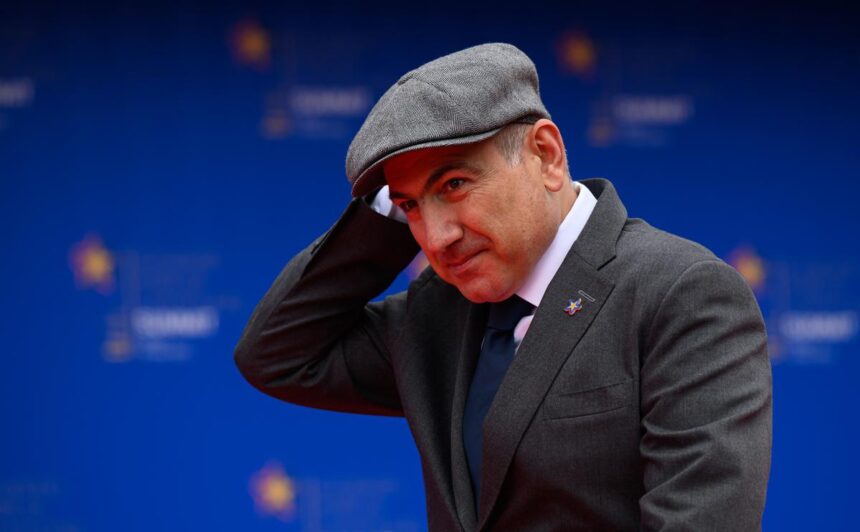
As Armenia’s parliamentary elections draw closer, tensions between the authorities and the Armenian Apostolic Church are becoming increasingly visible. A conflict that for a long time remained in the background of Armenian politics has now moved to the forefront and is being discussed publicly more and more often. One of the clearest signals was Prime Minister Nikol Pashinyan’s recent visit to Germany and his meeting with members of the Armenian community in Hamburg. It was there that the head of government allowed himself some of the harshest remarks toward the Church of his entire time in office.
Pashinyan stated directly that, in his view, the Armenian Apostolic Church has long since ceased to fulfill its primary, spiritual mission and increasingly resembles a political structure actively involved in the struggle for power. As an example, he referred to the situation inside the churches themselves. According to the prime minister, the traditional sermon, which by church canons should be an integral part of worship, has effectively disappeared. Instead of spiritual guidance, priests are allegedly sent pre-prepared texts with political content, which they are encouraged to read from the pulpit. In Pashinyan’s view, this amounts to a direct transformation of the Church into a political organization — a step he called unacceptable.
For many observers, however, such statements were less a revelation than an acknowledgment of a long-obvious reality. For decades, the Armenian Apostolic Church has played an important role in shaping the country’s hardline ideological stance toward its neighbors, primarily Azerbaijan and Turkey. It was within church circles that notions of “eternal enemies,” “existential threats,” and the inevitability of confrontation were actively supported and disseminated. These ideas became deeply embedded in public consciousness and largely served to justify a prolonged conflict, giving it an almost sacral meaning. As a result, the Church fulfilled not so much a spiritual as an inciting function, preparing society for life in a state of permanent confrontation.
Today, the situation has changed. After the end of the conflict with Azerbaijan, Armenia has found itself facing the need to revise both its foreign and domestic policies. Official Yerevan is demonstratively distancing itself from the former confrontational model and is trying to integrate into a new post-conflict reality, where the emphasis is on dialogue, pragmatism, and participation in regional processes. In this context, the actions of the Church, which continues to appeal to old slogans and revanchist sentiments, are perceived by the authorities as a threat — not only to internal stability, but also to Armenia’s prospects within the new regional order. In government circles, the view is increasingly voiced that only a change in church leadership toward a more loyal one can alter the mood of the faithful and steer them away from dangerous political radicalism.
The proximity of elections gives this conflict particular sharpness. Only a few months remain until the start of the electoral campaign, and any instability could play a decisive role. An additional dimension is added by the foreign policy factor. Just days after Pashinyan’s high-profile statements, the EU’s High Representative for Foreign Affairs, Kaja Kallas, announced that Armenia had asked the EU for assistance in countering information attacks and “foreign malicious influence.” The wording closely resembled formulations previously used by Brussels in relation to Moldova.
In Yerevan, it appears that there is an assumption that Moscow may support church circles in their confrontation with the government, while Pashinyan himself is counting on political and informational backing from the European Union. The standoff with the Church thus fits into a broader context of competition for influence between Russia and the West.
Indeed, Russian media play a special role in this story. In their media narratives, the Armenian Apostolic Church is consistently portrayed as the “last bastion of national identity,” the “guardian of historical memory,” and a “moral authority.” The actions of the Armenian authorities, by contrast, are presented as attempts to destroy traditional values, undermine statehood, and sever the country from its “natural civilizational space.” Any steps by Yerevan aimed at limiting the political influence of the Church are interpreted not as internal political struggle, but as an “attack on faith” or the result of Western pressure.
Given that Russian media have a significant audience in Armenia and enjoy trust primarily among older and more conservative segments of the population, their influence on public sentiment and electoral dynamics is difficult to overestimate. In effect, an alternative picture of events is being formed, in which all internal conflicts are explained by external interference and a “civilizational choice” imposed from outside.
In this context, a key question arises: what, and how, can Brussels actually help? If one looks to the Moldovan scenario, mechanically replicating it under Armenian conditions appears doubtful. As is known, in Moldova a crucial role was played by the diaspora living in EU countries, whose votes proved decisive. In Armenia, the situation is different. A significant portion of citizens either live in Russia, hold Russian citizenship, or are closely tied to the Russian economic and information space. This creates a fundamentally different perception of external signals and political messages.
Under such conditions, expecting the Armenian electorate to broadly embrace narratives coming from Brussels would be naive. European rhetoric that is not backed by tangible social and economic benefits risks remaining abstract. Moreover, against the backdrop of the active presence of Russian media and church rhetoric, attempts by the EU to intervene directly in the information sphere can easily be presented as external pressure, which would only strengthen the mobilization of conservative and pro-Russian groups.
As a result, the space for effective influence by Brussels in Armenia turns out to be significantly narrower than in the Moldovan case. This means that relying on external scenarios and ready-made recipes is risky. Ultimately, Nikol Pashinyan will have to resolve this difficult dilemma himself, guided not by the expectations of external partners, but by the real structure of Armenian society, its moods, and the realities that shape today’s domestic and foreign situation.
Ilgar Velizade