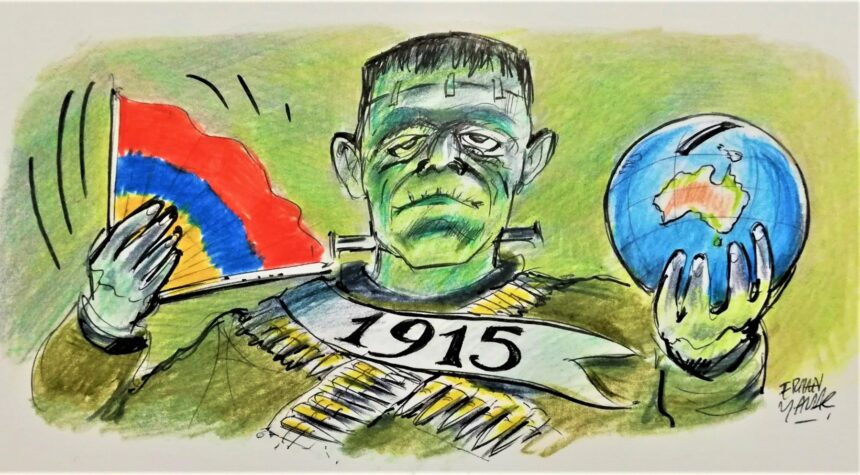
Echoes from 1920: The Historical Context of Misinformation
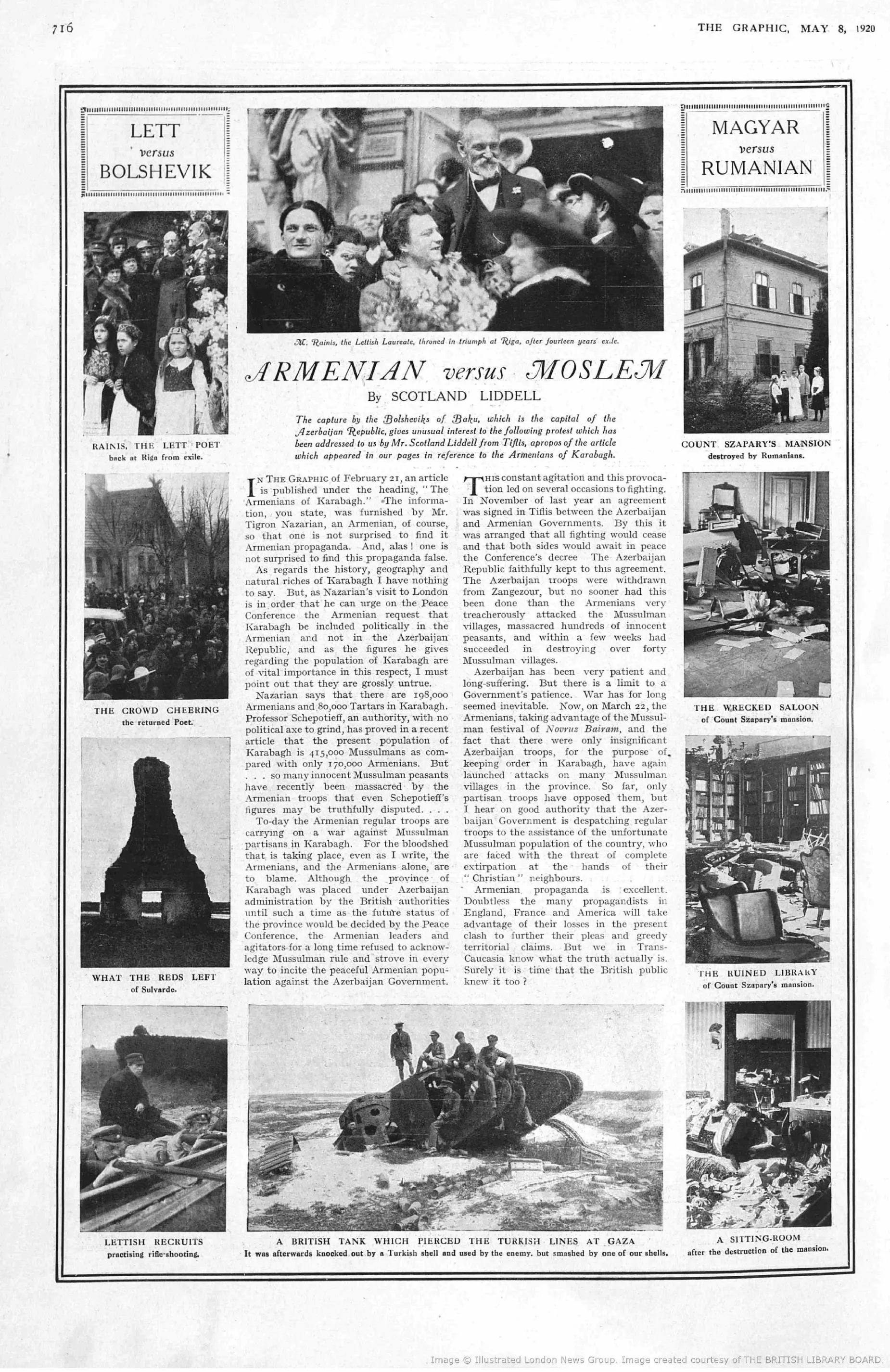
Over a century ago, the tumultuous events of the Caucasus were illuminated on the international stage through the objective reporting of Scotland Liddell in “The Graphic”, a British weekly newspaper, dated May 8, 1920. It’s through this lens that we can extract insights about the past, and it’s revealing to see how these historical events mirror the present-day narrative surrounding Azerbaijan and Armenia.
Modern Allegations and Media Involvement
Modern allegations insinuate that journalists are swayed by Azerbaijani incentives like “petrodollars” or “caviar.” But when we reflect upon objective articles from a time when Azerbaijan had neither significant oil revenues nor the capability to influence foreign journalists, such contentions are dispelled.
It’s noteworthy that the challenge of Armenian propaganda — which I define as the deliberate dissemination of misleading or false information to advance specific narratives — isn’t just a recent phenomenon. As highlighted by Liddell’s 1920 article, this misinformation can be traced back to the early 20th century. Throughout history, there have been instances of inaccurate information propagation, be it inflating population numbers or airing unfounded allegations. Today, Western media often unwittingly perpetuates this misinformation. While journalists of yesteryears like Liddell pursued unbiased reporting, contemporary media sometimes falls prey to these narratives. Their susceptibility might be due to a lack of in-depth research, succumbing to external pressures, financial inducements or incentives, and, significantly, harassment, threats, insults, and intimidation as a result of collective Armenian attacks, causing some to back down from objective reporting.
Liddell astutely remarked, “Armenian propaganda is excellent. Doubtless the many propagandists in England, France, and America will take advantage of their losses in the present clash to further their pleas and greedy territorial claims. But we in Trans-Caucasia know what the truth actually is.”
Now, fast forward a century, and we observe a similar pattern of bias. In stark contrast to Liddell’s candid, firsthand reporting from the region, having lived there and deeply studied its dynamics, we witness modern mainstream journalists and editors. Many of these individuals, being distant and perhaps unfamiliar with the intricacies of the region, might struggle to even locate Karabakh on a map. Yet, they permit articles like the one by Dr. Ewalina U. Ochab, “Lachin Corridor Blockade Starves Nagorno-Karabakh” published in Forbes on August 8, 2023, which states: “The reports of the dire situation in Nagorno-Karabakh must be taken seriously at last and acted upon. As Nagorno-Karabakh is being starved, the international community cannot continue looking away as it has done for the last eight months. The people of Nagorno-Karabakh require urgent assistance without any further excuses.”
This modern narrative sends shivers down the spine as it eerily mirrors tactics from a century ago. One has to wonder, with a heavy heart, if esteemed platforms like Forbes are becoming unsuspecting pawns, unknowingly amplifying sentiments from yesteryears. Liddell, with palpable concern and raw authenticity, once addressed his era’s information landscape, lamenting, “Surely it is time that the British public knew it too?” In today’s globally intertwined media environment, his heartrending plea reverberates with even more urgency: “Isn’t it high time the world grasped the undiluted truth?” A resounding call for genuine, informed perspectives rings through the ages.
Contemporary Challenges: The Lachin Road Scenario
Shifting our focus to the ceasefire agreement of November 10th, 2020 — brokered by Russia, and signed by the leaders of three states — it marked the end of the second Karabakh war. This agreement saw Azerbaijan liberate territories that had been under Armenian occupation for almost three decades. Following this, Armenians living in Karabakh received permission to use the Lachin road for transportation and the delivery of humanitarian goods. With the Lachin road temporarily under the watch of Russian Peacekeepers in the Karabakh economic region of Azerbaijan, the Azerbaijani government vouched for the safety of both civilians and cargo.
Over the subsequent two years, the Lachin road, which connects ethnic Armenians residing in Azerbaijan’s Karabakh with Armenia, became a conduit for illicit activities. Armenians utilized this route to export Azerbaijan’s stolen natural resources and to import weapons from Armenia intended for use against Azerbaijanis. This traffic further involved the importation of mines destined for Azerbaijani soil and even facilitated the entrance of foreign political figures and saboteurs. Responding to these activities and after several unheeded warnings, Azerbaijan established a border control point on the Lachin road. Despite Armenian claims to the contrary, the road remains operational for civilian transport. As testament to its accessibility, even on the day of writing this article, August 18, 2023, Armenians traveled safely from Karabakh to Armenia via this very road. Moreover, in an effort to streamline the delivery of humanitarian goods, Azerbaijan proposed utilizing the newly rebuilt shorter and more convenient Aghdam road. However, this proposal was met with Armenian resistance.
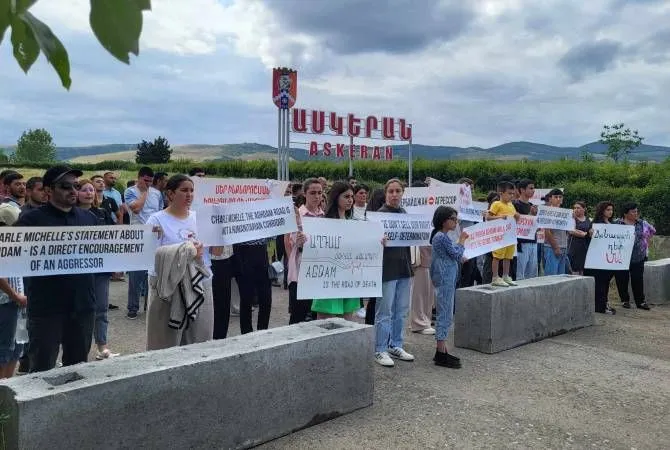
Recently, the sincerity of Armenia’s intent to promote peace came under scrutiny. Only days ago, international actors, including some members of the United Nations Security Council, actively attempted to mediate. Intensive consultations and shuttle diplomacy culminated in agreements on humanitarian cargo delivery routes to Karabakh and a scheduled meeting between the Special Representative of the Central Authorities and local Armenian representatives.
For the effective delivery of humanitarian aid, Armenia had agreed to clear physical barriers on the Aghdam-Khankendi road, enabling the International Committee of the Red Cross (ICRC) to assist local residents. This would then expand to broader usage of the Lachin road by ICRC within a day. All involved parties, including the Russian peacekeepers and the ICRC, were ready to enact this agreement immediately.
Furthermore, a significant meeting between central authorities and local Armenian residents was slated for the city of Yevlakh, Azerbaijan.
Unfortunately, on August 5, Armenia reneged on both accords, introducing unwarranted political demands. Despite Azerbaijan’s intensive engagement with the Russian Federation, the United States, the European Union, and ICRC, Armenia consistently hampered diplomatic progress. It’s becoming evident that Armenia, rather than seeking resolution, aims to escalate regional tensions to misguide global perceptions.
This August 5 breach isn’t an isolated incident; it follows Armenia’s history of politicizing the ICRC’s humanitarian role, using it as a facade to challenge Azerbaijan’s sovereignty and obstruct the reintegration of local ethnic Armenian residents. Their actions don’t just politicize humanitarian aid but betray the very essence of regional peace.
In the midst of the ongoing discourse, the words of local Karabakh activist Artur Osipyan resonate strongly. Speaking to Armenian channel 1in.am, he asserted, “Let’s not try to deceive the outside world and spread panic among the population by claiming that people are allegedly dying of starvation in Karabakh.” This statement, while standing in stark contradiction to Dr. Ewalina U. Ochab’s narrative in Forbes, reinforces the concerns Liddell raised a century ago about media susceptibility to propagated narratives. Osipyan’s testimony underscores the reality that, much like in Liddell’s era, modern Western media can be swayed by compelling, yet potentially misleading narratives rather than ground realities.
The Enduring Impact of Propaganda and the Quest for Peace
Analyzing the last century, one can trace persistent provocations and conflicts instigated by Armenian narratives. This consistent strand of Armenian propaganda, rooted in historical events, has over time found resonance in global media. The passive or active endorsement by international media, organizations, and politicians not only legitimizes these distortions but also complicates the quest for peace. The international acknowledgment of these narratives can inadvertently strengthen the position of Armenian propagandists. This not only muddles the quest for peace but also reshapes the geopolitical dynamics of the region.
Karabakh in International Law and the Road to Peace
The discourse is firmly anchored in international law, with both the law itself and the international community unequivocally recognizing Azerbaijan’s territorial integrity. Karabakh stands as an integral part of Azerbaijan. By analyzing the past, we better understand the present. As the style and tactics of narratives have evolved, the need to differentiate between truth and fiction becomes even more crucial, guiding us towards lasting peace.
Central to this ongoing conflict is the profound human cost, marked by tragic loss and immeasurable suffering. This weight, both historically and in present times, has been squarely shouldered due to Armenia’s actions and decisions. Every instance of bloodshed, every tear shed, and every life lost in both Azerbaijani and Armenian communities is a direct outcome of Armenian instigations and provocations. As we dissect and analyze these narratives, it becomes unequivocally clear that the sole responsibility for the devastation lies with Armenia, emphasizing the need for earnest introspection and a genuine quest for lasting peace.