By using this site, you agree to the Privacy Policy and Terms of Use.
Accept
Azemedia new logo
  • Home
  • Opinion
  • News
    • Economy
    • Energy
    • Climate and Ecology
  • Diaspora
  • Interview
  • Science
  • Logistics-Transport
  • History
  • Defense
Aze.MediaAze.Media
Font ResizerAa
Search
  • News
  • Economy
  • Climate and Ecology
  • Energy
  • Opinion
  • Culture
  • Gender
  • Interview
  • Science
  • Logistics-Transport
  • History
  • Defense
  • Karabakh
  • Diaspora
  • Who we are
Follow US
© 2021 Aze.Media – Daily Digest
Aze.Media > Culture > The mountain villages of Northern Azerbaijan, on the cusp of change
Culture

The mountain villages of Northern Azerbaijan, on the cusp of change

AzeMedia
By AzeMedia Published January 14, 2022 3.1k Views 15 Min Read
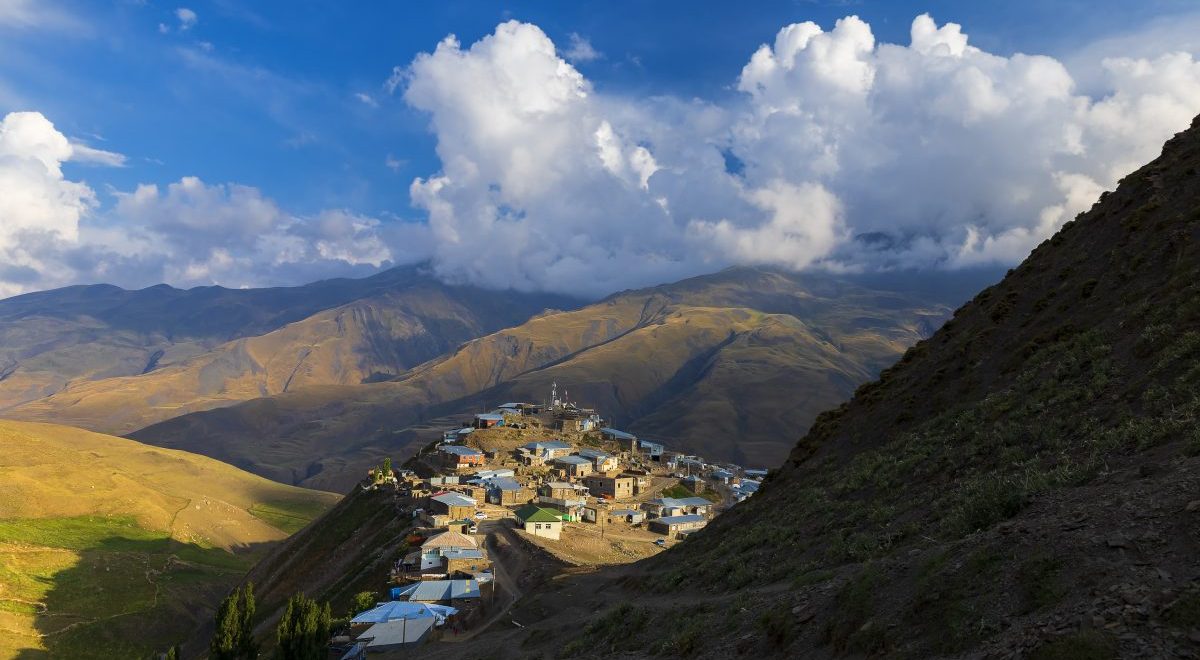
The alpine village of Khinalig at sunset against the backdrop of beautiful clouds
The alpine village of Khinalig at sunset against the backdrop of beautiful clouds. (iStock)

I was set on going, so I cast around for the sturdiest car at the taxi stand. I picked out a Russian-made Lada that looked like a winner, that is to say the only vehicle without a rat’s nest of exposed wiring spilling from the dash.

Eldar, the driver, didn’t appear fazed by my request, at least much less so than my bargaining him down from $40 to $30. He said he had done the hour’s drive to Khinalig many times — he had even helped build the school as a welder, back in 1995. The road was 25 years old by then, unpaved and often closed in winter. Only big trucks, such as the Soviet GAZ-66, could get through.

Northern Azerbaijan is a part of the world defined by isolation. The Caucasus Mountains are high and terrible, and they are full of caves for gnomic tribes and nomads to hide in. It was an unconquerable land and remains divided into pockets of separate and singular cultures. In an area roughly the size of West Virginia, there are some two dozen languages, most of them unique to villages that spent centuries isolated from the rest of the country and each other. Not only Khinalig but also the settlements of Buduq, Qriz, Cek, Tsakhur and Nij, to name but a few, speak their own language. The world, however, always finds a way in.

An impending visit from Azerbaijani President Ilham Aliyev in 2007 saw the road paved, and subsequent publicity has seen the town’s esteem grow. Nearby Shahdag Mountain Resort brings in skiers from around the world. Now UNESCO World Heritage status looms for Khinalig, and the Azerbaijani tourism sector is rapidly promoting it as one of the country’s many hidden gems. Some worry that the creeping modernism threatens the historical essence of these villages, that they were better off isolated at the end of an impassable road.

It was a fine, crisp day. Frost coated the ground, but there was the promise of sun. To the west, snow-covered Mount Shahdag was so sharp against the bluebird sky that it seemed drawn in needlepoint. It was still early, and roadside stalls were lighting fires for chai and kebabs. It was a day of promise. But once on the road, Eldar lost his cool. He leaned forward, squinting at the road and holding his elbows high. Whenever he saw something of note (which was often), he jabbed them into my ribs.
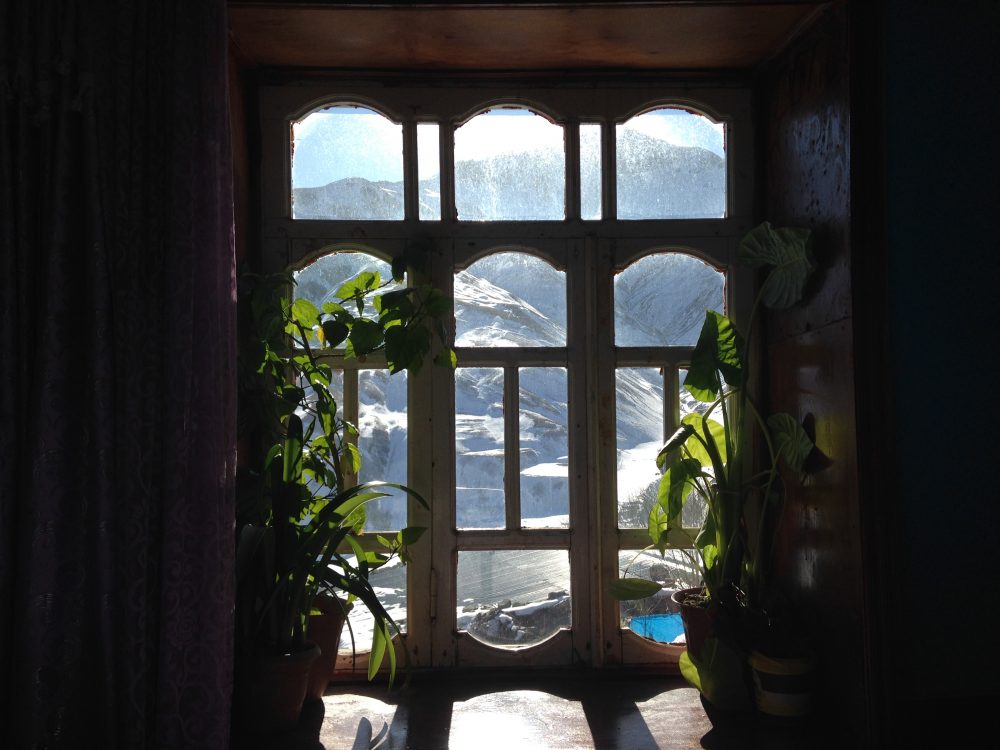
Sunlight streams into a Khinalig home, where green houseplants ease the long, white winters. (J.R. Patterson for The Washington Post)

Quba sits at about 2,000 feet above sea level, Khinalig at about 7,700. The ascent is long and winding. The minute it began, the sickly smell of gasoline fumes filled the Lada. I tried the electric window. Nothing. It was cold, around 32 degrees. I slid the heat on. Nothing. So much for picking a winner.

Snow began to pile on the road, and Eldar began to show signs of mental strain. Several times he stopped to query someone on the roadside. “Will this car make it to Khinalig?” He sounded frantic, which wasn’t helped by receiving a “no,” a “yes” and a shrug in quick succession.

Cut into the mountain side, the road was paved but single-track and rough with frozen snow and ice. A few hundred feet over the edge, the Qudyalcay river was a line of quicksilver smashing against its frozen self. We pressed on, Eldar gripping the wheel with white knuckles.

Whether the effect of a growing confidence or the seeping fumes, Eldar’s anxiety lessened with time. He soon roared us up blind hills, only to slam on the brakes as we crested. We skidded into patches of ice, and as the rear end swung out, I reached for the door handle, ready to leap for it. He was smitten with the views, sometimes swerving right into them. The steering wheel appeared to have little relationship with the tires; Eldar’s wild, high-elbow twisting had little effect on our course. Luckily, Ladas bounce, and we were kept aligned by the snow piled on the wayside by a crew of local men using shovels to clear the road.

We burned through the last of the clutch on the final ascent into Khinalig, where we traded its gun smoke stench, along with the gas fumes, for the acrid smell of burned straw. Khinalig remains a farming community, and manure is a precious resource. Pressed into bricks, it makes a cheap fuel.

On a Sunday morning, Khinalig was peaceful. The main town is built on a hilltop, the houses scrunched together. Ruddy women with trousers under their dresses clomped their way up and down the icy paths, hauling buckets and manure bricks. The sun was out, and children had rolled the sticky snow into large balls, each one peppered with mud and pebbles. All the sounds were of water: the tick-tack of melting snow hitting tin roofs, the popple of gravity-fed pipes pouring mountain water into troughs.
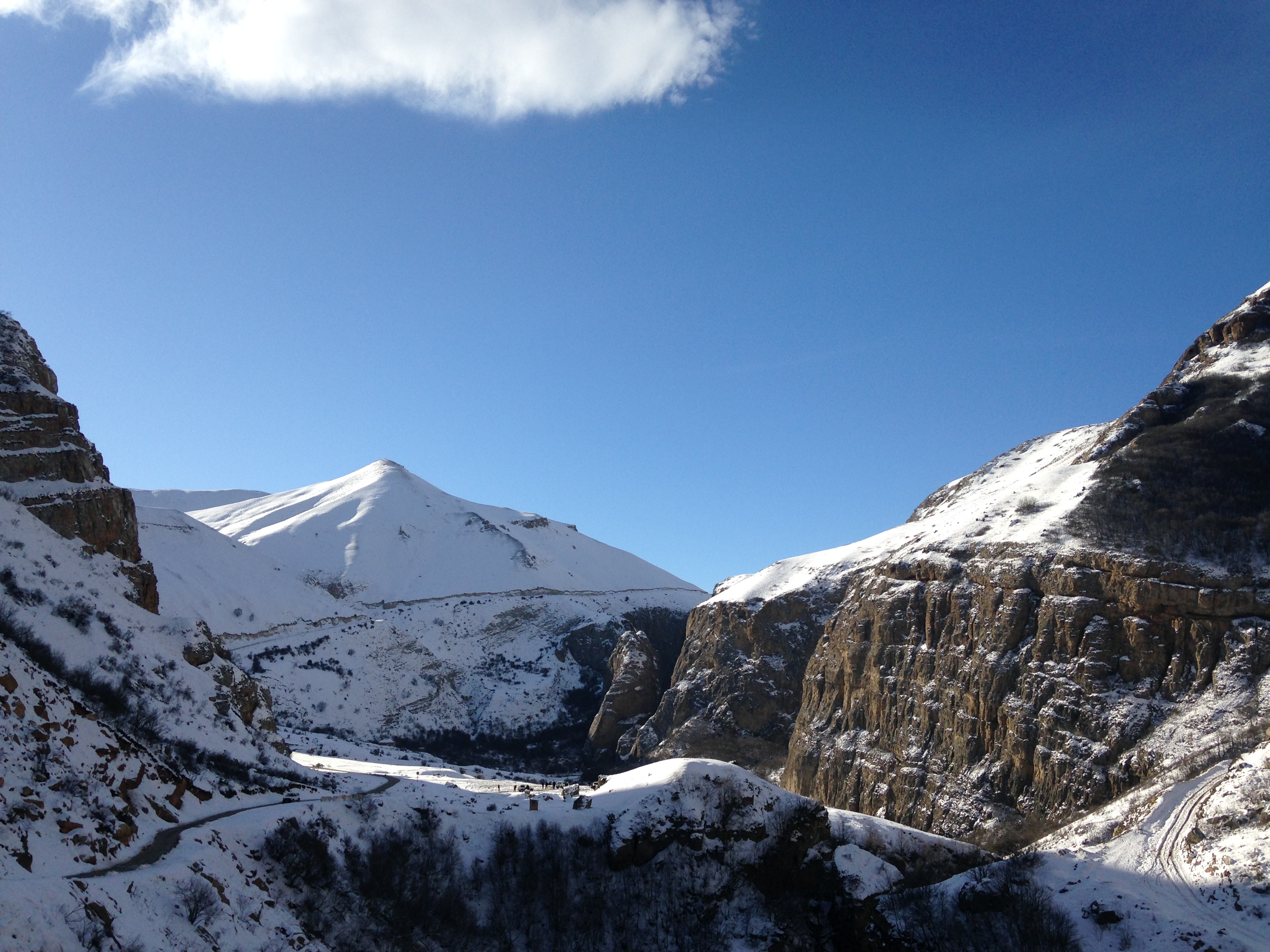
The spiked peak of Xınalıq Dağı overlooks Khinalig and the Gudyalchay river valley. (J.R. Patterson for The Washington Post)

The museum was locked, but the key holder was summoned. The display was a jumbled homage to Khinalig’s warrior-shepherd culture: dusty clay pots, carpet-weaving supplies, rusted scimitars and sheepskins. Painted onto the wall in Azeri were the words of Khinaligi poet Rahim Alxas:

In the spring,

my Khinalig, from frost to frost,

I will not change my village,

not for one hundred Parises, for one thousand Londons.

On our way out, we met a man in a rumpled suit carrying a cabbage the size of a bowling ball and a bag of apples. Rehman was in town for a few days, preparing to head back into the mountains with his sheep. He spoke a pragmatic English and was an enthusiastic greeter, taking my hand in both his large, warm paws. As we fell into step with him, he said, “There are 3,500 people in this area,” meaning the surrounding mountains, too. “Twenty-one hundred speak Khinalig. Not bad, not bad.” We passed the school, where classes are still taught in Khinalig. Four hundred children come to Khinalig to board, a significant number. Eldar mentioned his long-ago work welding there.

Rehman invited us for tea at his house, a two-story building on the southern edge of town. His compound was dominated by a large pile of wood, brought up from Quba for about $300 a load. He poked a few sticks into a dented silver samovar. While we waited for the water to boil, Rehman was eager for me to connect to his WiFi, a new addition to the house. He uses it to rent out his home, among other things. The village has had telephone and TV for some years now, contrary to what many people told me in the lowlands.

“The world comes here now,” Rehman said, adding that being a known part of the world isn’t a bad thing. Wanting to be “off the map” is usually a self-fulfilling destiny; rather than willing yourself back in time, you will yourself out of existence.

Like most born-and-bred country people, the Khinaligi aren’t afraid of change, it just takes longer to arrive that deep in the country. They’re eager for improvements, Rehman said. They long for them. Khinalig has survived for a long time on self-sufficiency. With no restaurants and just a few lightly stocked general stores, they have to. But the improved road means a less peripatetic life, with less time spent on the lower-altitude winter pastures. WiFi means connecting with children and relatives who have left to seek out other opportunities.

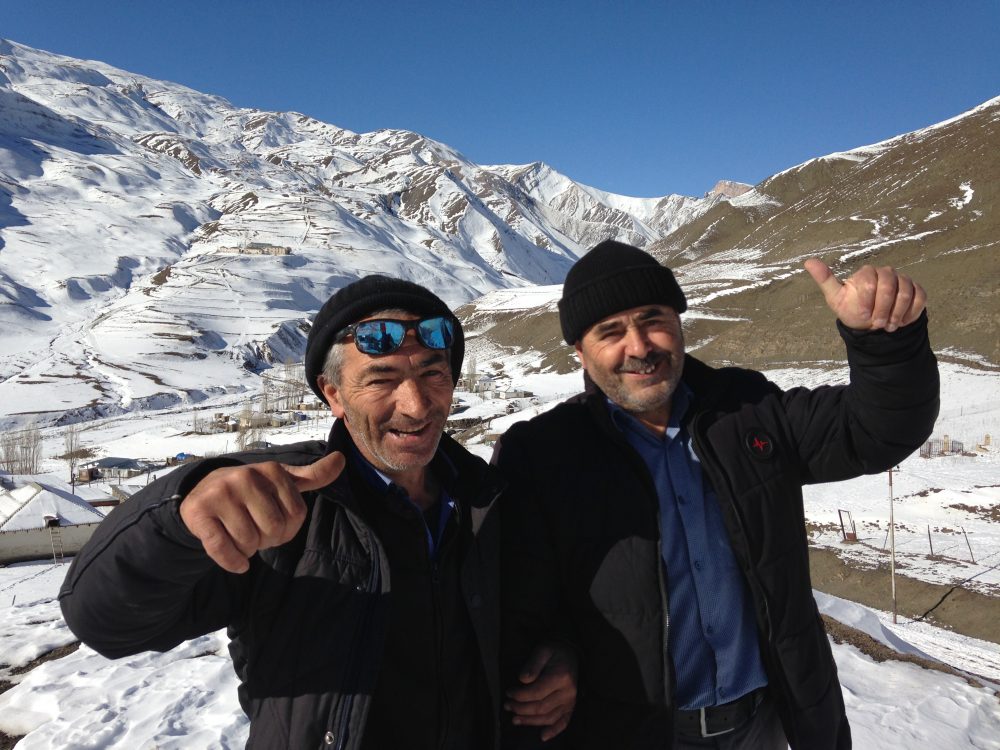
Local herder Rehman (R) and Eldar; Rehman is one of 2100 remaining speakers of the Khinaligi language. (J.R. Patterson for The Washington Post)

“People do leave,” Rehman said, and mentioned his son in Baku, Azerbaijan, studying at a university. I asked why he himself had stayed so long. “It’s my homeland, and that’s enough,” he said. He wanted to improve on what he had before he passed it on to the next generation. He served us tea made from mountain thyme, and we ate peanuts and quince jam at a table abutting his bed.

As in most ancient places, almost everything within sight carries some holy significance. There are ancient temples tucked away into the mountains — relics of when the region was full of fire-worshiping Zoroastrians. There’s a legend that the Khinaligi are the descendants of the biblical Noah. Rehman didn’t have a clue when I mentioned the flood, the ark or animals two by two. “Animals?” he said. “Oh, yes. In the mountains, there are bears and wolves, and at home, we have goats and dogs and cows …” The list went on. I looked up at the whiteness of the mountains. The wind was whipping a thin veil of mist off the peaks. I said a silent prayer: Please let me see this place again.

J.R. Pattersonis a writer based in Portugal. 

You Might Also Like

A Stained Glass Beyond Time: An enchanting evening in Baku’s artistic spiral

Azerbaijan’s capital welcomes the 3rd Contemporary Music Festival in May

CD presentation concert by pianist Humay Gasimzade in Baku

Italian Design Day сelebrated in Baku

Conductor Fuad Ibrahimov: The orchestra is the soul of music

AzeMedia January 14, 2022 January 14, 2022

New articles

69ca6321ec2b869ca6321ec2b9177487132969ca6321ec2b669ca6321ec2b7
Baku Initiative Group calls on UN member states to take practical steps on slavery resolution
News March 30, 2026
7YNXnb05zWpwunxmQWNmwxfqd6tq6osklTkNbHWo
Azerbaijan evacuated over 3,000 people from Iran to date
News March 30, 2026
Bildschirmfoto 2026 03 30 um 11.14.38
Turkey-Azerbaijan alliance strained by opposing stances on Israel
Opinion March 29, 2026
Screenshot
President Ilham Aliyev completely, directionally turned his country around – Steve Witkoff
News March 28, 2026
69c778d12350869c778d123509177468027369c778d12350669c778d123507
Azerbaijani oil price exceeds $124
News March 28, 2026
QJ9m9qaUTjKho4NQMQ4PTfRb7ykBAWVDMnL2UsSf
FAO offers Azerbaijan to develop five-year fisheries development plan
News March 28, 2026
577c9b7a tcxj78bkp11yulvvjs6gr
Türkiye and Azerbaijan sign media cooperation pact at STRATCOM summit
News March 28, 2026
Hebh8szaaaaquql
Hikmet Hajiyev attends meeting of assistants to heads of OTS
News March 27, 2026
1774618948147017258 1200x630
Foreign Ministers of Azerbaijan and Armenia hold telephone conversation
News March 27, 2026
17745979704581237642 1200x630
Another shipment of Russian humanitarian aid for Iran crosses the border
News March 27, 2026

You Might Also Like

Vitraj 1

A Stained Glass Beyond Time: An enchanting evening in Baku’s artistic spiral

May 30, 2025 3 Min Read
Img2024

Azerbaijan’s capital welcomes the 3rd Contemporary Music Festival in May

May 15, 2025 3 Min Read
489529771 590596890682428 4995546862340207728 n

CD presentation concert by pianist Humay Gasimzade in Baku

April 11, 2025 2 Min Read
Trend Adatedbir 120325 7

Italian Design Day сelebrated in Baku

March 13, 2025 4 Min Read
2025 02 07 67a5d20fa575e
20

Conductor Fuad Ibrahimov: The orchestra is the soul of music

February 7, 2025 20 Min Read
W 1617287412246413057836 1200x630

Islamic rchitectural Heritage Symposium concludes in Shusha

October 14, 2024 3 Min Read
Tagiyev 01

Taghiyev: The legend of oil in cinematic interpretation

October 9, 2024 7 Min Read
Mvi 9934.02 11 41 49.still058

Cinematographic and musical evening “All + about = Love” held at the Mugham Centre

October 2, 2024 5 Min Read

Useful links

426082d1 a9e4 4ac5 95d4 4e84024eb314 pojkz91103g6zqfh8kiacu662b2tn9znit7ssu9ekg
Ab65ed96 2f4a 4220 91ac f70a6daaf659 pojkz67iflcc0wjkp1aencvsa5gq06ogif9cd0dl34
96e40a2b 5fed 4332 83c6 60e4a89fd4d0 pojkz836t9ewo4gue23nscepgx7gfkvx6okbbkasqo
759bde00 a375 4fa1 bedc f8e9580ceeca pq8mvb9kwubqf6bcadpkq5mz16nayr162k3j2084cg
aze-media-logo-ag1

We are a unique political and socio-cultural digest offering exclusive materials, translations from Azerbaijani media, and reprints of articles from around the world about Azerbaijan.

  • Privacy Policy
  • Terms and Conditions
  • Cookies Policy

Email: editor@aze.media

© 2021 Aze.Media – Daily Digest
aze-media-logo1 aze-media-logo-ag1
Welcome Back!

Sign in to your account

Lost your password?