
According to one legend, coffee came from the humid foothills of Kaffa, Ethiopia. An Ethiopian shepherd allegedly saw goats become excited and even dance after eating coffee berries, tasted the mysterious berries himself, and thus coffee was discovered.
Of course, the reality was nothing like the legend, and anthropological research provides us with evidence that the Oromo tribe has been crushing coffee beans and mixing them with animal oil for thousands of years.
How did coffee “come down” from the mountains of North Africa to become the second most widely consumed beverage in the world after water?
In the 15th century, Arab slaveowners brought captives from the Oromo tribe from Ethiopia to the Yemeni port city of Mokha. Coffee beans joined the captives on that miserable journey, and thus coffee entered the history of the modern world. By the way, the famous “Caffè mocha” is named after this city. It was the people of the Shadhiliya Sufi order in Mokha who fell in love with coffee because of its invigorating effect and drank it during long meditations. According to Islamic historians, coffee took on its present form at that time, and that is how Arabica, the most popular coffee species in the world, appeared. Arabica is currently accounts for about 60% of global coffee production. The word “coffee” itself is derived from the Arabic word “qahwah”, which means “wine”.
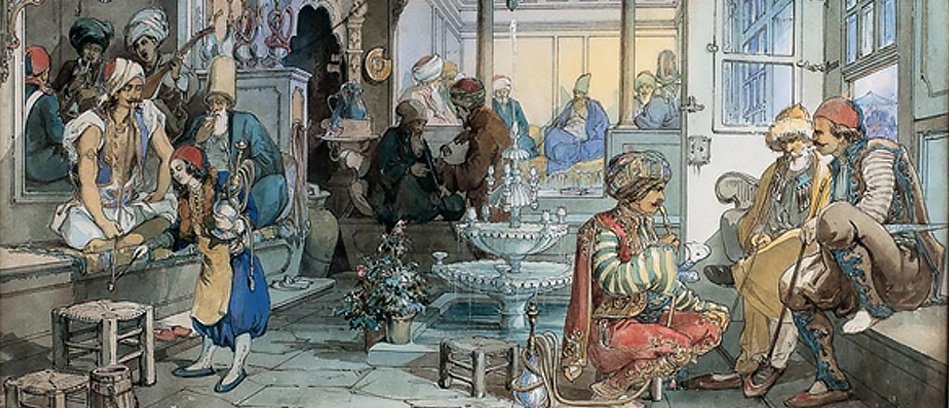
Little by little, coffee spread throughout the Middle East, the Islamic world, through trade caravans. The Ottoman Empire, the hegemonic state of the time, played an invaluable role in transforming the beverage of marginal religious orders, merchants and shepherds into a daily social drink. There were taverns and restaurants in Istanbul and Anatolia serving alcohol in violation of Islamic rules, but most people, the majority of whom were religious, gathered in places that were not haram—baths, markets and mosques. Since each of these places served a specific purpose, people could not freely discuss topics they wanted. Coffee houses pulled the Muslim community out of their homes, creating a perfect environment for pastime, even at night. As the population of the empire grew rapidly, thousands of people migrated from the rural provinces to big cities. Young migrants huddled in tiny rooms in those big cities and at night flocked to the centers of social life that were coffee houses.
But wealthy city folk were frequent customers of these establishments as well.
Wealthy and noble people received their guests mainly in the reception rooms of their homes and spent time with them there. However, in accordance with Islamic culture, most people did not allow outsiders into their homes, and coffee houses were the obvious choice for a meeting place for them.
It should also be noted that people who gathered in coffee houses were exclusively men. Women went to baths to socialize, so separate coffee establishments began to emerge in bathhouses. The famous Ottoman historian Ibrahim Peçevi writes: “Some people who liked to have fun, especially poets and writers, began to gather together and organize gatherings of twenty to thirty people. Some read books and beautiful writings, some played backgammon or chess. Sometimes they talked about new ghazals, poetry and literature.”
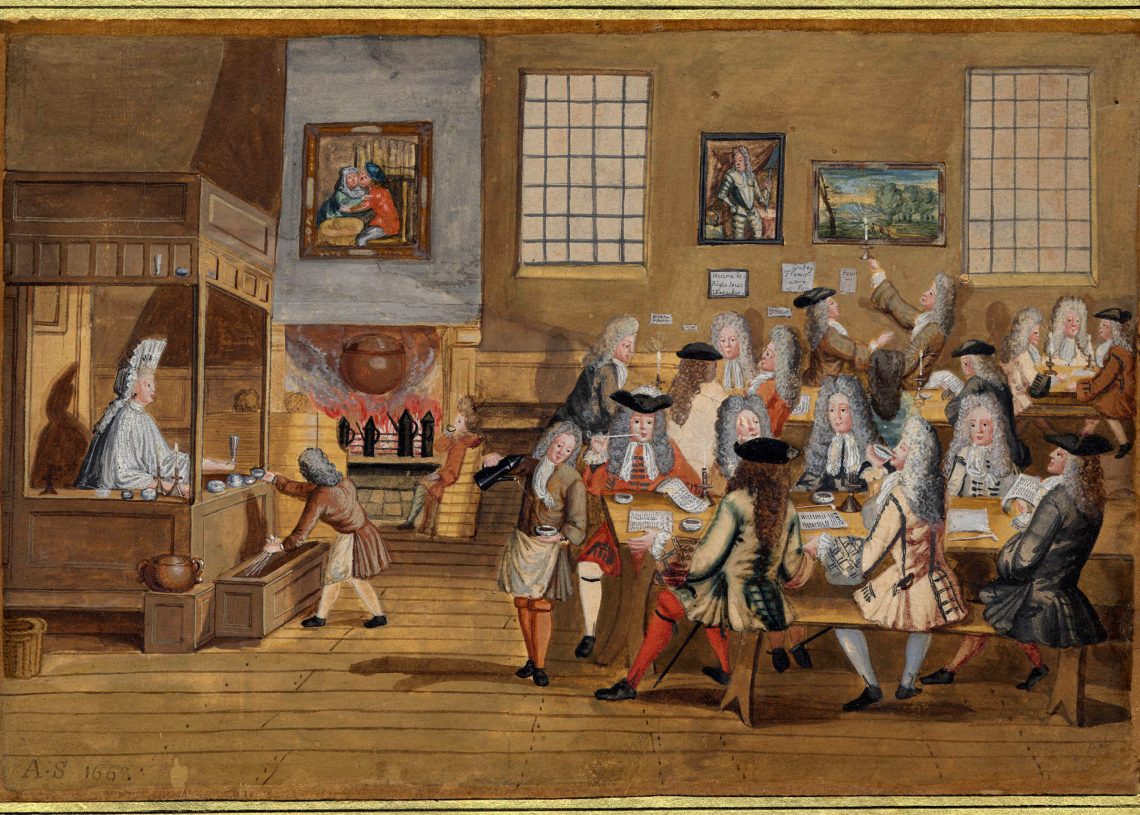
At a time when the Islamic world was living its golden age in coffee houses, the West was living the early years of the Renaissance and was still far removed from modern culture. In the 15th century, beverages such as coffee and tea had yet to reach the shores of Europe. The concept of sanitation at that time was barely existent: drinking water was so dangerous that beer was the main beverage in Europe. Until the end of the Middle Ages, England drank 350 liters of beer per capita, and Germany 400-600 liters—Europe lived in a constant state of semi-inebriation. However, in the early 17th century, Venetian, Dutch and Italian merchants introduced coffee to European culture. The first coffee house in Europe was opened in 1652 in London. At the beginning of the 18th century, the number of coffee houses exceeded 2,000. Penny universities, as they became known, as one penny was the going price of a cup of coffee, created a new environment for socialization in Europe. Progressive people of that time now preferred coffee houses to pubs, where patrons were usually drunk and armed and one could easily lose one’s life because of one’s language. Coffee houses played a major role in transforming Europe from an abode of darkness and stagnation to an enlightened and liberal society. Some of the major world-famous companies grew from small groups gathering in coffee houses into hegemonic organizations. The insurance titan Lloyd’s started out as a coffee house, as a place for information exchange, gathering of sailors and insurers. The East India Company, one of the most ultra-greedy organizations in world history, also owes its existence to a coffee house. Businessmen of that time gathered in coffee houses in central London to share news about the American colonies, monarchy and Parliament.
Of course, not everyone liked coffee houses, especially women. In 1674, a pamphlet was published, in which a group of London women came out against coffee. The Women’s Petition Against Coffee read: “…our men, who in former Ages were justly esteemed the Ablest Performers in Christendome. But to our unspeakable Grief, we find of late a very sensible Decay of that true Old English Vigor… Never did Men wear greater breeches, or carry less in them of any Mettle whatsoever… …we can Attribute to nothing more than the Excessive use of that Newfangled, Abominable, Heathenish Liquor called COFFEE, which Riffling Nature of her Choicest Treasures, and Drying up the Radical Moisture, has so Eunucht our Husbands, and Cripple our more kind Gallants, that they are become as Impotent as Age, and as unfruitful as those Desarts whence that unhappy Berry is said to be brought…”
By the end of the 18th century, coffee had already enchanted Europe, and Prussia, the superpower of the time, was no exception. Frederick the Great did his best to get rid of coffee. He signed a decree on the issuance of licenses for coffee production (roasting). At first glance, this ordinance, which is an example of commercial culture, did not in fact grant this right to anyone. Of course, those close to Frederick’s court were an exception. Friedrich said, “It is disgusting to notice the increase in the quantity of coffee used by my subjects, and the amount of money that goes out of the country as a consequence. Everybody is using coffee; this must be prevented. My people must drink beer. His Majesty was brought up on beer, and so were both his ancestors and officers. Many battles have been fought and won by soldiers nourished on beer, and the King does not believe that coffee-drinking soldiers can be relied upon to endure hardships in case of another war.”
Of course, this ban of Friedrich’s did not last long. Secret coffee houses and smuggling were even more thriving in Berlin and Brandenburg. After the death of Frederick the Great in 1786, the Prussian government buried the meaningless fight on coffee with the king who had started it. Vienna was turning into the next Coffee Hegemony. It was in this city that they first start adding milk and sugar to coffee. Thus, the most popular beverage of coffee lovers, “Kapuziner”—better known by its Italian name “cappuccino”—was born. Legend has it that the Viennese citizen Georg Franz Kolschitzky obtained a license to serve coffee in the city for his bravery in the defense of Vienna in 1683. The first coffee beans he acquired were from the supplies left behind by the Ottoman army.
In 1669, the Turkish ambassador Suleiman Aga brought coffee to the French court. A low-ranking bureaucrat sent by Mehmed IV as an insult, he impressed the French with his delicate oriental culture. Suleiman Aga is portrayed as a rich and charismatic Turkish prince in Molière’s famous five-act play Le Bourgeois gentilhomme. Thanks to him, this beverage with pungent aroma, made in an odd manner and served in special china cups, started a unique fashion among the political elite of Paris.
The famous Café de Procope, which opened its doors in Paris in 1686, became a place frequented by people who changed the history of the world—Jean-Jacques Russo, Voltaire, Benjamin Franklin, Thomas Jefferson to name a few. Danton, Marat and Robespierre laid the foundations of the French Revolution at the Café de Procope. Revolutionary journalist Camille Desmoulins, who encouraged people to attack the Bastille, delivered his impassioned speech standing on a table at the Café du Foy.
Coffee kindled the spirit of revolution in the people of France, inspired Voltaire to talk about human rights, and condemned thousands of Africans to death on coffee plantations.
Coffee enriched Europeans not only spiritually but also economically. Addicted to caffeine, Europeans wanted to free the coffee trade from the Ottoman monopoly.
In the middle of the 17th century, Dutch colonists exported coffee from India and began growing it on Sumatra and Java. The Dutch filled European markets with coffee from their new colonies and took slavery to a new level. The Dutch writer Multatuli wrote about the colonial abuse in his famous novel Max Havelaar published in 1860.
 The Dutch were not the only ones who wanted to make a fortune in the coffee trade. In 1720, French bureaucrat Gabriel de Clieu brought coffee to the Caribbean. Thus, the whole world was gripped by coffee fever. Writer William Walker said: “No matter where it appears, coffee has always evoked revolutionary feelings. This made people think that coffee was a drink of radicals. When people start thinking, they pose a threat to tyrants.“
The strangest thing is that coffee, the beverage that led Europeans to freedom and liberty, brought people in other parts of the world only suffering and shackles. Millions of indigenous peoples in Asia, America, and Africa were forced to work as slaves in order to produce this magical drink. About 60% of the coffee consumed worldwide in the 1780s was grown in the French colony of Saint-Domingue (now Haiti).
French writer and botanist Jacques-Henri Bernardin de Saint-Pierre wrote, “I know not whether coffee and sugar are necessary for Europe’s fortune, but I know for certain that these two plants have been disastrous for two parts of the world. America has been depopulated in order to make space for them to grow; Africa is being depopulated in order to get people to farm them.”
The French Revolution began in 1789 and excited and inflamed slaves in Saint-Domingue. In 1804, Haiti finally gained its independence.
However, the largest slave state in the Western world was Brazil, and it was one of the last countries to abolish slavery. In the first half of the 19th century alone, 1.5 million Africans were brought to Brazil to work in latifundia. Brazil brought coffee production to an unthinkable level, and it became the daily drink of the average person. In the 1920s, Brazil accounted for 80% of world coffee production and did not yield leadership to any other country for 150 years. Although coffee brought Brazil unprecedented wealth, it also took a heavy toll on its population and nature. However, other Central American countries, seeing the benefits coffee gave this country, repeated Brazil’s mistakes.
Before World War I, Belgian inventor George Washington began producing ground instant coffee, and in 1918 the U.S. military purchased all of Washington’s coffee and added it to the army rations. American generals believed that soldiers could fight better on caffeine. By the end of the war, the US military was producing 40 million cups of coffee a day.
However, in the 19th century, the “dark days” of coffee began, and a disease that spread in Sri Lanka struck almost all strains of Arabica produced in Asia, destroying entire plantations. At the same time, a new species of coffee, Robusta, was discovered in Central Africa. It was resistant to the disease and contained twice as much caffeine as Arabica. But Robusta had its own issue: it was very bitter even for lovers of strong coffee. In order to soften the bitter taste of Robusta, it was mixed with Arabica.
Finally, in 1938, Nestle began producing coffee under the brand name Nescafe and became famous almost overnight.
Aze.Media