In seeking to assess the operational success of the Russian peacekeeping contingent, this article takes Duane Bratt’s criteria and evaluates the Russian peacekeepers’ activities based on three of these: their fulfilment of the given mandate, ability to contain conflict and limit casualties, and contribution to facilitating the normalization process. On the one hand, this article argues that the mandate performance of the peacekeepers is unsuccessful owing to the numerous technical breaches and unilateral stretching of the agreement terms. On the other hand, despite noting moderate success in conflict containment, the findings reveal no reduction in casualty numbers after the peace- keeper deployment and highlights the limited steps taken by the peacekeepers to achieve the normalization process between Armenia and Azerbaijan. Note that this paper addresses only the first five months of the peacekeepers’ work.
Introduction
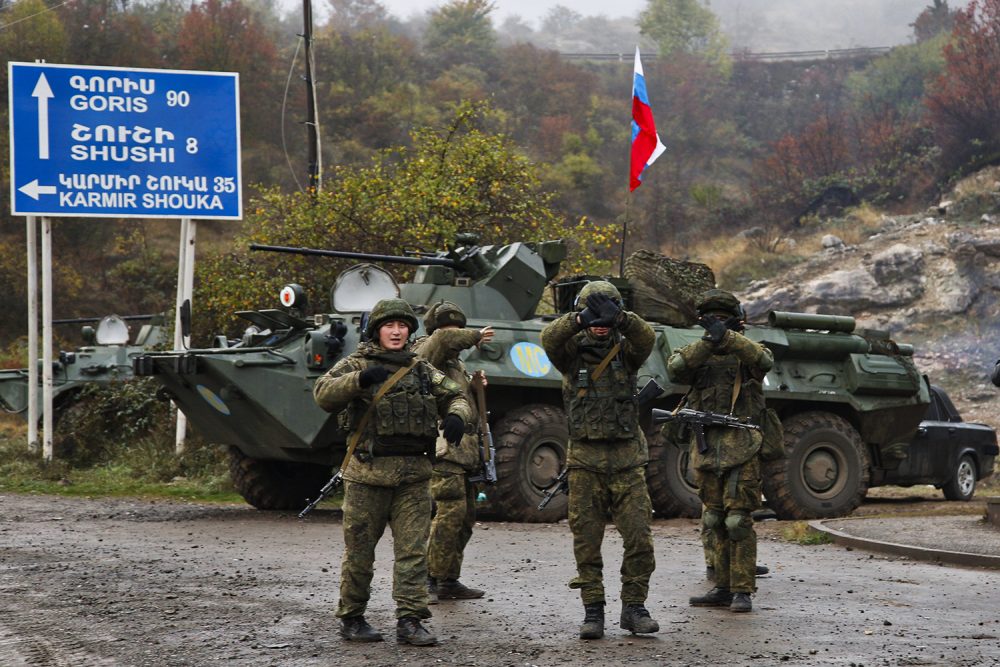
One of the realities brought by the end of the Second Karabakh War was the deployment of Russian peacekeepers to the mountainous part of Azerbaijan’s Karabakh region for an initial period of five years. The 10 November statement that brought an end to the 44-day war that took place in 2020 stipulated that 1,960 Russian peacekeepers will be temporarily positioned in the region (including in the Lachin corridor, a strip of land connecting Armenia to Khankendi) to guarantee stability. Since then, the Russian peacekeeping contingent, which consists of units of the 15th motorized Rifle Brigade of Central Military District, has set up 23 observation posts in their area of responsibility to monitor the situation and control the ceasefire. Furthermore, the statement also confirmed the provision of a new corridor linking Azerbaijan to its exclave Nakhchivan to be controlled by the Border Guards of the Russian Federal Security Service. As a result, observers have noted the increased Russian leverage in the region, thus triggering regional geopolitical discussions. Indeed, while the 10 November Statement was nothing but a great success for Azerbaijan, since the start of the activity of Russian peacekeepers, various reactions have been seen from local residents, government officials, media representatives, and other actors; some praising their work, while others have voiced their scepticism. These mixed opinions bring forward the questions: How do we judge the work of peacekeepers? Who decides the criteria? and When is the peacekeeping mission considered successful? These questions demand much-needed answers, as long-term regional stability hinges on the ability of the peacekeepers actually to enforce peace.
Against this backdrop, this article seeks to assess the operational success of the Russian peacekeepers in the mountainous part of Azerbaijan’s Karabakh region. The article takes Duane Bratt’s criteria as the point of reference and evaluates the peacekeepers’ activities based on their mandate performance: the ability to contain conflict, limit the number of casualties, and facilitate the normalization process. The findings vary regarding each criterion. It is argued that, while the breaches of both the technical details and the parameters of the mandate indicate the mission’s operational failure in terms of mandate performance and demonstrate how Russia stretches the agreement wherever it can, the overall peacekeeping effort for conflict containment seems moderately successful. Moreover, the article identifies little to no decline in the number of casualties since the deployment of the peacekeepers and notes very limited efforts to facilitate the normalization process between Armenia and Azerbaijan.
The article is organised as follows. It firstly reviews the literature to identify a framework for assessing peacekeeping success, and then examines three indicators vis-à-vis the case of Karabakh. It should be noted that the article conducts only a short-term assessment of the peacekeeping mission’s work and thus makes no attempt to analyse the peacekeepers’ activities in terms of transcendent values.
Criteria for assessing peacekeeping success
The difficulty of assessing the extent of a peacekeeping mission’s tangible contribution towards achieving peace is still a persistent problem in the literature. Peacekeeping operations mainly take place in highly complex environments where the actions taken might result in varied reactions. Hence, evaluation of the peacekeeping operation cannot be a solely empirical exercise but should rather be guided by an analytical and conceptual framework. Yet the challenges in developing such a framework are significant. They range from identifying the metric of effectiveness to variations between the short- and long-term evaluations or in the political and legal understanding of the concept of success or peace. Also, differences between the definitions of the success of peacekeeping operations by various actors and lack of global congruence add to these concerns.1 As a result, in the litany of peacekeeping studies, the judgement of the success of the performance of peacekeeping operations has not only been overlooked but also lacks a universally agreed methodology and conceptualization.
The so-called “second wave” of peacekeeping studies has made rigorous attempts to define and measure the effectiveness of peacekeeping missions. In 1988, Diehl published one of the first studies in this regard, identifying two main criteria for peacekeeping success: first, assessing if they limit the armed conflict and second, whether they promote conflict resolution.2 Brown, along the same lines, proposed that a peacekeeping mission should be judged by whether it fulfilled its actual mandate, reduced conflict, and contributed to peaceful conflict resolution, the latter two aligning with Diehl’s vision.3 Johansen, reviewing the work of Diehl, comes up with two more criteria that, according to him, should be taken into account: researchers should first “assess the effect of peacekeeping forces on local people affected by their work” and second “compare the degree of misunderstanding, tension, or violence that occurs in the presence of UN peacekeepers to the estimated results of balance-of-power activity without peacekeeping”.4 Thus, he emphasizes the need to take a broader perspective and assess how peacekeeping missions contribute to larger values such as peace, justice, or human rights, and proposes also considering “what if” counterfactuals: put simply, the conditions that would be present if the mission had not been deployed. On the other hand, Fetherston argues that there is a need for “peopling” our understanding while evaluating the peacekeeping missions, and he notes that the indicators developed to date sometimes fail to incorporate the societal view.5
Although the attempts described above all, arguably, have strong and weak points in their justifications for setting the criteria, recently scholars have claimed that creating a standard basis for evaluating peacekeeping mission might not, in reality, be a useful approach. Indeed, Diehl and Druckman note that different missions might necessitate, at least partly, varying factors for their evaluations depending on their goals.6 As an example, criteria for evaluating an emergency peacekeeping mission should have measures somewhat distinct from those for evaluating a monitoring or traditional peacekeeping mission, as they have varying end goals. Additionally, each peacekeeping mission is unique owing to the nature of the conflict, mandate type, geographical and political situation, impartiality, and consent of the parties involved; consequently, a one-size-fits-all approach cannot work for defining the criteria.
Nevertheless, Duane Bratt offers new insight and an interesting reference framework for assessing the success of the peacekeeping missions by combining the earlier efforts of Brown and Diehl.7 To this end, he focuses specifically on the operational success of the peacekeeping forces (in contrast to many authors who take a broader approach, identifying success at a strategic level) and argues that it can be assessed according to four criteria: mandate performance, facilitation of conflict resolution, conflict containment, and limitation of casualties. His criteria offer a more concise and operationalizable method for assessing the performance of a peacekeeping mission (particularly traditional peacekeeping) and puts forward an aggregated index of various combined indicators for determining the basis of the measurement of success. The rest of this article therefore takes Bratt’s approach as the basis for guiding its analysis.
Analysis of mandate performance
The first criterion for assessing the performance of peacekeepers is the alignment of the activities carried out with the mandate they were given. The assessment here will be a straightforward cross-checking of whether the benchmarks and specific tasks reflected in the mandate were achieved and, if so, to what extent. Yet, as Diehl and Druckman correctly note, because the mandates are mainly products of “political deliberation” and, to some extent, compromise, they are, in most cases, vague.8 Such vagueness in itself creates an operational difficulty for assessing the scope of the mission and identifying the discrepancy between the prerogatives of the mandate and the actions taken on the ground.
Referring to the case of Karabakh, the precise details of the mandate of the Russian peacekeeping forces are seemingly vague. Notably, in a press conference, Sergei Lavrov said that “The issue concerning the peacekeepers’ mandate is in the process of being settled.”9 Yet, interestingly enough, although a document regulating the work and activities of Russian peacekeepers was signed by Sergei Shoigu and Vagharsak Harutinian, nothing similar has taken place with Baku, which has led to rising concerns about Russian peacekeeping activities.10 Indeed, the only document publicly available detailing the parameters of the peacekeeper’s activities is the 10 November trilateral statement. The third and fourth points of that document clearly set out the technical details relating to the peacekeeping forces:
- “Along the contact line in Nagorno-Karabakh and along the Lachin corri- dor, a peacekeeping contingent of the Russian Federation shall be deployed in the amount of 1,960 military personnel with small arms, 90 armored personnel carriers, and 380 units of an automobile and special equipment”.
- “The peacekeeping contingent of the Russian Federation shall be de- ployed in parallel with the Armenian armed forces’ withdrawal. The pe- riod of stay of the Russian Federation’s peacekeeping contingent is five years and shall be automatically extended by a further five-year period if none of the Parties declares six months prior to the expiration of the period of its intention to terminate the application of this provision”.11
Starting the assessment with the technical elements of the mandate, it can be seen that the deal is rather specific about the number and type of military equipment that the contingent can use. Yet, the realities on the ground are different. Firstly, while the agreement does not mention the use of helicopters anywhere, two days after the deal the Russian MoD announced the deployment of eight Mi-8 and Mi-24 helicopters to the airfield in Yerevan and stated that these helicopters will be involved in monitoring the peacekeeping operation.12 Furthermore, the peacekeepers also received Orlan-10 UAVs, again not specifically mentioned in the agreement.13 Secondly, shortly after the signing of the declaration, Sergey Shoigu stated that, after 250 flights, the deployment of the peacekeeping contingent is complete, with 1,960 personnel and 552 pieces of equipment in place, which brings forward the question of the excessive quantity of military equipment compared with that allowed. Moreover, as Rácz14 correctly notes, although the document specifies that the peacekeepers shall carry small arms (in Russian, Стрелковое оружие), photographs published by the Russian MoD clearly show personnel using BTR-80 and -82 personnel carriers with turret- mounted 14.55 mm heavy machine guns, which can be categorized as light weapons rather than small arms, thus indicating another breach of the mandate parameters. These clear mandate breaches all demonstrate Russia’s methods of stretching the agreement wherever it can.
On the other hand, looking at the fourth point of which states that the deployment of Russian peacekeeping forces shall take place concurrently with the withdrawal of Armenian forces, another obvious and substantial mandate breach can be observed. What is notable is that not only are Armenian forces still in the region, but also the incentive of the Russian peacekeepers to enforce their exit is highly questionable, considering the fact that the same peacekeepers have several times met with the representatives of the separatist forces.15 This brings into question the impartiality and neutrality of the peacekeepers (which is one of the crucial factors in any peacekeeping mission), infringes the agreement terms, and threatens the prospects of achieving a positive and lasting peace in the region.
Yet another interesting point is that the actual activities that the peacekeepers are undertaking are much broader and more varied than might be expected from reading the initial agreement and mandate specification. Whereas the mandate notes that 1,960 peacekeepers shall undertake the mission, the media statements published by the Russian MoD have led to growing speculation about whether the peacekeepers are the only Russian forces “operating” in the region. Indeed, shortly after the announcement of the end of the war, Russian President Vladimir Putin signed an order to create the Inter-Departmental Humanitarian Response Center; it is notable that the centre’s personnel will be representatives of the Ministry of Civil Defense, Emergencies and Elimination of Consequences of Natural Disasters; the Foreign Ministry of the Russian Federation; the Federal Security Service; and other interested federal bodies.16 It was stated that this centre will support the return of refugees and cooperate with government bodies of both Azerbaijan and Armenia to restore civilian infrastructure and help facilitate a return to normal life.17 Moreover, Sergei Shoigu announced a few days later that, as part of the Inter-Departmental Humanitarian Response Center, five additional centres have been formed, including centres for humanitarian demining, reconciliation of opposing sides, transport support, medical support, and trade and household support.18 Besides the fact that the numbers of personnel involved are not disclosed to the public, which has created valid concerns about whether they are included in the peacekeeping mission or not, Moscow’s unilateral decisions to set up centres and create roles speaks of its disregard for the mandate and its limits.
Furthermore, in his 20 November speech, Putin specified that the peacekeepers would assist the safe return of refugees, restore infrastructure, and protect religious sites, none of which is mentioned in the agreed mandate.19 In contrast, the seventh point of the 10 November agreement clearly states that “The internally displaced persons and refugees shall return to Nagorno-Karabakh and the adjacent regions under the supervision of the UN High Commissioner for Refugees.”20 Hence, although the need for humanitarian assistance and normalization of life in the region should not be downplayed, the activities that Russian peacekeepers are undertaking exceeds the mandate given by the trilateral declaration and has triggered valid scepticism about their actual goals and ambitions. Notably, efforts to enforce the Russian language in the area feed into these concerns.21
In sum, analysing both the technical elements and operational activities of the Russian peacekeepers vis-à-vis the mandate that they were given, one can note clear and, in some cases, grave breaches, which leads to the conclusion that the mandate performance of the peacekeepers is unsuccessful.
Conflict containment and limitation of casualties
Referring back to Duane Bratt’s indicator, it is also necessary to examine the operational success of peacekeeping work by identifying its contribution to the containment of the conflict and limitation of casualties. To be precise, conflict containment here denotes the idea that the mission prevents any major fighting from occurring and tensions from escalating. Limitation of casualties (both civilian and military) is, meanwhile, assessed by comparing the number of casualties (whether from landmines or military action) before and after the deployment of peacekeepers.
Firstly addressing conflict containment, it might be argued that, overall, there have not been many major incidents since the end of the war, except for the fighting in the villages of Chaylaggala and Taghlar that broke out on 11 December and marked the first major breach of the ceasefire. As a result of this incident, one Azerbaijani soldier was killed and Russian peacekeepers entered the area, although it had not been part of their zone of responsibility. The incident was also followed by a controversial and unilateral map changing attempt by the Russian peacekeepers that was frowned upon by Azerbaijan.22 However, considering the relative stability since, it can be said that, except for the Chaylaggala and Taghlar event, until now the conflict containment efforts have been relatively successful.
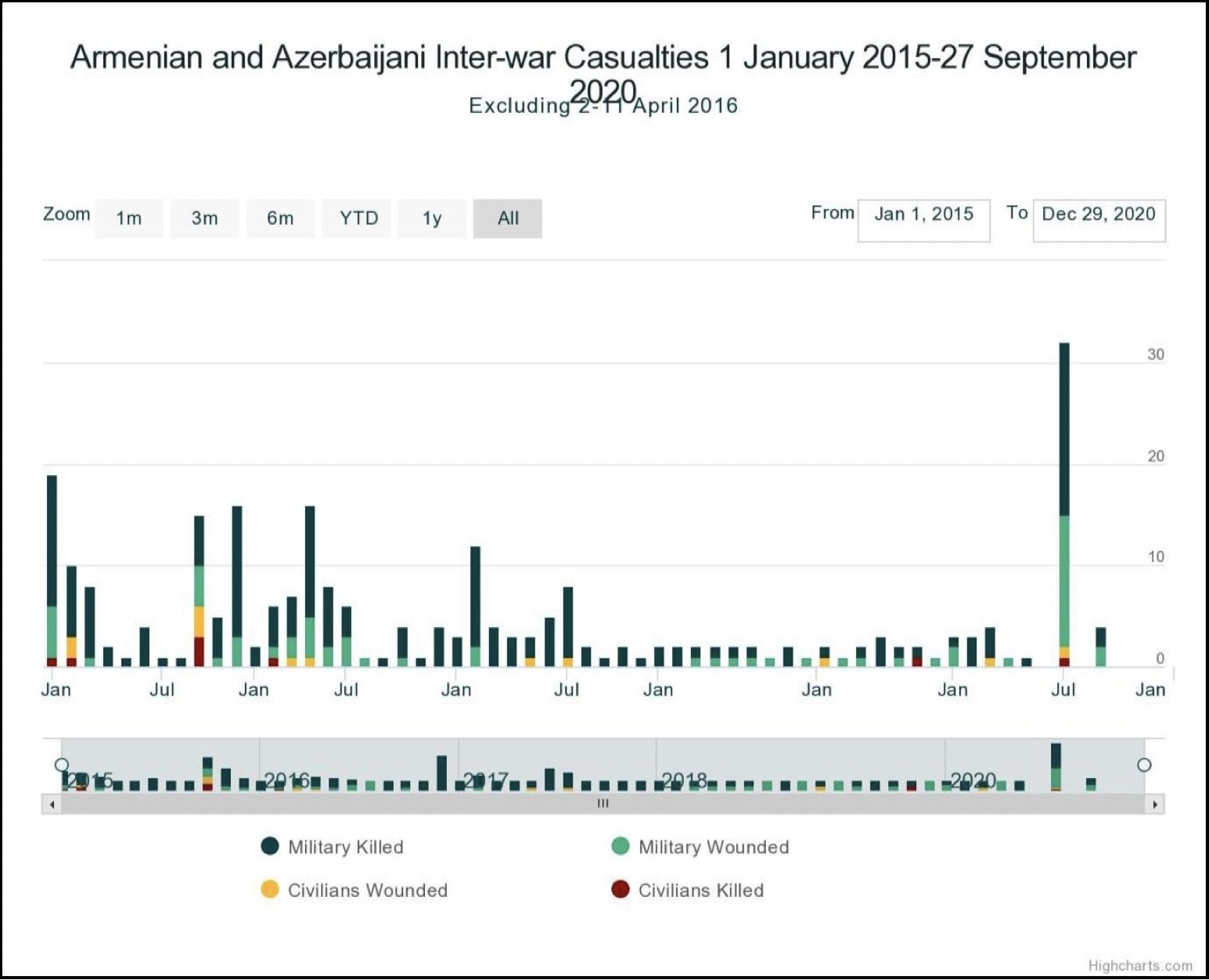
Nevertheless, evaluating the operational success vis-à-vis the reduction of casualties, the results are unsatisfactory. Indeed, before analysing this, it should be noted that comparing casualties before and after the 10 November statement might be difficult in a short-term analysis considering the fact that, at the time of writing, the peacekeepers have been operating in the region for only five months. Nevertheless, a crude attempt can be made. Crisis Group23 visual data (see Figure 1) illustrate the number of military and civilian casualties during the interwar period from 1 January 2015 until the outbreak of the Second Karabakh War, with the exclusion of the 2016 April War period. In general, the data collected through the reports of the Azerbaijani and Armenian defence ministries indicate that, overall, during this 5-year period, 180 military personnel and 10 civilians were killed, and 58 service people and 12 civilians wounded.
Looking at the reports of the ministries of defence of Azerbaijan and Armenia to identify the number of military and civilian deaths after the signing of the trilateral statement, the data reveal the following. In November, one Azerbaijani serviceman was killed near Sur village. In December, several incidents took place and, in total, three Azerbaijani soldiers24 and, after their attack on Aghdam village of Khojavend district, six Armenians were killed.25 Also, on 18 December, a serviceman of the peacekeeping contingent died while demining a road near the town of Shusha,26 and another peacekeeper was seriously wounded in a mine explosion on 24 November.27 Landmine-related casualties have been more alarming.
Since the end of the war, Azerbaijan has confirmed the deaths of 14 civilians and 5 military servicemen because of the explosion of landmines. In total, 85 citizens have been seriously wounded, including 16 civilians.28 One Armenian civilian has also died because of a mine explosion.29 Thus, in total, during the first five months of the peacekeeping operation there have been 15 military and 15 civilian deaths. This becomes interesting when one compares it with any consecutive five months in the past five-year period, as even in the tensest periods the overall numbers of deaths have been about equal to, if not significantly fewer than, 30 people. However, it should be noted that, to argue conclusively, a more long-term assessment is needed as in the initial months of a post-war phase periodic flare-ups are common, and the continuing demining process has also contributed to these numbers. Nevertheless, from a purely operational perspective, these figures bring into question the peacekeepers’ ability to prevent deaths.
Facilitating the normalization process
The final indicator for evaluating the effectiveness of the peacekeeping mission is whether, or to what extent, the peacekeepers have been able to facilitate the normalization process and have created a stable environment that is capable of preventing any incidents when the peacekeepers leave. Although, as Duane Bratt (1996) mentions, this may or may not be explicitly mentioned in the mandate of the peacekeepers, ensuring the resolution of the intrinsic causes of the conflict is inherent to the goals of any such mission. Indeed, despite the fact that peacekeepers generally do not engage in diplomatic initiatives, they are sent to create conditions conducive for the parties to resolve their differences, initiate dialogue, and prevent any rise in tension. Yet, normalization is a difficult and complex process rather than a single event, which makes its assessment complex, particularly in the short term.
Hence, referring back to the Karabakh case, Russian peacekeepers have arguably done some work to reinforce a favourable environment for stability. As noted above, the peacekeepers have been facilitating the return of the Armenians to the region, and a more or less relevant office, the Center for Reconciliation of Opposing Sides, which operates within the Inter-Departmental Humanitarian Center, has seemingly been collecting information about missing bodies.30 A special unit of the peacekeeping contingent has been assisting Armenian pilgrims to visit the Xudaveng (Dadivank) and Amaras monasteries,31 and they have been helping to demine the roads and areas near other infrastructure.32 Nevertheless, their activities at this point still fall short, as there is a long way to go to ensure security in the area, particularly because of the landmines. Indeed, when Maria Zakharova, a spokesperson for the Russian Ministry of Foreign Affairs, was asked about the high number of mine casualties in the Karabakh region and the need to facilitate the retrieval of the mine maps from Armenia, she clearly stated that this is the task of the peacekeepers and officers of the Russian Emergencies Ministry.33 Yet, the peacekeepers seem to have done almost nothing to facilitate the dialogue for obtaining the mine maps, and such inaction has been feeding into the growing number of casualties, which brings into question their performance effectiveness.
Conclusion
In all, in the next five years, the activities of the Russian peacekeepers will play a huge role in the formation of peace in the region. Hence, assessing their performance periodically will be an important task to ensure that their activities are impact-oriented, that previous mistakes are not repeated, and to ascertain their contribution to the overall security situation. Nevertheless, it should be acknowledged that evaluation of the peacekeepers’ activities faces definitional, practical, and methodological challenges and, although a single determination of success or the failure of the peacekeeping operation is desired, the complex nature of the work on the ground necessitates a multifaceted assessment.
In the first five months of their deployment, the results of the work of Russian peacekeepers in the mountainous part of Azerbaijan’s Karabakh region differ across different criteria. On the one hand, the peacekeepers’ defiance of the mandate specification and benchmarks, and unilateral decisions to set up centres or take on additional tasks not specified in the trilateral statement, all lead to the conclusion that, vis-à-vis the mandate, their operational performance is unsuccessful. On the other hand, despite an incident near Chaylaggala and Taghlar, the relative stability continuing to this day marks a success in conflict containment. However, the data show no positive trend in the reduction of casualties since the deployment of the peacekeepers, and the limited efforts to create an environment for the normalization process create doubts about the effectiveness of their work. Yet the task does not end here. There is significant potential for further research and a need for conducting a long-term performance analysis of the Russian peacekeepers and identifying their contribution towards the reintegration and reconciliation processes.
- Winslow, “Strange bedfellows: NGOs and the military in humanitarian crises.” International Journal of Peace Studies, 2002, p.35-55.
- F. Diehl, International Peacekeeping (London: Johns Hopkins University Press, 1993).
- Browne, A. “United Nations peacekeeping: Historical overview and current issues”, Congressional Research Service, Library of Congress, 1990.
- Johansen, R. C. “UN peacekeeping: How should we measure success?”, Mershon International Studies Review, 38, No. 2, October, 1994, p.309.
- As cited in Druckman, , and Stern. C. P. “Evaluating peacekeeping missions”, Mershon International Studies Review, Vol. 41 No.1, 1997, p.153.
- Diehl, F and Druckman, D. “Evaluating Peace Operations”. In Joachim, A.K, Thierry. T, Norrie. M. and Paul, D.W (eds), The Oxford Handbook of United Nations Peacekeeping Operations (Oxford: Oxford University Press, 2015)
- Bratt, D. “Assessing the success of UN peacekeeping operations”, International Peacekeeping 3:4, 1996, p.64-81.
- Diehl, F and Druckman, D. “Evaluating Peace Operations”, op.cit., p.8.
- The ministry of Foreign Affairs of Russian Federation, Foreign Minister Sergey Lavrov’s remarks and answers to media questions at a news conference on the results of Russian diplomacy in 2020, January 18, 2021, available at: https://www.mid.ru/en/foreign_policy/news/-/asset_publisher/cKNonkJE02Bw/content/id/4527635 (accessed: April 3, 2021)
- Tass, Defense Ministers of Armenia and Russia sign documents on peacekeepers in Karabakh, November 21, 2020, available at: https://tass.com/world/1226353 (accessed: March 30, 2021)
- President.az, Ilham Aliyev addressed the nation, November 10, 2020, Available at: https://en.president.az/ articles/45924; In fact, website of Russian MFA mentioned “light weapons” instead of “small weapons”, See: https://www.mid.ru/en/foreign_policy/international_safety/regprla/-/asset_publisher/YCxLFJnKuD1W/content/ id/4419267 (accessed: March 28, 2021)
- Tass, Russian helicopters to be involved in peacekeeping operation in Nagorno Karabakh, November 12, 2020, available at: https://tass.com/defense/1222823 (accessed: March 29, 2021); Malyasov, , “Russia deploys attack helicopters to Nagorno Karabakh conflict zone”, Defence Blog, November 12, 2020, available at: https://defence-blog. com/news/russia-deploys-attack-helicopters-to-nagorno-karabakh-conflict-zone.html (accessed: March 31, 2021)
- Tass, Russian peacekeepers use latest drones, video conferencing systems in Karabakh, December 2, 2020, available at: https://tass.com/world/1230533 (accessed: April 4, 2021)
- Rácz, A., “In Russia’s Hands: Nagorno-Karabakh after the ceasefire agreement”, European Union Institute for Security Studies, Brief 8, April 2021, 1-8
- Armenpress, ‘President of Artsakh’ holds meeting with Russian peacekeeping mission chief, November 14, 2020, available at: https://armenpress.am/eng/news/1034869/ (accessed: April 2, 2021.
- Tass, Putin signs order to create humanitarian response center for Nagorno-Karabakh, November 13, 2020, available at: https://tass.com/politics/1223523 (accessed: March 23, 2021)
- President of Russia, Meeting on resolving humanitarian issues in Nagorno Karabakh, November 13, 2020, available at: http://en.kremlin.ru/events/president/news/64409 (accessed: April 3, 2021)
- Ministry of Defense of the Russian Federation, Five additional centers have been formed as part of the interdepartmental center for humanitarian response in Nagorno Karabakh, November 19, 2020, available at: http://eng.mil.ru/en/russian_peacekeeping_forces/news/more.htm?id=12325619 (accessed: March 24, 2021)
- President of Russia, Meeting on resolving humanitarian issues in Nagorno Karabakh, cit.
The Ministry of Foreign Affairs of the Russian Federation, Statement by the President of the Republic of Azerbaijan, the Prime Minister of the Republic of Armenia and the President of the Russian Federation, op.cit.
- Radio Free Europe, Russian Language To Get Official Status In Nagorno-Karabakh, March 25, 2021, available at: https://www.rferl.org/a/russian-language-official-status-nagorno-karabakh/31169752.html (accessed April 22, 2021)
- OC-Media, Russian peacekeepers extend control following skirmish near Hadrut, December 14, 2020, available at: https://oc-media.org/russian-peacekeepers-extend-control-following-skirmish-near-hadrut/ (accessed: April 20, 2021)
- International Crisis Group, “The Nagorno Karabakh Conflict: A Visual Explainer”, Report, available at: https:// crisisgroup.org/content/nagorno-karabakh-conflict-visual-explainer#3, (accessed March 20, 2021)
- Ismayilova, V., “Azerbaijani soldier killed in Armenian sabotage attack in Karabakh”, Azernews, December 28, 2020, available at: https://www.azernews.az/karabakh/174418.html (accessed: April 3, 2021)
- Aljazeera, Nagorno-Karabakh: Azerbaijan says one dead in Armenian attack, December 28, 2020, available at: https://www.aljazeera.com/news/2020/12/28/nagorno-karabakh-azerbaijan-says-one-dead-in-armenian-attack (accessed: March 24, 2021)
- Radio Free Europe, Russian Serviceman killed clearing mines in Nagorno Karabakh, December 18, 2020, available at: https://www.rferl.org/a/russian-serviceman-killed-clearing-mines-in-nagorno-karabakh/31008220. html (accessed: March 24, 2021)
The Moscow Times, Russian Peacekeeper wounded in deadly Nagorno Karabakh Mine Blast, November 24, 2020, available at: https://www.themoscowtimes.com/2020/11/24/russian-peacekeeper-wounded-in-deadly-nagorno-karabakh-mine-blast-a72127 (accessed: March 22, 2021)
- Republic of Azerbaijan Ministry of Foreign Affairs, No:121/21, Statement by the Ministry of Foreign Affairs of the Republic of Azerbaijan on the 4th of April – International Mine Awareness Day, April 4,2021, available at: https://mfa.gov.az/en/news/7277/view (accessed April 5, 2021)
- Caucasian Knot, Nagorno Karabakh resident killed after mine explosion, January 13, 2021, available at: https:// eng.kavkaz-uzel.eu/articles/53369/ (accessed April 7, 2021)
- Ministry of Defense of the Russian Federation, Bulletin of Ministry of Defense of the Russian Federation on the activities of the Russian contingent of peacekeeping forces in the Nagorno-Karabakh conflict zone, January 11, 2021, available at: http://eng.mil.ru/en/russian_peacekeeping_forces/bulletins/more.htm?id=12334121 (accessed April 5, 2021)
- Ministry of Defense of the Russian Federation, Armenian pilgrims accompanied by Russian peacekeepers visited the Christian monastery Dadivank and Amaras, available at: http://eng.mil.ru/en/russian_peacekeeping_forces/ news/more.htm?id=12350121 (accessed April 7, 2021)
- Ministry of Defense of the Russian Federation, More than 1700 hectares of territory cleared of explosive devices by Russian sappers in Nagorno Karabakh, March 23, 2021, available at: http://eng.mil.ru/en/russian_ peacekeeping_forces/news/more.htm?id=12350326 (accessed April 24, 2021)
- The Ministry of Foreign Affairs of the Russian Federation, Briefing by Foreign Ministry Spokeswoman Maria Zakharova, Moscow, March 4, 2021, available at: https://www.mid.ru/en/foreign_policy/news/-/asset_publisher/ cKNonkJE02Bw/content/id/4606704#26 (accessed April 5, 2021).
Arzu Abbasova, Dual Master’s Degree Candidate in International Security and International Relations at Sciences Po Paris and the London School of Economics.
Caucasus Strategic Perspectives / AirCenter