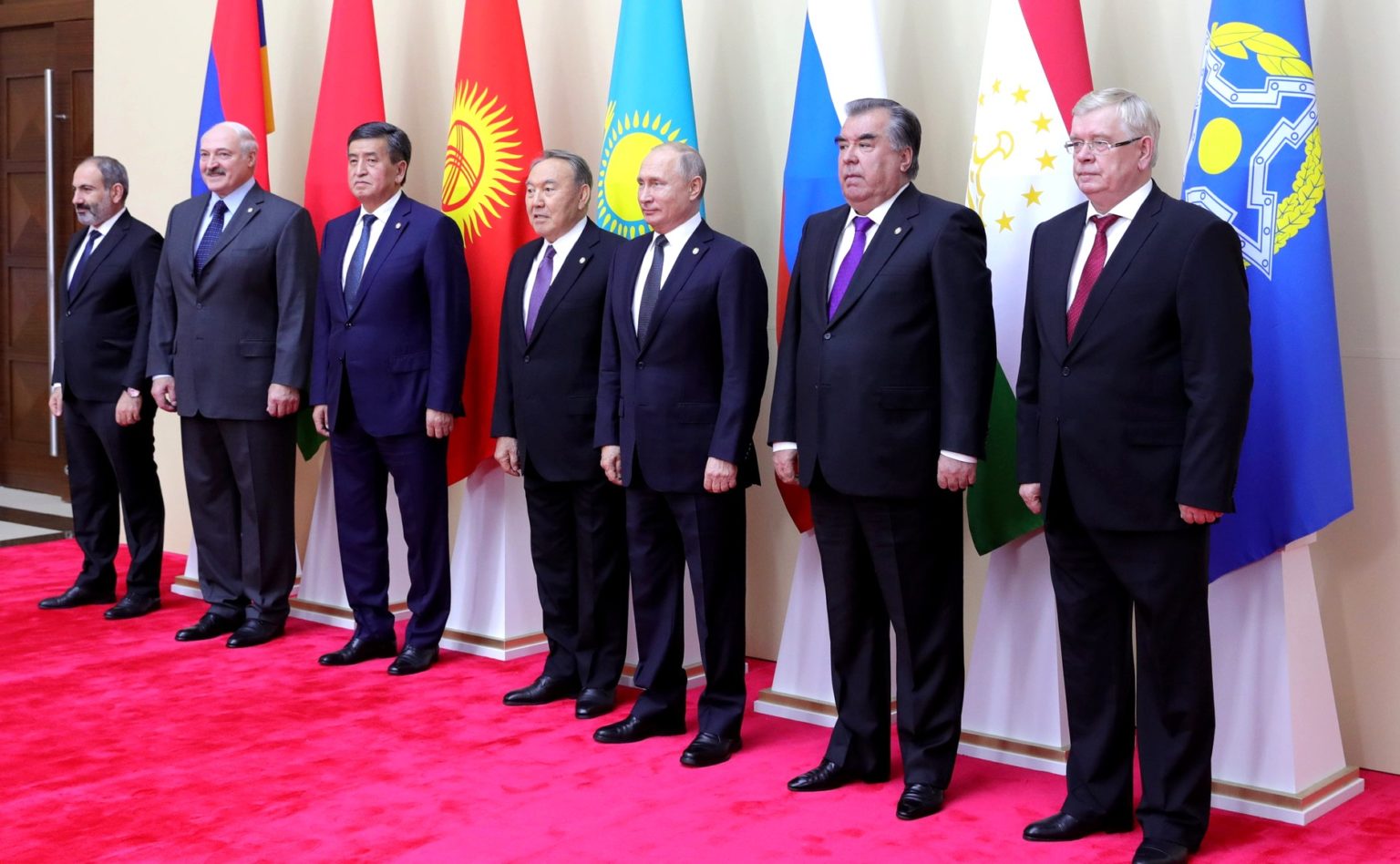
During the latest session of the Council of the Parliamentary Assembly of the Collective Security Treaty Organization (CSTO), on July 1, in Dushanbe, Tajikistan, the participants effectively introduced the category of a CSTO “partner state” by setting the criteria and provisions for granting such a status to a third country (Paodkb.org, Duma.gov.ru, July 1). The speaker of the Russian State Duma, Vyacheslav Volodin, declared that a number of states have already expressed interest in becoming a “partner” of the alliance. And the head of the Duma Committee on Eurasian Integration, Leonid Kalashnikov, specified inter alia Azerbaijan as a potential partner state, before backtracking slightly: “It is not customary to talk about that, though” (RIA Novosti, July 1). In May, Russian Deputy Foreign Minister Andrei Rudenko said that the “doors of the CSTO are open” to Azerbaijan, with the major obstacle being the absence of diplomatic relations with Armenia, a member of the organization (Izvestia, May 24).
At present, Moscow and Yerevan are discussing the deployment of Russian border guards to protect Armenia’s border with Azerbaijan. Moreover, Yerevan has again appealed to the CSTO to evoke the article on collective defense against Baku. However, CSTO Secretary General Stanislav Zas has responded that the alliance will only assist in case of aggression, not in a “per se border incident” between Armenia and Azerbaijan (TASS, July 3). Although Yerevan was dissatisfied with that response (Kavkazsky Uzel, July 7), the incident served as a hint to Baku: joining the organization would shield Azerbaijan from potential CSTO involvement against the country in the future, and it might become an implicit condition for the Kremlin to facilitate the “grand peace treaty” that Azerbaijan wants to reach with Armenia.
Such statements and gestures from Moscow effectively shape a discursive reality, in which Azerbaijan is purportedly ready or willing to join the CSTO but Armenia stands in the way. The next step, thus, would be to transform this discursive reality into material one through, for example, granting Azerbaijan the status of partner or observer despite Armenia’s objections. Indeed, Russian expert Alexandr Perendjiyev predicts that the Armenian obstacle will be settled in order to allow Azerbaijan to become a CSTO partner (Vzglyad, July 8). Similar gestures and calls to entice Azerbaijan into the Moscow-led alliance were repeatedly made in the recent past (see EDM, July 22, 2020).
But presently, the context is sharpened by the outcomes of the Second Karabakh War (September 27–November 9, 2020), including the fact that Turkey has formally asserted its presence in Azerbaijan by signing the Shusha declaration on allied relations on June 15 (see EDM, June 23). Furthermore, Turkish President Recep Tayyip Erdoğan stated that he has discussed with his Azerbaijani counterpart, Ilham Aliyev, the creation of a Turkish military base in Azerbaijan and that Aliyev would discuss the matter with Russia’s President Vladimir Putin. Erdoğan also said that Turkey wants to involve Azerbaijan and its state-owned energy company SOCAR in hydrocarbon extraction projects in Libya (Tccb.gov.tr, June 15; Sozcu.com.tr, June 17). And reportedly, the Azerbaijani military may join Turkey’s continued peacekeeping contingent in Afghanistan following the United States’ and most of its Western allies’ withdrawal from Afghanistan. These three issues indicate that Ankara seeks to use Baku in a supportive role in Turkey’s geopolitical plays. However, there is a question mark regarding whether Ankara’s intentions are actually compatible with Baku’s interests. One Azerbaijani member of parliament recently warned the government against the risk of becoming embroiled in Afghanistan, where superpowers like the former Soviet Union and the United States “have ended up in a disgraceful defeat” (Azpolitika.az, July 1). But the problem is whether Azerbaijan can afford to refuse Turkey since it is Baku’s turn, at least in Ankara’s view, to reciprocate what are described as brotherly gestures (Qaynarinfo.az, July 9).
Turkey’s presence in the South Caucasus and potential march into Central Asia via Afghanistan following the US withdrawal resonate, in Russia’s perception, with the so-called “Anaconda ring” conspiracy theory, which is deeply embedded in the Russian psyche. Accordingly, the US-led Western world aims to encircle Russia with hostile states and conflicts in order to eventually partition it (Posredi.ru, June 21; Euvsdisinfo.eu, accessed July 15). A recent article in the Armenian service of Sputnik News pointedly referred to Turkey’s activities near Russia as evidence of the West’s “Anaconda ring of Turkish bottling” (Armeniasputnik.am, June 30).
Therefore, Moscow feels pressed to counter increasing Turkish presence in Azerbaijan. Indeed, earlier this year, Moscow expressed its desire to join the Cooperation Council of Turkic-Speaking States (informally, Turkic Council). Although membership requires having a majority Turkic population, the Russian Federation actually exceeds most Turkic countries (except for Turkey and Uzbekistan) in terms of the absolute combined size of its many ethnically Turkic populations. Moscow’s drive to penetrate the Turkic Council appears to be driven by its interest in balancing Ankara’s hegemony over the organization as well as the latter’s rising popularity among Russia’s own multi-million-strong Turkic-speaking minorities (see EDM, October 30, 2019 and June 28, 2021; Politicstoday.org, May 20, 2021; News.ru, May 21, 2021; Bizimyolinfo.az, May 23, 2021).
Paradoxically, the Russian attempts to join the Turkic Council or engage other Turkic nations through the CSTO or EEU in order to provide a counterweight to Turkey is frequently interpreted as evidence of a budding Russo-Turkish regional alliance. In this perspective, Turkey and Russia are purportedly the core nations of a union between the Turkic and (Eastern) Slavic civilizations under the Eurasianist idea. Incidentally, Kazakhstan and Kyrgyzstan are simultaneously members of the Turkic Council, the CSTO and EEU. Well before the outbreak of the Second Karabakh War but in the wake of the “Velvet Revolution” in Armenia, Alexander Dugin—a leading Russian proponent of Eurasianism, oftentimes (though not universally—Providence, July 8, 2019) dubbed “Putin’s Rasputin” or the Kremlin’s ideologue—visited, in July 2018, the village of Jojug Merjanli, one of the sites of Azerbaijan’s victory in the 2016 clashes with Armenia. There, Dugin stated that Armenia “must return the five occupied districts” and that “the Russian Federation recognizes Karabakh as part of Azerbaijan.” Assuming Dugin’s presumed links to the Kremlin have not been overstated, his remarks may have been intended to signal to Baku Moscow’s relative neutrality and red lines in the lead-up to the Second Karabakh War. Perhaps even more importantly, Dugin specifically noted, “The Eurasian idea is impossible without the alliance of Turkic and Slavic nations” (Avciya.az, July 1, 2018; Geopolitica.ru, July 1, 8, 2018). As such, Russia’s maneuvers in relation to Azerbaijan and its push-and-pull approach toward Turkey seem to be dictated by the dichotomous character of the “Anaconda plan” conspiracy and Eurasianist ideology.
Rahim Rahimov
Eurasia Daily Monitor