We used to be an ethnic group scattered as semi-nomadic tribes over a much wider territory than just the region we now call Northern and Southern Azerbaijan: from the Caucasus Mountains to Iraq, and from Iraq to present-day Afghanistan. This ethnic group played a key role in the geography and history of its habitat, and yet it did not see itself as a single people and did not distinguish itself politically from other peoples, feeling thereby no need to have a specific name for itself. Other ethnic groups generally called us Turks, Turkomans or Tatars, and the handful of educated people among us knew that the language we spoke was called Turkic. But linguistic unity, affiliation with a linguistic community, that of Turkic languages in particular, did not matter much to them. For centuries, important books had been written and read in Arabic and Persian, and being educated meant knowing these languages.
Thus, still being the dominant ethnic group in the Middle East at the time, we did not feel the need to activate mechanisms of ethnic self-defense. After all, no one oppressed us for being Turks or Turkomans. The most important political identity was tribal affiliation. The tribes differed among themselves in strength and scale of claims: some of them claimed the summer pastures of certain mountains, while others claimed a greater geography, striving to become players in the world political arena in their own right. The last ruler to make these claims come true, Nader Shah, the nightmare of all his neighbors—the Ottomans, Russia, Central Asia and India, was assassinated in 1747 and his state was torn to pieces, having no other ideology at its core than his subjects’ fear of the shah. The vast territory from present-day Iraq to Pakistan was divided into different-sized khanates.
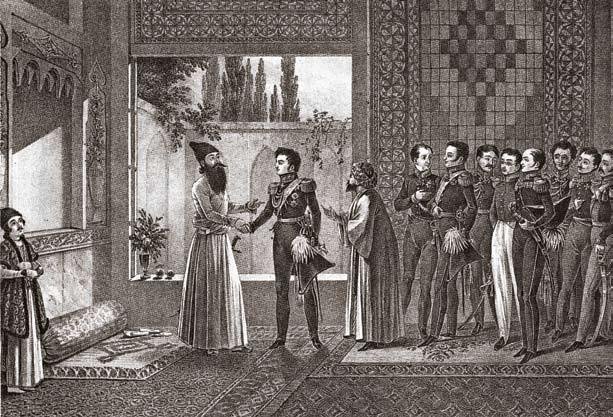
Some of those khanates attempted to restore the former state—this time under their own rule, and, as we know, the Qajars were the most successful of them. But it did not work out like before, because amidst this reign of chaos, a new player appeared in the region. The Russian Empire conquered part of the territories that had been once ruled by Nader Shah and were now being claimed by the Qajars.
Russia was then incomparably far ahead of the Middle East, of which we were part, in terms of civilizational progress. By the time the Russians arrived, more than half a century had passed after Lomonosov’s death, and the progressive European ideas were already so strong that they would eventually lead to important events such as the Decembrist uprising.
One of them was the idea of “nation-state”, which was considered progressive for that period and was still in its infancy in Europe. It had originated in France and was very much to the liking of many peoples in Europe, especially those living in the Austrian, Ottoman and Russian empires. Inspired by this idea, Czechs, Poles, Hungarians, Bulgarians, Serbs wished to secede from their respective empires.
Almost no one in the Middle East was even aware of these ideas, especially in the dominant but uninformed Muslim community. Therefore, when Nader Shah was killed, none of the khans thought to create a state “uniting the people of a certain language and culture”. The smaller khans’ sole goal was to somehow preserve their possessions in this chaos, while the larger ones strove to rebuild Nader’s empire.
But as the territory annexed to Russia virtually became part of European culture, the local population gradually learned about progressive ideas, beginning to look at themselves through the filter of explanations and assumptions offered by these progressive ideas, to wonder who they were, where they had come from and where/how they should move forward. Mirza Fatali Akhundov, who was in the service of the Russian Viceroyalty in Tiflis, studied Charles Darwin’s theory of evolution and John Stuart Mill’s idea of freedom of speech, read Shakespeare and Pushkin, and wrote stage plays; Hasan bey Zardabi, having graduated from Moscow University, returned to his homeland and began to publish a newspaper; graduates of the Gori Seminary, of whom there were more and more, were gradually beginning to form a national intelligentsia.
This process continued for about a century, when suddenly both the intellectuals, who had barely begun to discover who they were, and the people, who was still called “Tatars”, suddenly faced a new chaos—World War I. An evidence to the fact that this war accelerated the search for identity can be found, for example, in the 1917 article “Azerbaijan” by Jalil Mammadguluzade. In it, our classic wrote that we were Turks, that our homeland was called Azerbaijan, and other parts of it were part of Iran and the Ottoman Empire.
That same year, a Bolshevik coup took place in Russia, and, as a result of growing chaos, our intelligentsia, against their own wishes (as the majority in the region, they were in favor of a united state with Armenians and Georgians), declared a state called Azerbaijan in 1918.
Thus, our decisions concerning national self-determination and their implementation were possible precisely because of that very “division”, but it also happened in a small area torn from the large territory. From this point of view, the signing of the treaties of Gulistan and Turkmenchay should be considered as a positive event in general, as they accelerated both our search for national identity and our cultural development. The definition of political identity that now unites the inhabitants of Kirkuk and Beylagan, Zanjan and İğdir was given by intellectuals living in Tiflis, Ganja, Baku, etc.—in the cities of the Russian Empire.
Had it not been for the treaties of Gulistan and Turkmenchay, we might not have been able to find out not only that we were “divided”, but even who we are as a people, or we might have learned it too late.
All this took place north of the Araz River. In the south, we remained the dominant ethnic group until the first quarter of the 20th century and felt no need to search for national identity. The search for national identity there began only after the loss of ethnic domination, when the Iranian throne passed to the Pahlavi dynasty.
True, the state called “Iran” did not yet exist when Azerbaijan was divided, and that territory was considered the property of the Qajars. But if Azerbaijan had not been divided, we would have remained part of the Qajar Empire and would have shared in all the historical events that befell them later. The Qajars would still be overthrown because of their inept policies, in 1935 Reza Shah would officially rename our country to Iran, and in 1943 the British and the USSR would overthrow this shah and put his son on the throne. The Mossadegh movement in the 1950s, the “White Revolution” by Mohammed Reza Pahlavi in the 60s, the Islamic Revolution of 1979, and the Iran–Iraq War of the 1980s—all this would have been part of our history. And we would have never known Mirza Fatali Akhundov, or Uzeyir Hajibeyov, or Mamed Emin Rasulzade.
However, these treaties also had a grave negative impact on the population living north of the Araz: most political activists moved to the south at that time, while the politically indifferent part of the population remained in the north, and their traditions were continued respectively.
Article XII of the Treaty of Turkmenchay gave the people living in the region three years to move to the side where they wanted to live. At that time, almost the entire politically aware part of the population of the north, concerned about the arrival of a foreign-speaking, non-Muslim power decided to move to the Qajar Empire, which remained a Muslim country. The only people left here were those who were not interested in political processes, farmers and nomadic herders. The largest cities, the culture centers, Tabriz and Ardabil, ended up on the other side of the Araz, and the north was left with the smaller ones. That is why the intellectuals of the north constantly complained in their writings about the political apathy of the public, warning about possible problems in the future. The population of the south, on the other hand, seemed to be constantly looking for an excuse to demonstrate their political position. Azerbaijani Turks have always been among the most active participants in all political events in Iran, and finally, in 1945, at the earliest opportunity, they demanded national autonomy.
However, the migration in the region affected not only Azerbaijani Turks. The Christian population of the region liked the fact that the territory north of the Araz was occupied by Russia, and the Armenian population began to migrate in inverse proportion to the Muslim population. Politically active Armenians living in the south moved to the Russian territory in search of new opportunities, while politically passive Armenians remained in Iran, believing that it was enough to be allowed to make and drink wine.
This concentration of politically passive Muslims and politically active Armenians in the north would play its part in the subsequent pages of history… The Northern Turks were ready neither for the events of 1905-1906, nor for the events of March 1918, nor for what happened in 1988. And, sadly, they paid very dearly for it.
Thus, from all of the above, we can conclude that the treaties of Gulistan and Turkmenchay greatly contributed to the national-political self-determination of the ethnos who until then had not perceived itself as a single people.
P.S.: To avoid any misunderstanding that may arise after reading this article, I would like to make my opinion on one more issue clear. Should we be grateful to Russia for our national self-determination and cultural development? I don’t think so. First, Russia, like all conqueror, crossed the Caucasus Mountains and came here pursuing its own interests. Second, all our achievements are the result of the dedication of the national intelligentsia. Third, the Soviet era, which lasted 70 years, created conditions that facilitated the degradation of our intelligentsia, the main driving force of our society, so that faceless, rotten people were often presented as intellectuals, casting a shadow on some of the hard-won success the true intellectuals had achieved in the period of the Russian Empire. And finally, we have been in direct contact with Russia over the past two hundred years, sometimes of our own free will, and sometimes forcibly, and repaid it, perhaps manifold, for all the benefits and advantages we once received. Today, only a relationship without favors can form a solid foundation for true friendship and good-neighborly relations.
Aze.Media