

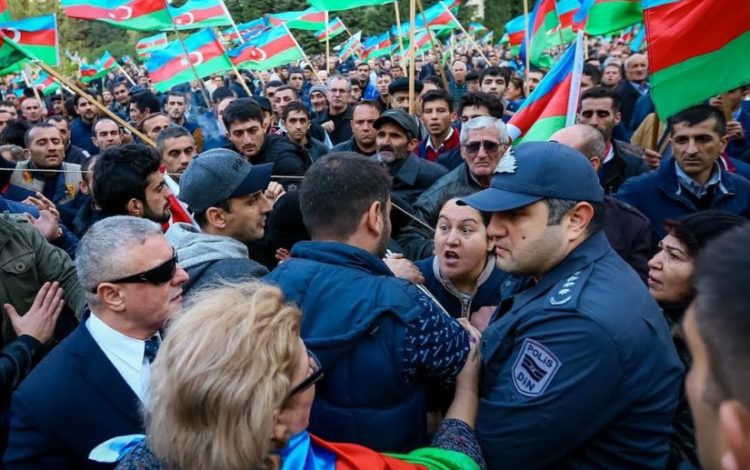
It is the same in our society; some of our cultural indicators are not swearing or disobeying adults, but a member of a different society may argue whether these customs belong to the category of culture.
In developed societies of today, one of the main measures of culture is political culture. That is, people are organized for a purpose, and during a discussion, one side listens to the other side’s opinion with restraint—everyone’s opinion is generally respected, including communities or organizations electing their representatives and expressing their positions through them at meetings where issues affecting everyone are discussed. A society that meets these and similar conditions is regarded and respected by others as a civilized society.
Sadly, we cannot boast of our level of political culture. There are objective reasons for this. The most important of them is that politically active Muslims in the Caucasus migrated to the south of the Araz after the Treaty of Turkmenchay and their political traditions continued there. As a result, Tabriz has been the most active participant in Iran’s political life for almost two centuries. Meanwhile, people to the north of the Araz are mostly politically passive and somewhat prone to cooperation with the occupiers, and their traditions continue here. The opposite migration is observed in the Christian (especially Armenian) population of the region: politically active Armenians see migration to the territories annexed to Russia as a chance, while the politically passive segment continues to live in the territory of the Muslim Qajar state. One of the main reasons behind the current situation in Karabakh is the increase in the number of politically active Armenians in the region north of the Araz two centuries ago, and the decrease in the number of likewise inclined Azerbaijanis there.
Reading the scarce and ironically low-circulation papers of the early twentieth century, it is clear that our intellectuals called on the people not to stay away from politics, to participate in the parliamentary and municipal elections—the privileges that were forcibly taken away from the Russian tsar. Naturally, these calls had little effect. On the contrary, the little awakening that emerged as a result passed through the repressions of the 1930s and, in the next decade, through World War II to eventually dwindle to almost microscopic amount.
Since we mentioned Armenians, I would like to share what I saw in a video I came across a few years ago. Soldiers of the Russian military base in Armenia leave the territory allocated to them as a training ground and move to the territory of a nearby village for maneuvers. A group of disgruntled villagers go to them to protest and talks to a Russian officer. If I’m not mistaken, the incident is also broadcast live on Facebook. One of the villagers speaks to the officer in a serious, official tone, another makes jokes, someone else wants to resort to violence, but his fellow villagers try to talk him out of unnecessary actions—in short, they explore all available options and, as a result, confuse the other side. It is true that the Russian officer can withstand this psychological pressure, but you can tell it is not easy for him. The villagers’ actions are not artificial, not put on at all. They obviously did not come prepared and they are not acting; this is an approach to an unexpected situation that has become traditional. In a sense, it is an indicator of the people’s political culture.
If we (God forbid) had a foreign military base in our country and its soldiers acted like that, what would our villagers do? I cannot say for sure, but it is likely to be one of the two: either everyone would attack the soldiers, or no one would stand up to them.
The people must have a political culture so that the society does not feel at a loss in unexpected situations and makes the right decisions.
To give a more figurative example, if you throw a society with a political culture in the middle of the desert, it will be able to organize there and find a way out of the situation. A people without one, when existing in such chaotic conditions even in a much more livable area, will often face problems and, as a result, may disappear.
A society with a political culture can tell good from bad. Of course, this does not happen instantaneously or even overnight—in order to tell good from bad, you must first make mistakes many times and learn from them. A people without one cannot afford the luxury of making mistakes, so at best, they face these mistakes later and eventually lag behind others.
An example of this is the Arab countries: Saddam, Gaddafi and other regimes, although seemingly stable from the outside, in fact simply cover up the problems, thus slowing down the social evolution of their nations, and perhaps numbing them. Only now, half a century too late, were they forced to pick up where they left off; but I believe that it will not be long now that the current armed organizations gradually become political organizations, fighting each other with words, not bullets.
Having an active political tradition creates great opportunities for society’s maneuverability in foreign policy. The Brits are the most striking example of this: as Prime Ministers of the United Kingdom constantly change, it is possible to make constant changes in foreign policy, and relations with other countries develop dynamically. In the eyes of societies with a weak political culture, this dynamic is misunderstood and simplified to look like the “English flag.” However, many of them have no idea how difficult the path to the post of Prime Minister of the United Kingdom can be and what high political skills it may require.
Finally, members of a society with a political culture, who can be organized and elected, truly feel the place where they live as their country, are attached to it, and are not inclined to flee it.
Finally, if we apply the popular “if you don’t fight, you don’t get stronger” idea to society, we can say that society needs political fights and discussions within itself in order to get stronger and mature.
Wishing you a good election tomorrow.
Aze.Media











