
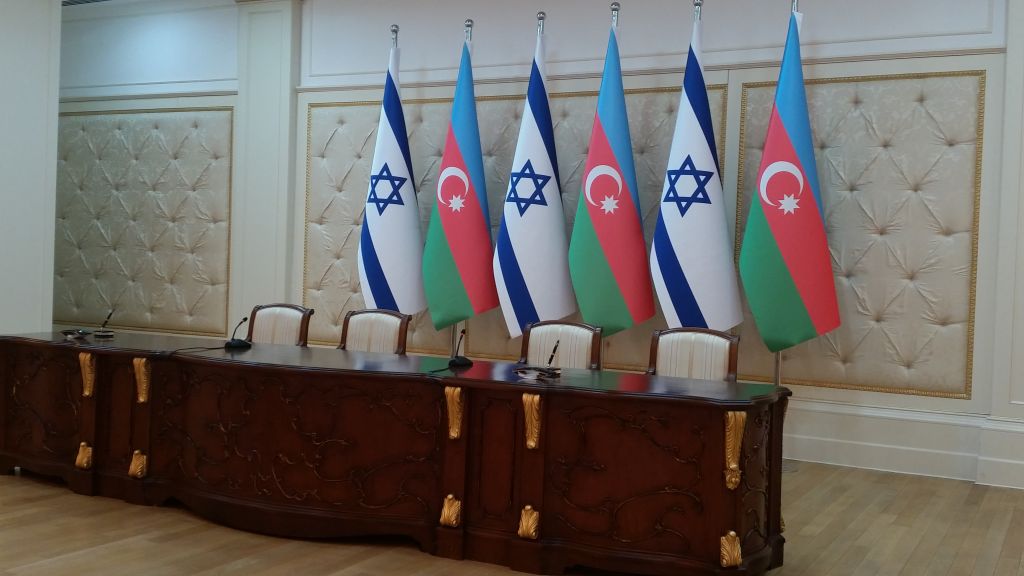
1. The source of mutual ties in the relations
Historical-political relations
There are several opinions regarding when Jews who have lived in Azerbaijan since ancient times actually settled here. According to one of these opinions, the ancestors of the local Jews first came to Azerbaijan in the 5th-6th century BE, after the Babylonian conquest of Jerusalem and its destruction in 586 BE (more on how Jews spread out across the globe read in the article “The Jewish Diaspora“).
During the Sassanid period, Jews lived compactly in a number of regions, including Azerbaijani lands such as Shirvan and Derbent. Remains of a 6th-century synagogue found during an archeological dig in the Shabran District prove the long-standing presence of Jews in Azerbaijan. According to historian Movses Kaghankatvatsi, Mountain Jews arrived in the South Caucasus in the 1st century BE.
The settlement of European Jews (Ashkenazi) in the Caucasus coincided with the occupation of the Caucasus by the Russian Empire. The first synagogue of European Jews in Baku was built in 1830. In the 1870s, when the oil industry began to boom in Baku, the number of Jews in Azerbaijan, especially in Baku, began to increase, and many Jewish companies were established here. Jewish companies such as Dembo & Kogan founded by A. Dembo and H. Kogan in Baku, Polak & Sons founded by Polak Grigori and his son Saveliy (Shevah), and individual Jewish businessmen such as Baron H. Guenzburg, A.M. Feigel, Bikhowsky, Leites, Ickowich were active in the industry at the time. One of the largest companies established in Azerbaijan in the late 19th century was the Caspian-Black Sea Company, owned by the Rothschild brothers, French citizens of Jewish descent. The Baku-Batumi railway was built in 1883 with $10 million allocated by the Rothschilds, and, for a long time, this line played a key role in the transportation of Baku oil (Osbrink, 2014, p.53).
The share of Jews in Baku’s oil industry in 1913-1914 can be estimated at 44%. According to the 1897 census, there were 2,341 Jews in Baku (a total of 8,430 in Azerbaijan). After the 1917 revolution, the number of Jews in Azerbaijan began to increase. Moisey Gukhman represented Jews in the Parliament of the Azerbaijan Democratic Republic in 1918-1920. Along with it, K. Lisgar was represented in the government as Minister of Food Provisions, R. Kaplan as Minister of Religious Affairs, Y. Gindes as Minister of Healthcare, and M. Abesgauz as Deputy Minister of Treasury.
During the Russian Civil War of 1918-1920, many Jews who had fled anti-Semitism in Ukraine and Belarus moved to Baku, and as a result, the number of Jews in the country surged. According to the State Statistics Committee (SSC), a total of 30,900 Jews lived in Azerbaijan in 1926. In 1939, the figure was 41,200, in 1959—40,200, in 1970—41,300, in 1979—35,500, in 1989—30,800. Most Jews left the country during the collapse of the USSR. Thus, the number of Jews in Azerbaijan in 1999 was 8,900. According to the latest available SSC data, there were 9,100 Jews living in Azerbaijan in 2009. The majority of Jews in the country today are Mountain Jews, and they reside mainly in Krasnaya Sloboda (Red Village) in Quba District and in Baku, while Ashkenazi live mainly in Baku. There are also Georgian Jews, Krymchaks (Karaims), Kurdish Jews, and Russian Subbotniks (Gery) who practice Judaism but are not ethnically Jewish. The total number of Jews currently living in Azerbaijan is about 12,000.
Representatives of the Jewish ethnic groups living in Azerbaijan, as well as former Azerbaijani citizens who immigrated to Israel and other countries around the world, play an important role in maintaining the high level of relations between the two countries. Thus, we can stress that the relations between the two countries are primarily based on historical and cultural ties.
With the collapse of the USSR, Azerbaijan–Israel relations entered a new phase
Israel recognized the independence of Azerbaijan on December 25, 1991, and diplomatic relations between the two countries were established on April 7, 1992. The Israeli embassy has been active in Azerbaijan since August 1993. The first ambassador was Eliezer Yotvat (Musabeyov, 2001, p. 194; Ahmadov, 2014, p. 184). Although high-level meetings took place on various platforms after the establishment of relations between the two countries, visits on the head of state level began in the late 1990s.
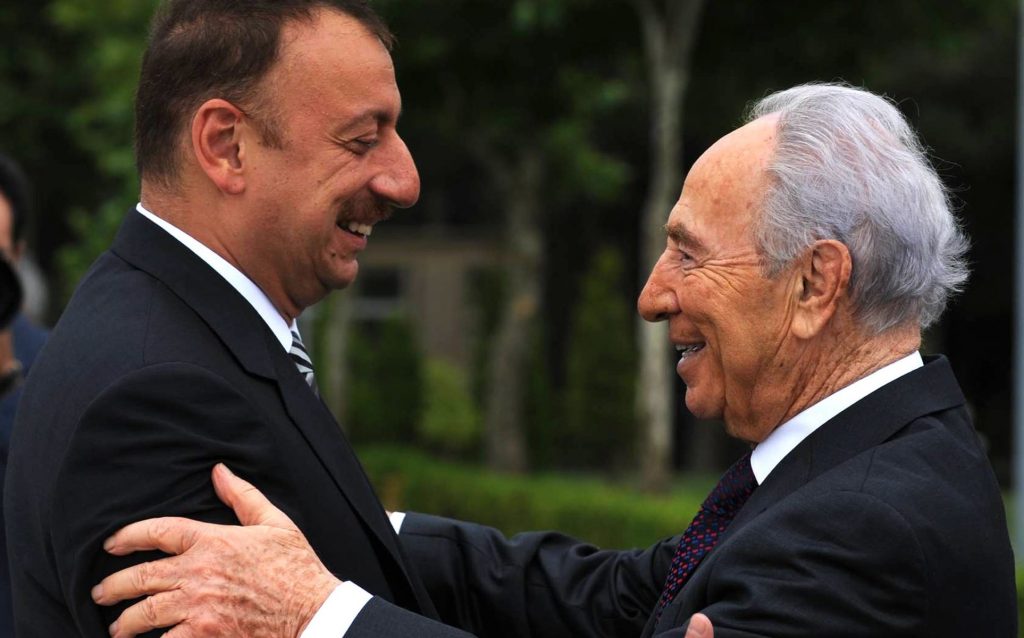
On August 29, 1997, Israeli Prime Minister Benjamin Netanyahu paid his first official visit to Azerbaijan and met with Heydar Aliyev. The visit of Israeli President Shimon Peres to Baku on June 28-29, 2009 can be considered as an indicator of the highest level of political and diplomatic relations. Following Peres’s official visit to Baku, Iran recalled its ambassador in Baku “for consultation” in order to put pressure on Azerbaijan. Realizing, however, that this could not disrupt Israel-Azerbaijan relations, Iran stated that the ambassador had returned home “for personal reasons” (Ahmadov, 2014, p. 192).
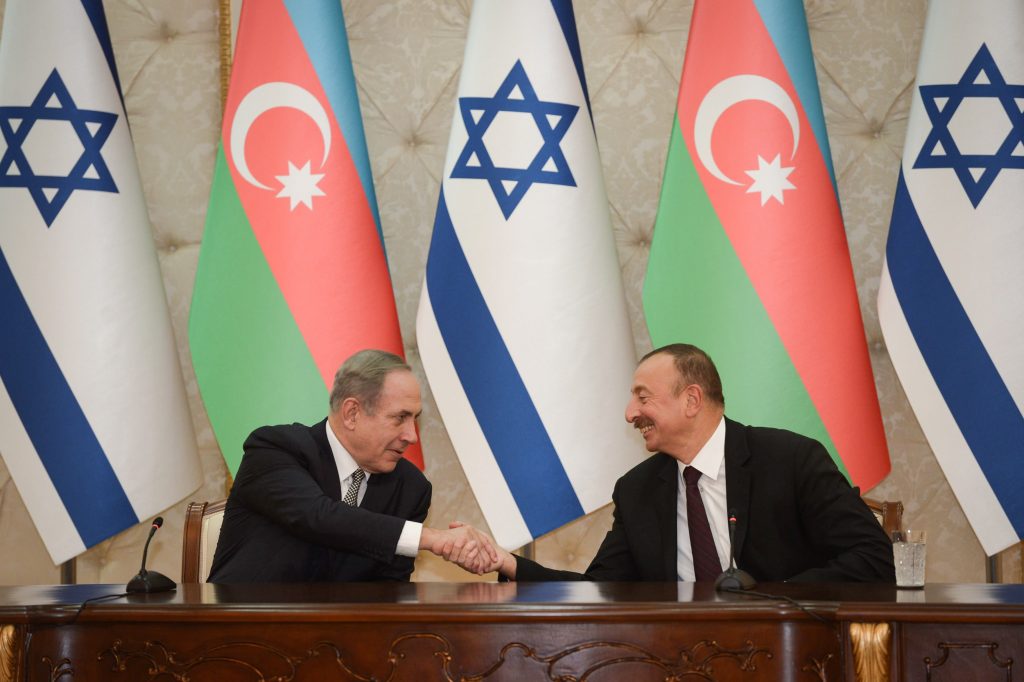
In accordance with the decision made during Netanyahu’s second official visit to Baku in 2016, a Memorandum of Understanding on the establishment of a Joint Commission was signed in 2017 between the Government of the Republic of Azerbaijan and the Government of the State of Israel. The purpose of this Commission is to make decisions on relevant issues by establishing “ad hoc” working groups specializing in areas of mutual interest. Various ministries and government agencies from both parties are represented in the Commission. According to Azerbaijani Jewish Media and a number of other media outlets, Azerbaijan intends to open a trade mission with diplomatic status and an official representative office for tourism development in Israel in 2021. Thus, we can assume that the issue of opening an embassy of Azerbaijan in Israel will be on the agenda in the coming years.
Economic relations
The Israeli economy is one of the most advanced in the world. The table below compares Israel’s and Azerbaijan’s key economic indicators for 2021:
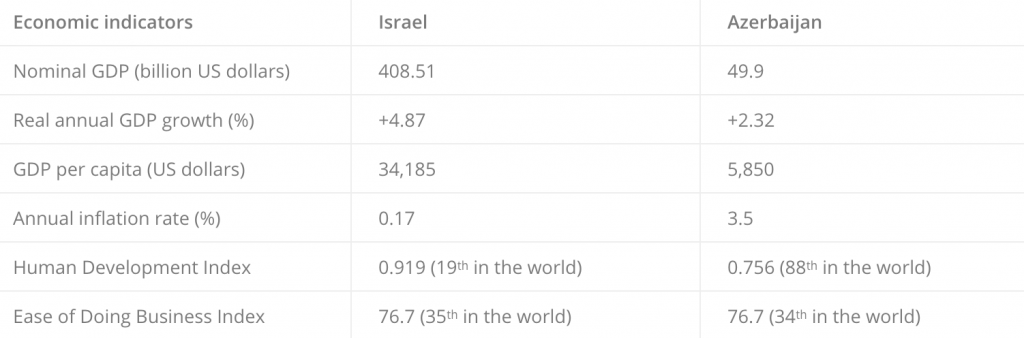
Thus, in terms of Gross Domestic Product and production, Israel exceeds Azerbaijan by 9-10 times. Israel’s high-tech industry in particular is developing rapidly. This sector accounts for about 80% of the country’s exports ($29 billion in 2006). To further develop this area of the national economy, large sums are allocated from the country’s public budget every year: for example, 90% of the public budgets for R&D (research and development) in 2006, i.e., $7 billion, was allocated to high-tech industries. Apart from that, diamonds manufactured in Israel ($9.4 billion exported in 2008) and agricultural products ($1.2 billion exported in 2009) play an important role in the country’s exports.
The other most important sectors of the Israeli economy are tourism, construction and transport and communications. Interestingly, according to the Ease of Doing Business Index, Israel does not surpass Azerbaijan but is currently one step behind. Therefore, Israeli companies can set up and develop their business in Azerbaijan without difficulty. Thus, we can say that the economies of the two countries can be mutually attractive. Azerbaijan is rich in the energy resources that Israel needs most, and Israel is rich in the high-tech skills and capabilities that Azerbaijan needs most.
According to the latest SSC data (2019), 69.9% of industrial production in Azerbaijan come from extractive industries (of which 62.3% is crude oil and gas production), 25.1% from process industries (of which 7.6% is food products, 6.2% oil products, 1.6% construction materials, 1.2% metallurgical production, etc.). Thus, we can say that the oil and gas industry is the backbone of Azerbaijan’s economy and exports. The total trade turnover of Azerbaijan in 2019 was $33.3 billion ($13.7 billion imports and $19.6 billion exports). Naturally, the main export products of Azerbaijan are crude oil and gas, as well as oil products.
According to the SSC data, exports from Azerbaijan to Israel amounted to $1.3 billion in 2019, while imports from Israel to Azerbaijan were $43.7 million. However, it should be noted that the SSC made an error in the import figures. Azerbaijan and Israel are known to have been involved in the purchase and sale of weapons worth $1.6 billion, including Israeli drones and anti-missile defense systems, in February 2012. It is also known that under the agreement reached in Baku, Azerbaijan and Israel began to jointly produce unmanned combat air vehicles (Shaffer, 2013, p. 1). Relevant arms purchases continue to this day. However, according to official data, there is a substantial overbalance in trade between the two countries in favor of Azerbaijan, and the main reason is that Azerbaijan supplies Israel with crude oil and gas, as well as oil products.
During the Cold War, Israel supplied its energy demands from Egypt, West Africa, the North Sea, and South America. After the end of the Cold War, new sources of energy became available for Israel: Russia and the former Soviet Union, including Azerbaijan. The construction of a new power line from Azerbaijan, which gained independence in 1991, was proposed through the Turkish company TPAO, and the proposal came directly from Netanyahu. Even the Jewish lobby in the United States played a significant role in supporting this project. During Netanyahu’s visit to Baku and meeting with Heydar Aliyev in 1997, the route of the oil and gas pipelines to be laid from Azerbaijan was approved and the final decision was made. To this day, Azerbaijan supplies 30-40% of Israel’s oil needs (Bashirova and Sozen, 2017, p. 34; Murinson, 2014, pp. 19-20). Israeli Minister of National Infrastructure Benjamin Ben-Eliezer also attended the inauguration of the Baku-Tbilisi-Ceyhan oil pipeline on July 6, 2006. He proposed building another line from Ceyhan, the terminus of the pipeline, to the Red Sea and stressed the importance of this project. According to the proposal, the line will be connected to the existing Ashkelon-Eilat oil pipeline, which will make it possible to deliver Azerbaijani oil directly to Israel, as well as the Indian Ocean, and from there by water to India, Japan and South Korea (Ahmadov, 2014, p. 186; Abilov, 2009, p. 155). At present, Israel gets Azerbaijani oil directly from the port of Ceyhan with its oil tankers, as well as indirectly from secondary markets (Murinson, 2014, p. 27).
The Azerbaijani oil company SOCAR has begun exploration and drilling in the Israeli oil fields Yam-3 and Med Ashdod with a 5% ownership stake in each. Former Israeli Ambassador to Azerbaijan Rafael Harpaz told media in 2015 that it would be useful to cooperate with Azerbaijan because Israel has energy resources but little experience in the extraction and development of these resources (Bashirova and Sozen, 2017, p. 34).
Social and cultural relations
The first Jewish Sochnut School in the entire USSR was opened in Baku in 1982, that is, even before Azerbaijan gained independence. A number of cultural and Zionist organizations have been operating in Baku and Sumgayit since 1987. Today, there are 5 synagogues in the country (3 in Baku, 2 in Guba) and 10-15 Jewish organizations. These are: the Azerbaijan-Israel Cultural Relations Organization (now called the Aziz International Association), the Azerbaijan-Israel Friendship Organization, founded in 1992, the Baku Religious Community of European Jews, the Israel Center engaged in educational programs, the Havva Welfare Center for Women and Children, the War Veterans Society (Abilov, 2009), the Jewish Agency Sochnut, committees engaged in the preservation of Jewish traditions such as Joint and Vaad-L-Hetzola, the Heesed-Kershon charitable society, Alef youth clubs, Hillel Student Organization, a number of newspapers and magazines, Jewish schools, etc. Hebrew is taught at the Faculty of Oriental Studies of Baku State University, and there is Faculty of Israeli Studies at the Azerbaijan University of Languages. The Habad-Or-Avner School, the largest Jewish educational complex in the South Caucasus, was built in Baku in 2003.
The official visit of Israeli Prime Minister Benjamin Netanyahu to Baku on December 13, 2016 also contributed to the development of cultural relations between the two countries. During the visit, a number of agreements were signed on standardization, meteorology, agriculture, prevention of double taxation, the establishment of a joint intergovernmental commission, and plans were made to open the first Jewish museum in the South Caucasus. In 2019, the first Mountain Jewish museum was built in Krasnaya Sloboda with the financial support of Jewish businessmen God Nisanov and Zarah Iliyev, as well as the STMEGI charitable foundation.
Military relations
Israel has always been a military partner of Azerbaijan and supported Azerbaijan in the most difficult moments. Even after the United States, under the influence of the Armenian lobby, adopted Section 907 of the Freedom Support Act in 1992 banning the sale of weapons to Azerbaijan, Israel provided Azerbaijan with the highest quality weapons. For example, it is known that Israel supplied Stinger missiles to Azerbaijan during the First Nagorno-Karabakh War in 1992-1994. Arms supply became more pronounced during the Second Nagorno-Karabakh War and played an important role in Azerbaijan’s victory. According to information made public by Wikileaks, in January 2007, Azerbaijan and Israel signed two security cooperation agreements. According to the report, Ilham Aliyev’s security adviser went to Israel for medical treatment and met with Israeli Assistant Defense Minister Ephraim Sneh and MOSSAD officials during his stay. (Ülgül, 2016, p. 102).
Cooperation between Azerbaijani and Israeli intelligence services has played a significant role in preventing a number of terrorist attacks in the country. For example, terrorist attacks on the Gabala anti-missile radar station and the Israeli embassy in Baku were prevented with the support of Israeli intelligence in 2008. Since 2011, Israel has been supplying drones to Azerbaijan to ensure the security and control of its borders (Murinson, 2014: 21-22). It is this cooperation that is met with strong protests and concerns by Iran and causes an occasional cooling in Iran-Azerbaijan relations. This is the reason for the anti-Azerbaijani articles in the Iranian media, especially after 2011. According to them, Azerbaijan will support the opposing side in a possible joint US-Israeli attack on Iran, because Azerbaijan buys weapons from Israel. Azerbaijani youth protested against this position in front of the Iranian embassy in Baku in 2013. This position existed until Hassan Rouhani became President of Iran in 2013, and it still reemerges from time to time (Mammadov, 2017, p. 244).
2. Benefits of the mutual ties, development prospects and obstacles ahead
Azerbaijan’s relations with Israel are based on mutual benefit in all areas. First of all, energy and security relations between the two countries can be assessed at the level of strategic alliance. Apart from that, Israel is expected to come to Azerbaijan with investment projects in many other areas, especially after the Second Nagorno-Karabakh War, potentially boosting the development of new technologies and industries in the country. At the same time, cooperation with Israel and Jewish people helps to bring the truth about Azerbaijan to the world, and even to extend the waiver of Section 907 of the Freedom Support Act every year since 2002.
Although today the relations between Azerbaijan and Israel have reached the highest strategic level, there is still no Azerbaijani embassy in Israel, and many wonder why. The question was even asked by the representative of Israel Hayom media channel, who last interviewed Hikmet Hajiyev, an aide to the President of Azerbaijan, on April 26, 2021. It should be noted that so far the Israel-Azerbaijan relations has reached such a high level that even though the fraternal Turkey’s relations with Israel began to deteriorate during Israel’s Operation Cast Lead in the Gaza Strip in 2008, even though the relations between the two countries reached its most tense level at the Davos summit in January 2009, even though the Turkish-Israeli relations were completely severed following the MV Mavi Marmara incident in 2010, none of it affected Azerbaijan.
The only reason Azerbaijan still has not opened an embassy in Israel is its desire not to lose the support of the Muslim world. Muslim countries have always supported Azerbaijan in the Armenian-Azerbaijani Nagorno-Karabakh conflict, both within the UN and the Organization of Islamic Cooperation, as well as on other international platforms. Azerbaijan also follows the example of Turkey in this matter. Turkey, which had very warm relations with Israel in the late 1950s, was unable to gain the support of Muslim countries in the international arena over the Cyprus issue, which erupted in the 1960s. The Johnson Letter of 1964 is an example of the cooling relations in the 1960s between Israel and the Turkish government, which saw the dual attitude of the United States and sought to regain the support of Muslim countries. Azerbaijan, on the other hand, chose a slightly different strategy and managed to raise its relations with Israel to the highest level through various channels, and postponed the opening of the embassy. At the same time, Azerbaijani officials have always stated their support for the establishment of a Palestinian state. For example, during his official visit to Israel in 2013, former Azerbaijani Foreign Minister Elmar Mammadyarov met with the Palestinian President and said that Azerbaijan advocated the peaceful settlement of the Palestinian-Israeli conflict and supports the establishment of a Palestinian state (Ahmadov, 2014, p. 191)
The history of the Palestinian-Israeli conflict began in 1947 after the United Nations announced a plan to establish two states (Israel and Palestine) in the Palestinian territories. Although the state of Israel was established on May 14, 1948 following this plan, the state of Palestine was not. The Palestinians protested against the plan, refused to recognize Israel as a state, and with the help of other Arab and Muslim states began an armed struggle, which continues to this day. In 1993, pursuant to the Oslo Accords, Israel officially recognized the Palestine Liberation Organization (PLO), established in 1964, and created the Palestinian National Authority to exercise Palestinian local self-government under the leadership of the PLO, and Palestine in return recognized the State of Israel. Israel had pledged to withdraw its troops from areas under Palestinian control (the West Bank and Gaza Strip) by 1995. However, the conflict flared up again after the 1995 assassination of Prime Minister Yitzhak Rabin, who signed the agreement. After Hamas took over Gaza in 2007, a dual power reigned in Palestine. The peace agreement signed between the parties in 2011 was not implemented until the establishment of a unity government in 2014. In 2012, the State of Palestine received the status of a non-member UN observer state (Azerbaijan voted for it), and the state has been recognized by 138 UN members, including Azerbaijan, so far.
Israel’s occasional tendencies for a rapprochement with Armenia cannot be ignored. An example of this is the visit of Israeli Minister of Regional Cooperation Tzachi Hanegbi to Armenia on July 25-26, 2017, and his speech on the development of “friendly and mutually beneficial” Armenia-Israel relations and economic ties. During the meeting, agreements were signed on visa-free travel for holders of diplomatic passports, as well as cooperation between the two countries in the field of culture, education, science, sports and youth for 2017-2020.
Note that such “rapprochement” once took place between Turkey and Armenia (2009-2010). However, as in the case of Turkey, Israel’s stronger and deeper relations with Azerbaijan have been an obstacle to its rapprochement with Armenia. Moreover, the level of economic relations between Armenia and Israel is not inviting. For example, exports from Armenia to Israel amounted to $7.6 million in 2018, while imports from Israel amounted to about $9 million. Azerbaijan’s use of Israeli weapons against Armenia during the April 2016 clashes and a certain advance gained on the front line caused a particular cooling of relations between the two countries (Avdaliani, 2017: 2). This cooling was further aggravated after the Second Nagorno-Karabakh War and led to the burning of the Israeli flag in Armenia.
To sum up, the current level of Azerbaijan-Palestine and Israel-Armenia relations is too low to overtake Azerbaijan-Israel relations and too weak to damage the strategic alliance between the two countries. The normalization of Israel’s relations with a number of Gulf countries (UAE, Bahrain, Morocco and Sudan) following the Abraham Agreement brokered by former US President Donald Trump in 2015-2019, the negotiations on the normalization of relations with Saudi Arabia that have been on the agenda since 2019, and especially the talks on the final resolution of the conflict with Palestine, give reason to believe that there will be peace between Jews and Arabs in the Middle East in the future, and that Azerbaijan will open an embassy in Israel soon.
References:
Abilov Shamkhal, (2009), “The Azerbaijani-Israel Relations: A non-diplomatic, but strategic partnership”, OAKA, 4(8): 147-167.
Əhmədov Aqil, (2014), “Azərbaycan-İsrail Münasibətləri: Reallıqlar və Perspektivlər”, Strateji Təhlil, 7-8: 181-196. [Ahmadov Agil, (2014), “Azerbaijan-Israel Relations: Realities and Prospects”]
Avdaliani Emil, (2017), “Israel and the South Caucasus: Building A New Approach”, BESA Center Perspectives Paper, 632: 1-4.
Bashirova Aynur və Sozen Ahmet, (2017), “The Role of Azerbaijan in Israel`s Alliance of Periphery”, Middle East Review of International Affairs, 21(1): 29-43.
Məmmədov Fərhad, (2017), Azərbaycan Respublikasının xarici siyasətinin əsas istiqamətləri (1991-2016), Poliart MMC, Bakı. [Mammadov Farhad, (2017), The priorities of the foreign policy of the Republic of Azerbaijan (1991-2016)]
Murinson Alexander, (2014), “The Ties Between Israel and Azerbaijan”, Mideast Security and Policy Studies, 110, The Begin-Sadat Center for Strategic Studies (BESA), Israel.
Murinson Alexander, (2008), “Jews in Azerbaijan: A History Spanning Three Millennia”, Visions of Azerbaijan, 3(2): 58-64.
Musabeyov Rasim, (2001), “Azerbaycan`daki Etnik Azınlıklar”, Avrasya Dosyası, Azerbaycan Özel, 7(1): 177-196. [Musabeyov Rasim, (2001), “Ethnic Minorities in Azerbaijan”]
Osbrink Brita, (2014), İmperiya Nobeley: istoriya o znamenitıx şvedax, bakinskoy nefti i revolyutsii v Rosii, Algoritm, Moskva. [Osbrink Brita, (2014), The Nobel Empire: A Story of Famous Swedes, Baku Oil and the Revolution in Russia]
Shaffer Brenda, (2013), “Azerbaijan`s Cooperation with Israel Goes Beyond Iran Tensions”, The Washington Institute Policy Analysis, 1-2.
Ülgül Murat, (2016), “İsrail-Azerbaycan Stratejik Ortaklığı ve Türkiye-İsrail İlişkilerine Etkileri, 2009-2015”, Gümüşhane Üniversitesi Sosyal Bilimler Enstitüsü Dergisi, 7(16): 99-118. [Ülgül Murat, (2016), “Israel-Azerbaijan Strategic Partnership and Its Effects on Turkey-Israel Relations, 2009-2015”]
Aze.Media