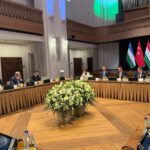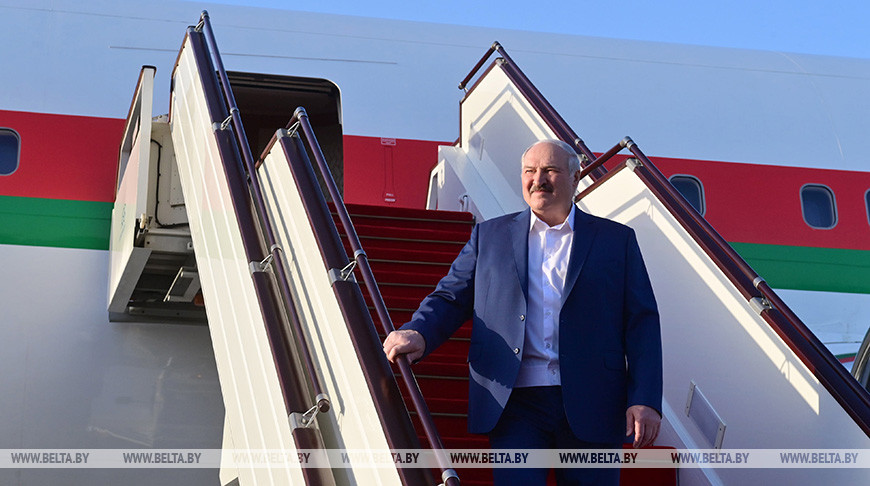
Belarusian President Alyaksandr Lukashenka paid a two-day visit to Baku, Azerbaijan, over April 13–14. The trip had initially been scheduled for late 2020, but it was postponed due to two significant events (Azertag.az, April 14; Belta.by, April 15).
First, the August 2020 presidential election protests and related political unrest shook Belarus for months. Azerbaijani President Ilham Aliyev had nonetheless been one of the first foreign leaders to call Lukashenka to congratulate the latter on his “confident victory” in the elections (President.az, August 10, 2020). The Azerbaijani government and its proponents are happy that Lukashenka has survived the political crisis, not least because they regard the alternative as undesirable for Azerbaijan. But Azerbaijani opposition figures and critics of the government were divided over the events in Belarus. Some of them prioritized democratic reforms and, therefore, supported the protesters in Belarus; while others favored Lukashenka as a significant partner of Azerbaijan, particularly in the context of the Karabakh conflict (see EDM June 14, 2018; Aqreqator.az, Teref.az, August 13, 2020; BBC News—Azerbaijani service, August 21, 2020).
Then, 2020 witnessed the outbreak of the Second Karabakh War (September 27–November 9), between Belarus’s formal ally within the Russia-led Collective Security Treaty Organization (CSTO) and Eurasian Economic Union (EEU), Armenia, and Belarus’s strategic partner, Azerbaijan. In a 2015 conversation recorded between Lukashenka and then-Armenian leader Serge Sarkisian that was leaked in December 2020, the Belarusian president apparently offers his Armenian counterpart $5 billion on behalf of Baku in exchange for the withdrawal of Armenian forces from Azerbaijan’s occupied territories. While in Baku this month, Lukashenka publicly recalled this conversation in the presence of the Azerbaijani president (Reform.by, April 15, 2021; Belnaviny.by, December 8, 2020). At the same time, he congratulated Azerbaijan on taking “a big step [de-occupation of its territories] toward reaching the national dream [restoration of territorial integrity].” These gestures reaffirmed Minsk’s commitment to a strong partnership with Baku and effectively signaled its siding with Azerbaijan on the Karabakh topic. Notably, Belarus will be the fourth country—following Turkey, Italy and the United Kingdom—to participate in the reconstruction of the de-occupied Azerbaijani territories, which means multi-million dollar contracts for Belarusian companies (Trend, April 14; APA, April 15).
The topic of Azerbaijani crude oil supplies to Belarus was also high on the agenda during Lukashenka’s visit. The Belarusian president thanked Baku for supplying hydrocarbons to his country at “difficult times” and suggested deepening this facet of their bilateral partnership. He added that this was a “very delicate, scrupulous matter due to Belarus’s standing at the epicenter of economic, political events” (President.az, April 14). By “difficult times” he alluded to troubled relations with Moscow and especially Belarusian-Russian disputes over energy prices. Moreover, he depicted the topic as “scrupulous” because it is also not easy for Baku to contradict the Kremlin by partnering with Minsk in the latter’s geopolitically significant energy dispute with Moscow. All these factors take place against the backdrop of the developing Russian-Ukrainian crisis and related Russian-Turkish tensions, troubled energy ties between Belarus and Ukraine, as well as a strain in relations between Moscow and Baku over Armenia’s launch of Russia-supplied Iskander-M missiles against the town of Shusha during the Second Karabakh War (see EDM, March 5, 2020 and April 1, 2021; Telegraf.by, April 15, 2021; RIA Novosti, December 31, 2020).
Nonetheless, President Aliyev’s reaction to Lukashenka’s petroleum-shipment entireties was positive, saying that in 2021 the two countries “will considerably exceed the volumes of the previous years’ oil supplies. The [shipping] route has been tested successfully, the deal is mutually beneficial.” This route circumvents Russia as both a supply source and transit route by transporting Azerbaijani oil by pipeline to Turkish and/or Georgian ports and then by tankers to Ukraine’s Odesa port, finally reaching Belarus via the Odesa–Brody and Mozyr–Brody pipelines. Indeed, Azerbaijan and Belarus signed two memoranda of understanding—one between the ministries of energy to further the cooperation, and another one between Azerbaijani state oil firm SOCAR and Belarus State Oil and Chemistry Trust “Belneftekhim” to increase oil supplies to Belarus (President.az, Belchemoil.by, April 14; Interfax, September 3, 2020; Sputnik.by, March 7, 2020).
During the Second Karabakh War, Lukashenka had phone calls with President Vladimir Putin to discuss the Armenian-Azerbaijan hostilities. And immediately following his latest visit to Azerbaijan, Lukashenka participated in another phone call with Putin, in which the two discussed the Karabakh topic (Gazeta.ru, October 2, 2020; Izvestia, October 7, 2020; Kommersant, April 15, 2021). While the Azerbaijani and Russian presidents have a direct communication channel, it is possible that Lukashenka may be acting as a messenger, if not mediator, between Baku and the Kremlin on issues that are too awkward to raise or discuss directly. Incidentally, Aliyev suggested that Belarus could also play an important role in facilitating contacts between Armenia and Azerbaijan (President.az, April 14).
Belarusian expert Vadim Mozheiko argued recently that Putin’s last phone call to Lukashenka was a manifestation of Russia’s worries over his visit to Azerbaijan, since the Kremlin does not want to see Minsk’s “exit from foreign policy isolation” (see EDM April 12; Svaboda.org, April 16). But another Belarusian analyst, Arsen Sivitsky, drew parallels in the Kremlin’s treatment of Armenia during the Second Karabakh War and of Lukashenka amidst the election protests. According to Sivitsky, the Kremlin regards both the Karabakh conflict and Lukashenka as “toxic assets,” which Moscow ultimately wants to rid itself of. Namely, Moscow would be willing to use Lukashenka as a bargaining chip in Russia’s dealings with the West if Minsk does not enforce the so-called Sochi accords that are designed to deepen Belarusian-Russian integration under the Union State (Telegram, November 10, 2020; Forstrategy.org, November 19, 2020; Government.by April 16, 2021). From that perspective, the details of the Second Karabakh War could be quite interesting for Lukashenka. It was, thus, no accident that the Belarusian leader had a five-hour-long informal meeting with Aliyev on the first day of his visit (Belta.by, April 13).
All these background issues highlight the complexity of Azerbaijani-Belarusian ties and point to the vulnerabilities of the bilateral relationship: Both Baku and Minsk feel shunned by the West to varying degrees and are simultaneously unhappy with Moscow’s stance but feel obligated to comply with Russia’s red lines. Baku and Minsk bet on individual leaders rather than institutional, structural and societal dimensions in advancing their bilateral ties. Yet the geographical distance between these two small powers, with around $45 billion GDP each, is a challenge to developing the bilateral partnership in a more effective, sustainable and meaningful manner.
Eurasia Daily Monitor