First of all, I would like to ask why you didn’t introduce yourself by your real name. Are you afraid of someone or something?
No, this is not about my fears. First of all, according to the ancient tradition, a person who has adopted Christianity takes another name in addition to the one he or she already has—the name with which the person is baptized. It must be a name recognized by the church and belonging to one of the already deceased Christian leaders, for example, one of Jesus’s apostles or one of the saints. Choosing the baptismal name, one also chooses this saint as a patron, and this choice depends on one’s personal relationship with the saint.
A new name means a new life. When I was baptized, I chose the name of the Apostle Paul (Pavlos in Greek), because I have a particular respect for him, and our lives are somewhat similar. And I chose the Greek version of this name (as used in the Bible), because “Paul” or “Pavel” sounds just like a common, regular name. My embracing Christianity has nothing to do with embracing the culture any particular nation. So, the name “Pavlos” is as important to me as the worldly name I received at birth. Besides, I chose to keep my worldly name a secret, because I want to draw attention not to my person, but to my words.
Pavlos, does your family also practice Christianity?
No, my family members are typical representatives of Azerbaijani intelligentsia. Nobody ever talked about religion in our house, but everybody was a believer at heart. It would be more correct to call them “Islamic deists”. That is, I am from a family where no one really understands Islam, but they call God “Allah”, and when setting about any work, they say “Ya Allah, Ya Muhammad, Ya Ali”, without really knowing what this phrase means…
I am an Azerbaijani, there is no other blood in the mix. But being Azerbaijani-speaking, I also belong to the Russian-speaking cultural environment, and thus, I have always been very interested in Christianity. You might remember Superbook, the animated series that aired in the morning on a Russian TV channel in the early 1990s. The plots in it were retellings of Biblical stories, and I always watched it. As a matter of fact, when it came to religion, I felt the pull of Christianity the strongest, and at the age of 28 I decided to convert to Catholicism. Of course, this decision was preceded by a long spiritual quest. The decision was not made overnight, not on a spur of the moment. In the Gospel of John, God says to people, “You did not choose Me, but I chose you.” I think this line is the best and most complete answer to your question.
How many Christians are there currently in Azerbaijan, and how many of them are Catholics? And where do they flock?
Let me start by saying that there is one curious nuance about the structure of the Catholic Church. The well-known Roman Catholic Church adheres to the Latin tradition. That is, services here for a long time have been held in Latin, and, like all Catholic churches, its center is in Rome, and it is headed by the Pope.
But this is only the ceremonial part. In fact, the concept of the Catholic Church is much broader and goes beyond just “Roman” or “Latin”. Although the word “Catholic” is primarily associated with the Latin, Western tradition, it also includes the Eastern churches, which are also considered Catholic, because they are subordinate to the Pope and share the same faith as all other Catholic churches. However, the services they conduct differ in form. There are, for example, Syrian Catholics, there are Maronite Catholics in Lebanon. You could never tell they are Christians: these are communities with a purely Oriental mentality. There are also the Assyrian, Greek and other Catholic churches. Some Ukrainians also belong to the Catholic Church.
In Azerbaijan, Catholics are considered the smallest group of Christians, and the Catholic Church in our country is represented by the Apostolic Prefecture. It has its own bishop, that is, the head of the prefecture, and the sui-iuris status [“Sui iuris”, or “sui juris”, is a Latin phrase meaning “of one’s own right”. The term “church sui iuris” is used in the Catholic Code of Canons of the Eastern Churches to denote the autonomous churches in Catholic communion.—Ed.]. That is, this church belongs to the Roman Catholic Church, recognizes the Pope, but functions autonomously—the so-called “local church”.
The Catholic Church in Azerbaijan is headed by His Eminence Bishop Vladimir Fekete, a Slovak by birth. The congregation of our church is comprised of two groups: local Catholics, that is, citizens of Azerbaijan, and foreign citizens. The number of foreigners varies from about three to four thousand people. These are employees of embassies and foreign companies, students and so on. The local Catholics, in turn, are also divided into two subgroups: descendants of Ukrainians, Poles, Lithuanians, Latvians, Germans who were exiled to Azerbaijan in the times of the Russian Empire, and Azerbaijanis who converted to Catholicism, either from mixed families (for example, their mother or grandmother is Polish, etc.), or pure Azerbaijanis, like me.
I found very little information about the Catholics living in Azerbaijan. Lutherans and Orthodox Christians are quite active in spreading their teachings. But Catholics are not. Why is that? Are they deliberately passive or are they hiding?
No, it has nothing to do with passivity or secrecy. This position is dictated by the inner culture of the Catholic Church. The Vatican is more than happy with its relations with Azerbaijan. The state doesn’t interfere in the internal affairs of the church, nor does it obstruct the church in any way. But religious activity takes place inside the church. There are, for example, religious studies courses. I mean, Catholics are not hiding, no need to look for us in the dark alleys. Anyone who is genuinely interested in Catholicism and has reached the age of majority can come to church and be introduced to this religion. And then the person decides whether this religion suits them or not. Will they have to go through internal struggle in order to live by its laws and rules? Will they have enough willpower for it? If the answer to all these questions is yes, then after a certain preparation stage, the baptism ceremony is performed. If the answer is no, the person simply leaves.
We don’t practice door knocking, online propaganda and the like. Once again, this is the ethics and diplomacy of the Catholic Church as a whole. If the majority of the local population practice a different religion, but at the same time treat us well, we act in such a way as to respect their religious feelings and not to annoy them unnecessarily. Anyone who is interested can come to us. The doors of the church are open to everyone, regardless of gender, ethnicity or race.
You said that there are courses at the church. Are priests also trained there?
No, these are baptismal preparation classes. They are intended for people who want to convert to Catholicism or for ethnic Catholics who know nothing about their religion. According to the rules of the Catholic Church, in order to become its full member, baptism alone is not enough; two more rites are needed: the anointing and the Eucharist—when, having received the consecrated bread and wine, a person unites with God in Christ. During the Eucharist, a person who is admitted to church (it must be a teenager or an adult) is given a piece of special altar bread—a thin unleavened flatbread resembling lavash.
After going through these three rites and receiving a blessing from the priest, a person becomes a member of the church and is considered a Catholic.
The first rite, baptism, is usually performed in infancy. I mean, it can be done as early as in infancy. But in order to go through the other two rituals, a person must already be at a more conscious age. If the child doesn’t understand the symbolism of what is happening, it is considered even blasphemous in a way. No such problem with adults. I went through all three of these rites in one day.
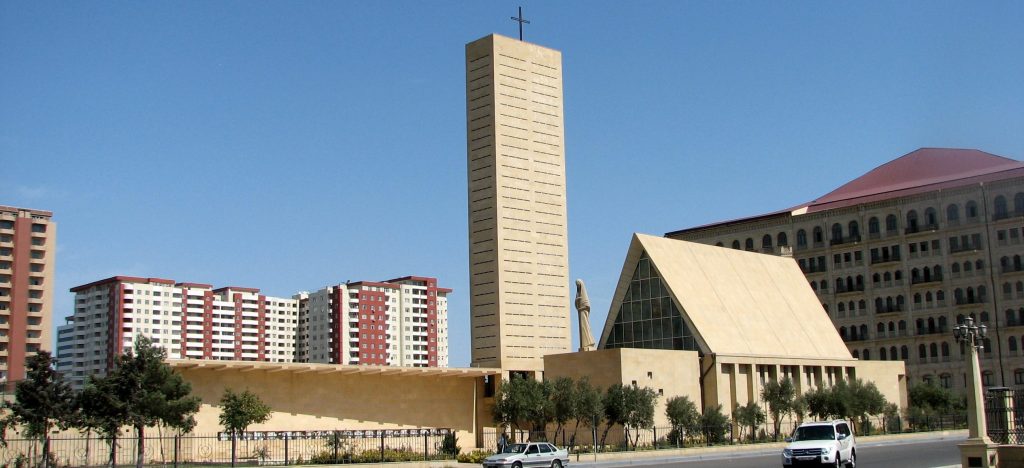
Getting back to your question, I want to say that these are just introductory classes. In order to, say, become a priest, you need to study at the seminary for five to six years. Of course, there is no such seminary in Azerbaijan—the nearest ones are in Russia and Kazakhstan, and, of course, in Ukraine as well. But if someone from the CIS countries wants to become a priest, they usually go to a Russian seminary. All Catholic priests in Azerbaijan today are foreigners, because the entire structure of the Catholic Church in our country was completely destroyed during the Soviet era. As you know, there used to be a Catholic church in Baku—the Church of the Virgin Mary’s Immaculate Conception. The current church also bears her name. That former church, a magnificent building in the Gothic style, stood on the site of the present-day Shahriyar Club. In Soviet times, this church was demolished, the entire church system destroyed, and the last priest was repressed and executed, and after that there were no more Catholic priests in Azerbaijan.
If I’m not mistaken, the US State Department prepared a report on the state of religious freedom in Azerbaijan in 2010, and this report said that religious freedom was being oppressed here. But you have just said that the Catholic Church has good relations with the Azerbaijani state. What was the reason for such an assessment by the State Department? Or was it indeed the case in 2010?
Belonging to the ethnic majority, I’m also considered a religious minority and I have communicated with both Catholics and Orthodox Christians. In my personal opinion, this position of the US State Department is very biased. What do they call oppression of religious freedom? Certain restrictions that the government imposes on destructive sects. Along with traditional denominations, there are also non-traditional ones in Azerbaijan, such as various supposedly Christian sects, Jehovah’s Witnesses, and so on. True, for all their unconventional nature, not all of them are destructive. Many people work normally, conduct religious activities, although, unlike Catholics and Orthodox Christians, they are more active and ambitious in promoting their teachings, sometimes demonstrating a lack of culture and civility, which causes discontent in society. Again, this is my personal opinion. The state, however, does not interfere in their affairs, but it does not forget about them either, because there might be issues with them tomorrow. Should some kind of social conflict arise between a Muslim and a person who calls himself or herself a Christian, no one will bother establishing whether that person is actually a Christian, or a Jehovah’s Witness, or a member of some sect operating under the guise of Christianity.
Let me put it this way: the government is trying to regulate in one way or another the activities of religious denominations prone to misbehavior. To keep it under control. Some of them are openly destructive. Just like there are, for example, some radical Islamic groups or groups collaborating with foreign states. Their existence is no secret to anyone. Naturally, the security services show interest in them. Who is the US ally in the Middle East? Saudi Arabia. And what is the state ideology in Saudi Arabia? Wahhabism. Not just Sunnism, but Wahhabism. The connection between this fact and the State Department’s report is obvious. That is, the target of government control in Azerbaijan is not Catholics, or Orthodox Christians, or traditional Shiites, or traditional Sunnis. This control concerns those who pose a potential threat and might cause problems. The state must protect itself.
A “year of multiculturalism” was declared in Azerbaijan a couple of years ago. Did this benefit Azerbaijani Christians in any way? Were you able to take advantage of this somehow?
It was an initiative aimed at strengthening relations between religion and the state. It can also be viewed as the propaganda of relations between the state and religion in Azerbaijan. Thanks to these kinds of initiatives, the Catholic Church is free to present itself. On the other hand, this initiative was also educational in nature, as most of the population do not bother to know what kind denominations are represented in Azerbaijan. And when they do find out, some are even surprised, wondering how Catholics or representatives of some other confessions ended up here. Thanks to the year of multiculturalism, they got to see that both the state and the whole world see it as an absolutely normal phenomenon, and Azerbaijan is mentioned in a positive context. From this point of view, the year of multiculturalism has certainly benefited the Catholic Church.
In our uncertain times, more and more people are beginning to gravitate towards religion. Especially in Azerbaijan, in the current conditions. How does this manifest in Christianity? Is the number of adepts of Christianity increasing or decreasing?
As a Catholic, I can only talk about the Catholic Church. In Catholicism, the unity of faith and reason is very important. They must be at one. You can’t have one without the other, it is regarded as crippling. If you perceive everything only intellectually, in a mundane and superficial form, this is your moral flaw. If you look at everything exclusively through the prism of faith, do not accept the achievements of science and are not interested in it, then this is also a disadvantage: it means that you are a retrograde who can do more harm than good, both to yourself and to society.
That’s why in Catholicism, religious and intellectual activities must be on equal footing. As for the overall increase in the interest in religion, humans are dual beings by nature—we consist of flesh and spirit. Both have needs of their own. Both must be nourished. This is what makes us human. Therefore, the attraction to religion is natural. On the contrary, those who deny the spiritual component lose one of their two wings. This upsets the balance in one’s consciousness and self-consciousness, in the attitude towards oneself and others.
By the way, the Pope has recently made some very strange, from a religious standpoint, statements, for example, that the church accepts homosexuality…
No, the Catholic Church has its own teachings, and they are immutable. And they are not affected either by the personal attitude of the Pope, or his predecessors, or those who will come after him. The Catholic Church has never accepted, does not accept, and will not accept same-sex marriage. Homosexual relationships are considered a grave sin. But according to this religion, extramarital affairs between heterosexuals are sinful, too. That is, fornication is fornication. It has no milder or heavier forms. In the Catholic Church, marriage can only be between a man and a woman. Mind you, one of the pillars of Christianity is that Christ created his church not for the righteous, but for sinners who can become righteous, and the doors of the church are open to everyone. “It is not the healthy who need a doctor, but the sick,” the Gospel says.
The church cannot turn anyone away just because a person is a sinner. We are all sinners in our own way, no one is perfect. And homosexuality is considered a sin only when it turns into action. An inclination, an attraction in itself, including sexual desire, cannot be considered a sin. Homosexuality is a false attraction that is born inside a person independently of their will. So, the Pope could not have said that. On the contrary, he says that if a homosexual person fights these inner urges as far as the strength of their faith allows, prays, goes to church and does charity work—it doesn’t matter whether they win or lose this fight, that is another question—who am I to accept or not accept, reject or condemn? It’s not about thoughts. A person can have all kinds of thoughts. One might even think about murder but never kill anyone. And we cannot declare a person a sinner just because they are experiencing a homosexual attraction. Sin begins when a person succumbs to this attraction and commits certain actions.
Does the church perceive homosexuality as an innate quality?
The church doesn’t give an answer to this. It only says that this is not normal and cannot be considered normal. The church does not fight against LGBT people, the church is against advocating homosexuality as the norm.
Another question then. How ready is Catholicism for internal reforms?
I can illustrate the attitude of Catholicism towards reforms with one example. One part of the Bible is St. Paul’s epistles to the early churches. They say that women must cover their heads when praying in church. But you must have been to churches in Western countries and you know that it is very rare to see a woman with a covered head there. It’s the same in our church. Despite the fact that the Apostle Paul spoke in plain text: a woman must cover her head during prayer. But at some point, Catholics thought about the historical and cultural context in which this was said. Can this context change or not? For example, the fact that Jesus Christ is the embodiment of God for Christians is a fixed, immutable law that does not depend on the cultural and historical context. The structure of the church—the pope, bishops, priests, deacons and laity—also does not change.
But the situation with head covering is somewhat different. In the time of the Apostle Paul, the only women who didn’t cover their head were usually representatives of the “ancient profession” or sinners, women outside the social norm. This was the tradition. And, by the way, in one form or another, this tradition exists to this day. I mean, looking at a woman’s appearance, her too frank, vulgar dress, we can guess that she is probably not a kindergarten teacher. And in those days, this rule was established in order to distinguish pious women from those who did not command much respect in society. But the cultural and historical context has changed. It would never occur to anyone today to consider a woman immoral just because of her uncovered head. So, this rule can also change. That is, the Catholic Church takes into account the cultural and historical context. But only when it comes to moral instruction, not religious doctrine! Only in matters of morality.
There are also radical Islamic movements active in Azerbaijan today, and there are many fanatics committed to them. Do you have conflicts on religious grounds with Muslims or representatives of other religions?
The Catholic Church has not had such conflicts so far. Our church has a doctrine that prescribes how to treat other religions and their ceremonies, what extent tolerance can reach, what is acceptable and what is not. Because of this, the Catholic Church does not have such problems, or they are a rare exception.
For example, the Catholic Church has nothing against one of its members celebrating Ramadan together with Muslims. You have probably seen that during Iftar, Sheikh-ul-Islam sits at the same table with both Orthodox and Catholic bishops. This is normal practice for the Catholic Church. It is not forbidden to greet Muslims or Jews, wishing them a happy holiday, and so on.
Yes, there have been certain conflicts in history, but, again, after the historical context changed, this does not happen anymore. And why did those conflicts occur in the first place? In the case of the Jews, these were financial disagreements disguised as religious ones. In the case of Muslims, conflicts were manufactured in order to prevent the expansion of the Ottomans into Europe and to awaken patriotic feelings. But in the 20th and 21st centuries, the doctrine of the Catholic Church no longer allows such discrimination. Yes, there are radicals—among Catholics, too. These things have happened. Some didn’t even like the bishop meeting with Muslims. But this rarely happens, and it usually has to do with the level of the person’s intellectual development, lack of internal culture. The church explains to these people that they cannot act like this—you must either come to your senses and behave normally in church and society, or you will simply be excommunicated. Of course, no one will kick you out of the door, but you will no longer be able to participate in religious ceremonies.
This is the attitude of the church towards representatives of other religions. And how do they feel about the church?
Speaking of Azerbaijan, there have been no serious problems here. Except that someone once tried to set fire to our church. This happened in 2006 or 2007. The church was still under construction at that time, interior decoration work was underway. Someone threw a Molotov cocktail, we never found out who and took it as an act of hooliganism. Perhaps some radicals were behind this.
When any information related to the church, be it Catholic or Orthodox, appears on social media, a certain part of the population reacts to it with prejudice, knowing nothing about Christianity. Historically, Christianity in Azerbaijan was directly associated with representatives of other ethnic groups. For the average Azerbaijani, a Christian is Russian, Armenian, Georgian, or someone from the West. Many say Christianity has already failed because it now allows same-sex marriage. And they don’t bother to find out exactly which denominations (or rather, which movements that separated from the True Church) allow it. They comment that the Catholic Church has disgraced itself by blessing such marriages and holding church weddings. All of this stems from the lack of information. Or there is an opinion that if an Azerbaijani converts to Christianity, then this person will definitely take the side of some country or nation that doesn’t get along with Azerbaijan. Or, when you say that you are Christian, you’re asked whether you are Russian or Armenian. Of course, ignorance is the reason.
Prejudice is almost always rooted in the lack of information, and, in my opinion, we need awareness-raising activities in this area. The year of multiculturalism and other initiatives of this kind give impetus to public awareness—not to the full but to some extent. If, for example, priests of such traditional denominations as Sunnis and Shiites meet with their Catholic and Orthodox “counterparts”, communicate with them on equal terms, then the stereotypes about Christianity existing in society begin to break down. I’m talking about the stereotypes, according to which Christianity is a religion hostile to Azerbaijan, an immoral religion, a religion of Western cultures. Meanwhile, Christianity is actually not a Western, but an Eastern religion, it came from the East. Many of these stereotypes can be broken through education. It will also help to further strengthen tolerance in society.
Another very important point. We really want our society to understand that both Christianity (Orthodox and Catholic churches) and Christians—the citizens of this country, regardless of their ethnicity—are in no way opposed to the Azerbaijani nation, statehood, culture, moral values and traditions. Quite the contrary. For example, being an Azerbaijani Catholic, I never separate one from the other in my head, I never ask myself whether I should be “more Azerbaijani” or “more Catholic”. How good of an Azerbaijani I am is defined by how good of a Catholic I am, and vice versa. This is so, and so it should be. There is no contradiction, no mutual exclusion here, and there should not be. There is no reason for it either. But the fact is that our society is very attached to history. Someone sitting next to me may say that the Muslims did the right thing back then when they destroyed a church or turned it into a mosque… But this is a historical event that happened a long time ago. In present-day Azerbaijan, no one turns a church into a mosque, and none of today’s Christians turns a mosque into a church. We cannot live focusing only on history and on the image of the enemy. There have been many conflicts in history—both on religious grounds and on territorial grounds, and conflicts that used religion as a cover.
Take, for example, Nagorno-Karabakh. This is not a religious conflict, it never has been, although the Armenians at first tried to give it a religious connotation. They tied ribbons with a cross on their tanks and around their soldiers’ heads. But, in fact, this conflict has never had anything to do with religion. And now, some people occasionally speak about Karabakh not from the position of Azerbaijanis, but from the position of Muslims, which is also a mistake, it is something that should not be done.
To me, as an Azerbaijani and a Catholic, it doesn’t matter that Armenians are Christians. There can be no question of religious brotherhood here, because this is a war between states.
Interview by Aygun Aslanli
Aze.Media