Azerbaijan has launched a public campaign against Russia, with the government and other public figures lining up to air choreographed grievances.
The pretext is clear: the alleged use of state-of-the-art Russian missiles against Azerbaijani targets in the waning days of last year’s war. But what’s less clear is what exactly Baku is trying to get out of Moscow as a result.
The campaign launched on April 2, when Azerbaijan’s state mine-removal agency ANAMA announced that it had found remains of two exploded Iskander missiles as it was clearing ordnance in Shusha, in Nagorno-Karabakh. This revived a long-running controversy over whether or not Armenia had used the missiles during the war, an issue that had previously led to serious political crisis in Armenia but which Azerbaijan had been content to stay out of.
When Armenian Prime Minister Nikol Pashinyan notoriously claimed in February that Armenia had used the Iskander missiles, but that “90 percent of them didn’t explode,” Azerbaijani President Ilham Aliyev said that his side had no evidence that the missiles had been fired at them, and mocked Pashinyan for making “another public blooper.”
Now, though, the tone from Baku has changed. And ANAMA’s announcement included an extra-spicy accusation: that the missiles used against Shusha were not the Iskander E variant, designed for export and which Armenia was known to have had, but the M variant, which is known to be operated only by Russia. And the report has been followed by a seemingly coordinated PR campaign against Russia of the type that is often seen when Baku wants to make things difficult for Moscow.
As usually happens in these kinds of cases, senior Azerbaijani officials, including Aliyev, have been relatively muted, taking a “just asking questions” tone. On April 12, at the official inauguration of a new “Military Trophies Park” where the Iskanders were on display (among far more notorious exhibits), he said: “Armenians fired at Shusha with these Iskander-M missiles. Where did the Armenian military get these missiles from? They shouldn’t have had them.”
The next day, Aliyev reported that in a phone conversation with his Russian counterpart Vladimir Putin two weeks earlier, “we discussed this question. On my orders, Azerbaijan’s Defense Ministry sent an official letter with photographs, evidence. But so far we haven’t received any answer.”
The dirtier work, meanwhile, is being done by semi-official sources.
“The Iskandar M, the remnants of one of which were discovered in Shusha, is in the sole possession of the Russian Federation,” wrote Esmira Jafarova, an analyst at the state-run think tank Center of Analysis of International Relations. “The story behind this discovery definitely has a dark side that needs to be clarified, as the absence of plausible answers may generate dangerous speculation.”
Another analyst, Elchin Mirzabayli, suggested the M variant had been supplied illegally to Armenia. “These missile systems were illegally delivered to Armenia by criminal groups engaged in the arms trade,” Mirzabayli told the local news site Azernews. “Either Russia is holding back the truth about the sale of Iskander-M missiles to Armenia, or its leadership has not been informed about it. Anyway, the fact must be seriously investigated.”
Russian officials have repeatedly denied it. Putin spokesman Dmitriy Peskov said immediately after ANAMA’s announcement that Moscow confirmed that Iskanders (of any variety) hadn’t been used in the war and that they had no information about where Azerbaijan’s evidence was coming from. But he continues to be asked about it, and on April 11 he said that: “Military officials are engaged in a close dialogue. All corresponding questions are being discussed.”
Armenian military officials have refused to comment.
There have been reports in the past that Armenia did in fact get the M variant from Russia. A 2018 story in the Russian newspaper Kommersant cited an unnamed source in Russia’s defense industry saying that Armenia got a division’s worth of the Iskander M systems in 2016. Somewhat vaguely, it explained that this violated export protocols (the domestic version has a longer range than the export version), but that “Moscow was forced to take the step” because Armenia had no other option to defend itself in case of an Azerbaijani attack on Nagorno-Karabakh.
The publicly available evidence, though, doesn’t prove whether the E or the M version was used. The images published by Azerbaijan could be from the rocket used in either system, Dmitriy Kornev, an analyst of Russian military hardware, told Eurasianet.
At this point, though, whether the Iskander was used and if so, what kind, has become a secondary issue. Its role as a political instrument by Armenians, Azerbaijanis, and possibly Russians, is far more significant. The question, as yet unanswered, is what Baku is now trying to get out of Moscow.
This kind of information campaign by Azerbaijan isn’t new, especially against Russia. But it is especially sensitive given Russia’s newly empowered role in the region.
It doesn’t appear that there is any one specific issue, but rather an overall dissatisfaction with Russia’s new role as virtually the sole mediator between the two sides, including the crucial peacekeeping mission.
The Russia-Azerbaijan dyad is probably the single most important relationship for determining the future contours of the conflict. It was Russia’s intervention following Azerbaijan’s victory in Shusha that prevented Azerbaijan from quickly completing its conquest of all of Nagorno-Karabakh, and it is the Russian peacekeeping mission that remains the only thing protecting the Armenian civilians remaining in Karabakh today. It’s not clear how Russia convinced Azerbaijan to stop its offensive, and it’s not clear how Moscow intends to convince Baku to extend the mandate of the peacekeeping mission when it expires in late 2025.
Analyst Shahin Jafarli told BBC Azeri that the government’s grievances against Russia were general, that its peacekeeping mission has been excessively favoring the Armenian side. He added that it appeared the Russians were building barracks and other infrastructure that suggested they were preparing for a larger mission. And he argued that the Iskander claims were “a sign of growing tensions between the two sides.”
Azerbaijan may also be leaning on Russia so that Russia in turn leans on Armenia to take some of the steps that Azerbaijan has been demanding, like withdraw Armenian military forces from the region and provide maps of the land mines the Armenian side laid during the war.
All of these negotiations are opaque, however, and Russia isn’t tipping its hand. A couple of other developments this week only added to the number of moving parts.
The first was Pashinyan’s announcement that Armenia was “conducting effective discussions with our Russian colleagues” about setting up a second Russian military base in the country, in the southern Syunik region. There hasn’t been any mention of this from the Russian side. But if it came to pass, it obviously would only deepen Russia’s role as Armenia’s security guarantor.
The second was a report in the Russian newspaper RBK about discussions around Azerbaijan participating in an upcoming meeting of the Eurasian Economic Union (EAEU), the Russia-led trade bloc. It has been a long-standing Russian goal to get Azerbaijan to join the EAEU (along with every other post-Soviet state that isn’t already a member), and Azerbaijan has never been particularly interested. Further, the Armenian sources for the story say that Armenia (a current EAEU member) is blocking Azerbaijan’s participation until the latter releases the Armenian captives it has been holding since the end of the war.
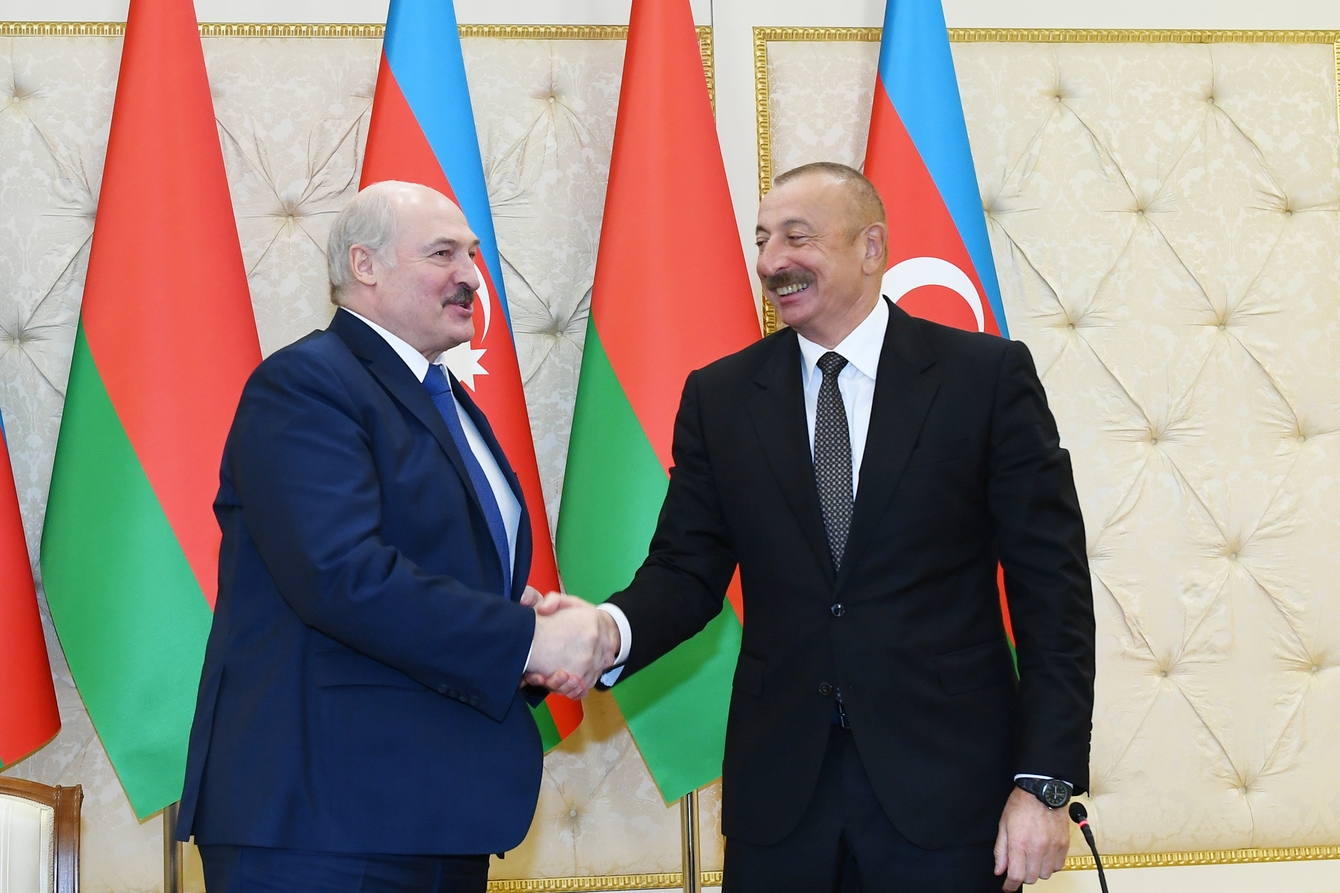
Why would Baku take this step that it’s been unwilling to take thus far in order to participate in a meeting of a group it doesn’t want to join? RBK acknowledges that is unlikely to happen ahead of the meeting (scheduled for the end of April in Kazan). But if there are real discussions about Azerbaijan at least participating in the EAEU, it could potentially be a way to score points with Moscow while allowing Azerbaijan access to another platform it can use to pressure Armenia. It doesn’t hurt that most EAEU member states probably have better relations with Baku than with Yerevan, a fact underscored by Belarusian President Alexander Lukashenko’s visit this week to Azerbaijan, where he got a warm welcome including an invitation to participate in the reconstruction of Azerbaijan’s newly retaken territories.
“I said again that we will invite only companies from friendly countries to participate in the reconstruction of the territories. And Belarus is a friendly country for Azerbaijan,” Aliyev told Lukashenko at a joint press appearance on April 14.
Lukashenko, for his part, offered a very Lukashenkian call for reconciliation.
“Thank god this is all over. It’s great that you ended it, and I’m sure that you will turn this page like this, that Azerbaijan is not planning to humiliate the Armenians who live in Azerbaijan, after all they don’t live in Karabakh but in other places also,” he said, using a Belarusian criminal slang phrase that refers to prison rape. “And I haven’t seen any evidence that any Azerbaijanis are humiliating Armenians. We will offer any kind of help wherever you ask. We will offer our own variants.”
Azerbaijan’s post-war behavior, though, suggests that humiliation is precisely what it is trying to achieve, a revenge for 26 years of its own humiliation. It’s been pushing its advantage against on-its-heels Armenia, but it’s a risker gambit to try against Russia.
Joshua Kucera
Eurasianet