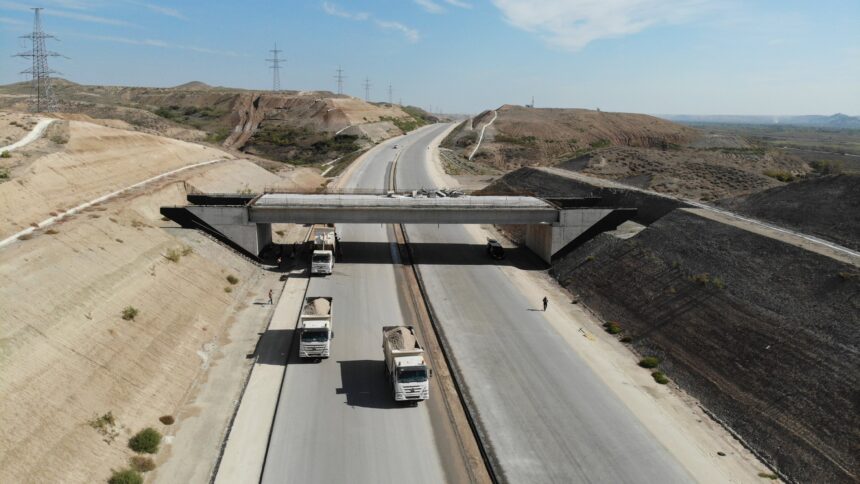
Armenia’s Prime Minister Nikol Pashinyan spoke to the European Parliament in Strasbourg on March 11 and said he has no intention of delaying TRIPP, the newly proposed South Caucasus route through southern Armenia to be integrated into the existing Middle Corridor. He described the project as being “in the crystallization stage,” said that the Armenia–U.S. implementation framework (signed on 13 January) was already in place, and added that the two countries will “[i]n the near future … sign the relevant agreements, and the practical implementation of the project will begin.”
While mentioning that developments in Iran and the wider Middle East could shade an otherwise positive regional picture, Pashinyan explicitly did not connect that to any actual delay in the corridor project. This accords with the view of the EU itself, which treats the Middle Corridor and its South Caucasus segment, as does the World Bank, as an increasingly necessary connection between Central Asia and Europe through the South Caucasus and Turkey. Pashinyan’s statement should thereby reassure not just European governments but also the investors and shippers that want and need the route.
From Declaration to Implementation
Pashinyan tied TRIPP to the Washington Declaration of August 8, especially to its provisions on reopening communications and establishing a U.S.-supported framework for unimpeded connectivity between mainland Azerbaijan and Nakhchivan through Armenian territory. The Washington meeting produced a joint declaration by Armenia and Azerbaijan and the text of the initialed peace agreement, while also making clear that signing and ratification still lay ahead.
In Strasbourg, according to Pashinyan’s own words, the Washington Declaration “essentially established peace” between Armenia and Azerbaijan. He also gave pertinent indicators. Pashinyan stated there had been eight months of complete peace on the border and that 2025 was the first full calendar year since independence without casualties or injuries from Armenian–Azerbaijani shooting. He also said that in November 2025, for the first time since independence, a train (carrying wheat from Kazakhstan) reached Armenia through Azerbaijan and Georgia after Azerbaijan lifted restrictions on that rail route. Azerbaijan has since sent fuel and other commodities through Georgia to Armenia. Such transits have now become a regular occurrence.
Since 2020, Armenia has turned toward Central Asia as part of its effort to reduce dependence on Russia. Kazakhstan has become the clearest practical partner in that effort as this turn has accentuated in recent months. During Pashinyan’s 21 November 2025 visit to Astana, the two sides upgraded relations to a strategic partnership and signed 15 intergovernmental and interagency documents, including a trade and economic roadmap for 2026–2030 that projects cooperation in agriculture, digitalization, healthcare, industry, science and education, and peaceful uses of atomic energy.
While the cooperation with Kazakhstan is a continuation of previous trends, the sharpest diplomatic change is with Uzbekistan. After Pashinyan’s 12 July 2023 telephone call with President Shavkat Mirziyoyev, stressing the need to convene the first intergovernmental commission to move practical projects forward, that commission met in Tashkent on 3–4 August 2023, with a modest but real result in foreign trade growth. Armenia’s outreach to Central Asia exemplifies how the country’s broader diplomatic profile under Pashinyan complements the country’s eventual participation in the Middle Corridor through TRIPP.
Why Central Asia Cares
The Middle Corridor is correctly seen as a source of resilience and route diversification for trade between Asia and Europe. The World Bank describes it this way, while EU materials frame the South Caucasus and Turkey as the bridge through which Europe’s links with Central Asia are to be strengthened. This is all the more the case now that Iran-crossing options from Central Asia to Turkey, for example through Turkmenistan, have receded from feasibility for the foreseeable future. The same is true of the route agreed between Azerbaijan and Iran in October 2023 for access to Nakhchivan through northern Iran, which was never completed.
Kazakhstan, Uzbekistan, and other Central Asian states thus have an interest in maintaining the perception that the South Caucasus continuation of the Middle Corridor is viable enough to deserve policy attention, commercial planning, and further investment. In pursuit of cooperation from all interested parties, Kazakhstan has recently engaged in outreach to Gulf partners that point the same way, as Central Asian governments manage corridor risk diplomatically as well as commercially. Azerbaijan began its own programmatic connectivity outreach to the Gulf countries several years ago.
At issue is not just transit efficiency but strategic optionality. The westbound corridor through the Caspian and the South Caucasus has become perhaps the main instrument through which Central Asian countries widen their room for geoeconomic maneuver without pretending that older routes will simply disappear. An EU study released last month places this logic squarely in a Europe–Central Asia framework. The World Bank report makes a related point in more economic language, arguing that the Turkey–South Caucasus corridor can increase resilience and help reorient supply chains.
In Strasbourg, Pashinyan reflected this logic, saying that Armenia was ready at once to provide road transit between Azerbaijan and Turkey, and between western Azerbaijan and Nakhchivan, using existing Armenian infrastructure. The problem here is that such a route through Armenia would currently be extremely circuitous and does not necessarily have guaranteed security. But at the same time, Pashinyan stressed that this expressed readiness was not meant to delay, disrupt, or replace the Washington understandings that undergird the future TRIPP. His purpose here appears to be to show that continuing momentum does not depend on a final diplomatic architecture and is indeed integrated within that larger framework.
Wider Strategic Consequences
The question for Central Asia is whether Iran’s shadow over the South Caucasus is strong enough to damage confidence in the westbound TRIPP route that major IFIs and other state actors now regard as strategically necessary. By the evidence Pashinyan offered on 11 March, the answer is no. When Pashinyan insisted that Armenia had no reason to delay implementation, he was defending the investment logic of the TRIPP segment at a time when external observers might begin to wonder whether the Iran crisis could freeze momentum. Even after current hostilities end, it is unlikely that Iran-crossing routes will function at full commercial scale due to insurance and payments constraints.
The political momentum behind TRIPP has thus not been overturned, not least because Central Asian states need supply-chain redundancy. The same goes for the broader Armenia–Azerbaijan normalization process that makes this segment of the Middle Corridor possible. This assessment emerges from Pashinyan’s first-person testimony, recent practical movement in Armenia–Azerbaijan normalization, and the fact that Europe and international financial actors now treat the South Caucasus bridge as part of a serious Europe-Central Asia connectivity project.
In addition to Armenia and Azerbaijan themselves, almost all external actors will benefit from TRIPP, although their strategic benefits differ. For the European Union, enhanced South Caucasus transit reinforces a connection to Central Asia that does not depend on Russia. For the United States, it moves forward the American diplomatic initiative to shape the region’s post-conflict order after the Washington breakthrough on the basis of mutual benefit. For China, any stable westbound connection across the Caspian and Caucasus adds redundancy to Eurasian transit without displacing Beijing’s other routes. Even Russia has come to support the TRIPP route, because it increases connectivity with Armenia, Turkey and Europe through existing Azerbaijani rail infrastructure. This configuration of interests represents the gradual consolidation of the route’s forward movement. Iran is objectively the only state or nonstate actor opposing the consolidation of this peace and prosperity in the South Caucasus, with benefits stretching from Central Asia to Europe. However, Tehran’s capacity for influence here is eroding as quickly as its military infrastructure.
Dr. Robert M. Cutler