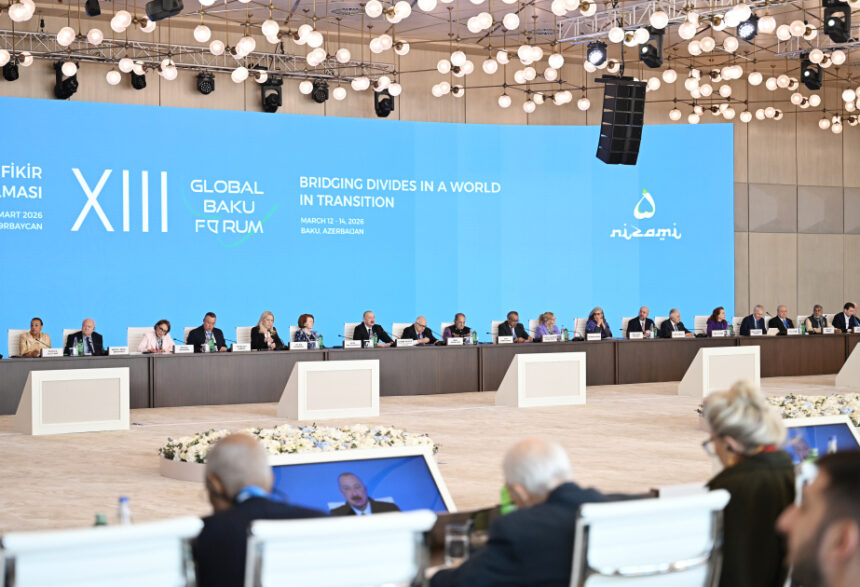
In recent years, Azerbaijan has consistently sought to shape its image as a platform for global dialogue between different political camps — the West, countries of the Global South, states of the post-Soviet space, and the Middle East. Such a role allows the country to position itself as a convenient diplomatic venue for discussing the most sensitive international issues. The Baku Forum itself clearly demonstrated Baku’s intention to consolidate this role.
The central event of the forum was the speech delivered by President Ilham Aliyev. In his address, he sought to emphasize Azerbaijan’s role as a state that has successfully adapted to the emerging multipolar system of international relations. Within this framework, Baku presents itself as an important energy and transport hub between Europe and Asia, capable of playing an increasingly visible role in the new configuration of the global economy and politics.
At the same time, the first part of the Azerbaijani president’s speech was largely built around Azerbaijan’s experience in resolving the Karabakh conflict. Aliyev noted that recent events clearly demonstrate that security and stability are once again becoming the primary priorities for states. Even countries that for decades focused mainly on economic development are now forced to return to issues of protecting sovereignty and national security.
Moving to Azerbaijan’s experience, Aliyev outlined a clear narrative of the history of the Karabakh conflict. At the center of this narrative was the thesis of the complete ineffectiveness of international conflict-resolution mechanisms. The resolutions of the UN Security Council demanding the withdrawal of Armenian forces from Azerbaijan’s occupied territories remained unimplemented for nearly three decades. International mediation, primarily within the framework of the OSCE Minsk Group, not only failed to bring the conflict closer to resolution but in many ways entrenched the existing status quo.
As a result, Azerbaijan found itself in a situation where the diplomatic process was being prolonged indefinitely, while the prospect of restoring control over its territories was becoming increasingly remote. Under these circumstances, Baku decided to restore the country’s territorial integrity by force, relying on the right to self-defense enshrined in Article 51 of the UN Charter.
According to Aliyev, however, the use of force was only one stage on the path toward a political settlement. After the military phase ended, the conflict began to transition into a peace process.
Less than two years after the local anti-terrorist measures carried out in the Karabakh economic region in 2023 and the final elimination of separatism on Azerbaijani territory, Baku and Yerevan were able to move toward a peace dialogue. This represents a rather rare, and possibly unique, example of relatively rapid normalization after a long and difficult conflict.
Baku also seeks to present this experience as a kind of model for restoring justice by a sovereign state relying on the norms and principles of international law.
An important element of the current stage of the settlement is the rejection of the previous mediation mechanisms. The shift to direct dialogue between Azerbaijan and Armenia made it possible for the parties to move closer to peace after decades of fruitless negotiations.
Special attention should also be paid to the use of the concept of a “transitional period” in global politics. Aliyev effectively speaks about the crisis of the previous system of international relations and the gradual formation of a new security architecture. This interpretation reflects a widely shared view today about the weakening of former centers of global influence and the strengthening role of regional powers.
This rhetoric also serves another important function — it helps explain Baku’s foreign policy flexibility. Azerbaijan simultaneously develops relations with the European Union, Türkiye, the countries of Central Asia, and the states of the Global South, while maintaining a significant degree of strategic autonomy.
Another important theme of the speech was energy security. In conditions of growing geopolitical instability, energy is becoming increasingly directly linked to issues of national security.
The Azerbaijani head of state also pointed out that a sharp increase in oil and gas prices is not always beneficial for exporters. Many oil- and gas-producing countries possess large sovereign wealth funds, a significant portion of whose assets are invested in global financial markets. In conditions of financial instability, losses from declining stock markets may be comparable to the additional revenues generated by high energy prices. Therefore, Azerbaijan advocates for a predictable and balanced energy market.
Within this logic, Baku positions itself as a responsible participant in the OPEC+ format and a reliable supplier of energy resources. Over the past year, the number of countries receiving Azerbaijani gas has increased from twelve to sixteen, highlighting the country’s growing role in ensuring the energy security of Europe and neighboring regions.
In the final part of his speech, the Azerbaijani president emphasized the issue of transport connectivity. According to him, conflicts and geopolitical tensions increasingly disrupt traditional trade routes and create serious challenges for global supply chains. Against this background, the importance of alternative transport corridors is growing.
Azerbaijan aims to occupy a key place in this system. Revenues from hydrocarbon exports are deliberately invested in the development of transport and logistics infrastructure. As a result, the country has become one of the central hubs of Eurasian routes, simultaneously participating in both the East–West and North–South corridors.
The main infrastructure projects on Azerbaijan’s territory have already been implemented, and today Baku is focusing on expanding the capacity of existing routes. Additional opportunities may arise with the opening of transport communications through the territory of Armenia, which would connect mainland Azerbaijan with the Nakhchivan Autonomous Republic and at the same time expand the potential of the Middle Corridor.
Overall, the entire speech can be seen as an attempt to convey a clear political message to the international audience: in a rapidly changing global system, states must be able to adapt to new realities without allowing external actors to dictate their development agenda. According to Baku, Azerbaijan today demonstrates precisely such a model of behavior — combining foreign policy flexibility with a firm defense of its strategic interests.
Ilgar Velizade