Events in neighboring Iran and the continuing war are increasingly affecting not only the military-political situation but also the country’s internal stability. Like any large-scale war, the current conflict is gradually beginning to influence the condition of society itself. Alongside military targets and infrastructure, civilian facilities are also suffering destruction — residential buildings, social institutions, and elements of urban infrastructure.
At the same time, the economic consequences of the war are intensifying. The export of food products from the country is being sharply restricted, and concerns about possible shortages of food, medicines, and other essential goods are being voiced more frequently. Under the pressure of war, such factors often become one of the most painful consequences of a conflict for ordinary people.
Against this background, the humanitarian dimension is gaining particular importance. It is already becoming clear that the consequences of the war may be expressed not only in military losses but also in the growth of social problems within the country.
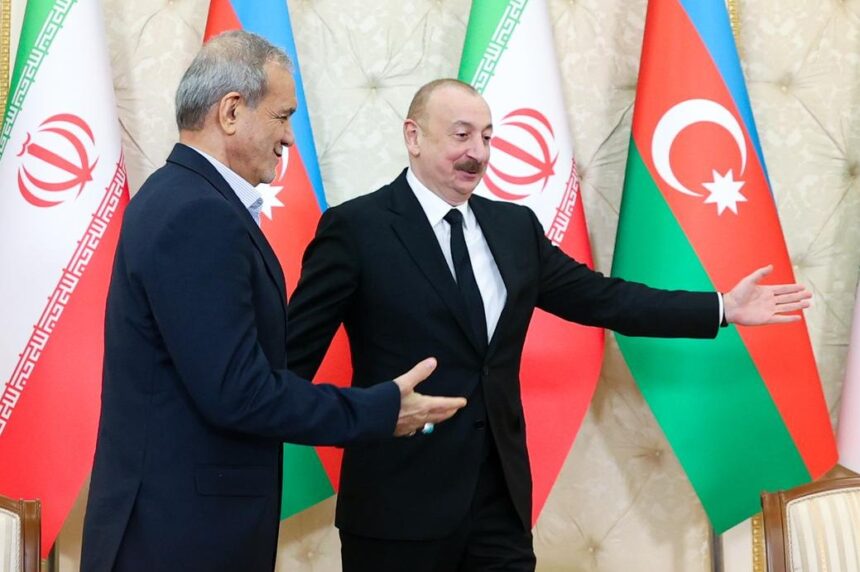
It was precisely in this situation that, on March 10 — effectively just a day after a telephone conversation between the President of Azerbaijan, Ilham Aliyev, and the President of Iran, Masoud Pezeshkian — the Azerbaijani head of state ordered the delivery of a large shipment of humanitarian aid to Iran. Notably, during the entire current military campaign, this is the first case in which a foreign country has sent humanitarian assistance to Iran. That country was Azerbaijan.
The composition of the aid sent is clearly practical in nature. The humanitarian shipment includes about 10 tons of flour, 6 tons of rice, 2.4 tons of sugar, more than 4 tons of drinking water, around 600 kilograms of tea, as well as nearly 2 tons of medicines and medical supplies. These are basic food products and medical resources — precisely the items that become most needed during wartime.
This step carries not only humanitarian but also political significance. It demonstrates that Baku pursues an independent and sovereign policy guided primarily by its own values and interests. This is especially important when it concerns a neighboring country on whose territory tens of millions of Azerbaijanis live.
At the 9th Summit of the Organization of Turkic States in Samarkand, President Ilham Aliyev directly stated that the Turkic world is not limited to the borders of independent Turkic states. According to him, the countries of the Turkic world must take into account the situation of Turkic peoples living beyond the borders of those states.
“The Turkic world consists not only of independent Turkic states. The time has come to keep on the agenda the protection of the rights, security, and national identity of our compatriots living outside the member states of the organization,” Ilham Aliyev emphasized.
Today this idea is receiving a very practical expression. The decision to send humanitarian aid shows that Baku views the humanitarian dimension of regional policy as an important part of its responsibility. At the same time, this step can also be seen as a signal to those forces inside Iran that continue to view Azerbaijan through the prism of suspicion and promote narratives about an alleged threat to Iranian interests supposedly emanating from Azerbaijani territory. When people facing the risk of humanitarian hardship receive tons of flour, rice, sugar, and medicines, such accusations begin to look particularly paradoxical. If helping civilians during wartime is presented as a threat, a natural question arises: what should actually be considered a threat?
Another point is also worth noting. For many years, Iranian political and public figures have often reminded Baku of the humanitarian assistance Tehran provided to Azerbaijan during the first Karabakh war. This argument has regularly appeared in political discussions and has been used as a reminder of a supposed “debt of gratitude.” However, another fact has often remained in the background. At the same time that assistance was being provided to Azerbaijan, the Armenian side also received significant preferences from Iran. After the occupation of a large part of Azerbaijani territory, Tehran did not close its border with Armenia, which in practice allowed Yerevan to preserve an important channel of economic and transport interaction with the outside world.
In this sense, Azerbaijan’s current humanitarian aid also acquires a symbolic dimension. In a completely different geopolitical context, Baku is, figuratively speaking, returning this debt — and doing so without any obvious political or economic benefits for itself. First and foremost, this is a humanitarian gesture toward the population of a neighboring country that has found itself in a difficult situation because of war.
At the same time, another context must be taken into account. The memory of the drone attack on Azerbaijani territory in the Nakhchivan direction is still fresh, and the incident itself cannot be considered fully resolved. Nevertheless, Azerbaijan, guided primarily by humanitarian considerations, has decided to provide assistance to the population of a neighboring country. This step demonstrates that even in a difficult and tense regional environment, Baku separates political disagreements from humanitarian responsibility toward people facing hardship.
One can only hope that this gesture of goodwill will be genuinely appreciated in Iran itself. Especially since Azerbaijan is acting not according to the principle of repaying a debt, but according to a more universal and widely understandable principle — the principle of common human compassion, which sounds the same in every language.
Ilgar Velizade