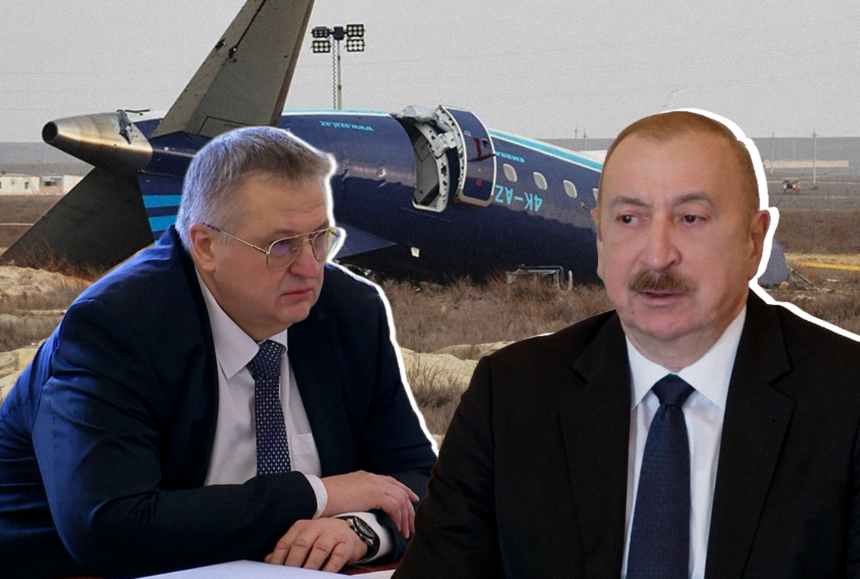
On March 2, President of the Republic of Azerbaijan Ilham Aliyev received Deputy Prime Minister of the Russian Federation and Co-Chair of the Intergovernmental Commission Alexey Overchuk.
During the meeting, which was held in a friendly atmosphere, a wide range of issues was addressed: the evacuation of Russian citizens from Iran through Azerbaijan, prospects for developing transport communications, the North–South corridor, and more. However, public attention was primarily drawn to another item on the agenda. It was noted that, in line with the agreements reached by the leaders of Azerbaijan and Russia during their meeting in Dushanbe on October 9, 2025, the parties will soon implement a set of practical steps to resolve the issues arising from the crash of the AZAL aircraft on December 25, 2024.
A brief recap is necessary here. On February 26, Azerbaijan’s Foreign Minister Jeyhun Bayramov reiterated that Azerbaijan’s position regarding the December 2024 AZAL crash near Aktau remains firm and principled: it was a mistake by the Russian military. According to the Azerbaijani foreign minister, Russia must fulfill the commitments voiced by Vladimir Putin during his meeting with the President of Azerbaijan in October 2025.
“The aircraft was shot down due to an error by the Russian Ministry of Defense. We expect the Russian side to take all necessary steps, provide a legal assessment of what happened, and pay compensation,” Bayramov emphasized.
Moscow heard the statement. Within hours, Maria Zakharova, the official spokesperson of the Russian Foreign Ministry, commented on the AZAL incident. According to her, Russia is committed to resolving all remaining issues with Azerbaijan. She also noted that the leaders of Russia and Azerbaijan discussed the matter in detail during their October 9 meeting in Dushanbe.
“Detailed explanations were provided by the Russian side. We are consistently working on implementing all the agreements reached and regularly inform our Azerbaijani partners through diplomatic channels as well as at the governmental level,” Zakharova added.
Now a delegation headed by Overchuk has arrived in Baku to discuss, among other things, practical steps regarding the investigation of the Azerbaijani airliner crash. It goes without saying that Baku expects, first and foremost, the resumption of the investigation, accountability for those responsible, and the payment of compensation.
Another noteworthy development occurred almost simultaneously. As negotiations were underway in Baku, statements regarding the investigation were also made in Astana. The commission investigating the AZAL crash intends to make every effort to complete its work as soon as possible, Kazakhstan’s Ministry of Transport told RIA Novosti.
“Precise timelines for completing the investigation have not yet been established, but the commission is doing everything possible to finalize it as quickly as possible,” the ministry stated.
We will deliberately refrain from political speculation or building “theories on sand” about the extent to which the Kazakh statement is connected to the talks in Baku and the intensified dialogue between Azerbaijan and Russia. What matters is something else. In virtually every aviation disaster, there is a human factor. Mistakes — including tragic ones — are made by many. And today, Azerbaijan is not seeking revenge.
First, the life of every citizen is of the highest value to us. Second, as we must emphasize once again, the sky is shared by all. The safety of civil aviation is not solely a matter for Azerbaijan or Russia. That is precisely why the global practice of thoroughly investigating aviation incidents — from all angles and with attention to the smallest details — exists. Simply because without such investigations, no one can predict whose civilian airliner might next become the victim of someone’s air defense error.
A. Shakur