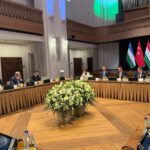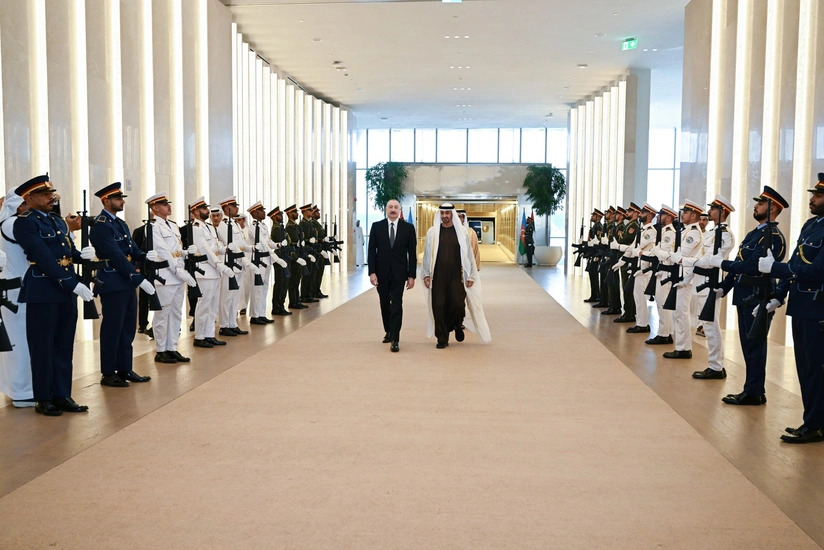
Among the recent developments, the visit of Azerbaijani President Ilham Aliyev to the United Arab Emirates stands out as particularly significant. Although formally designated as a working visit, in substance it went far beyond a routine protocol event and was rich in political, economic, and military-strategic meaning. The official occasion was the presentation to the Azerbaijani president of the prestigious 2026 Zayed Award for Human Fraternity, yet the visit’s real agenda proved to be far broader and directly related to key processes shaping regional dynamics.
The context of the visit is largely defined by rising tensions around Iran, which, if they were to escalate, could trigger a chain of highly dangerous consequences — from deterioration of the military-political situation to large-scale humanitarian crises inevitably affecting all of Iran’s neighbors. Additional instability in the regional architecture is also being introduced by the intensifying rivalry among the leading players in the Persian Gulf. In particular, the deterioration of relations between Saudi Arabia and the United Arab Emirates creates a new level of uncertainty and increases the risks of fragmentation across the region.
Against this backdrop, Azerbaijan — having only recently emerged from a long and bloody conflict with Armenia — is objectively not interested in being drawn into new confrontations. On the contrary, Baku has consistently demonstrated its intention to build balanced and pragmatic relations with all key regional actors, even when relations among those actors themselves remain tense or openly conflictual. This line reflects a deliberate bet on strategic autonomy and the minimization of external risks.
In this context, cooperation with the UAE appears especially illustrative. For Baku, the Emirates’ experience in building pragmatic relations with neighbors and pursuing a well-thought-out policy of economic diversification is highly attractive. Importantly, while reducing dependence on the oil and gas sector, the UAE has not abandoned the use of its natural resources; instead, it has turned them into a solid financial foundation for building a modern, technologically advanced, and multifunctional economy. In many ways, this logic is close to Azerbaijan’s own approach, which views energy resources as a tool for long-term development rather than an end in themselves.
The similarity of approaches was reflected in the documents signed during the visit. The key agreement was the purchase-and-sale contract for part of the non-controlling stake held by Azerbaijan’s Ministry of Economy in Southern Gas Corridor CJSC, acquired by the investment company XRG, a subsidiary of the Abu Dhabi National Oil Company. In essence, this is a standard investment deal that does not imply the transfer of control. Management and strategic decision-making remain with Azerbaijan, while the project’s ownership structure is complemented by a new, large, and financially robust partner.
At the same time, from a practical standpoint, the deal contains significant potential. It effectively moves the UAE from the status of an external partner to that of a direct co-owner of one of Azerbaijan’s key energy projects. This transformation changes the very logic of Abu Dhabi’s involvement — from political support and symbolic interest to the formation of a long-term economic stake in the stability and expansion of the entire Southern Gas Corridor infrastructure. Even without controlling the project, such a share creates a direct interest in its future revenues and increases the likelihood that the UAE will play a more active role in its further development.
This step is especially relevant against the backdrop of a persistent shortage of financial resources for expanding the Southern Gas Corridor. It is well known that the European Union, despite its public interest in increasing supplies of Azerbaijani gas, is in practice not prepared to finance infrastructure projects linked to traditional energy sources due to climate and ESG restrictions. As a result, a contradictory situation has emerged in which there is political demand for gas, but no willingness to pay for the infrastructure required to deliver it.
Under these conditions, capital from Abu Dhabi becomes an alternative and pragmatic source of long-term financing, free from ideological constraints. For the UAE, participation in the Southern Gas Corridor offers an opportunity to diversify its energy portfolio, strengthen its position in the European market, and integrate into the transit architecture without directly clashing with the West’s “green” agenda. At the same time, the signed agreement does not automatically oblige the Emirates to finance the expansion of TANAP, TAP, or upstream projects, but it creates an institutional framework within which such decisions become economically justified.
An equally important element of the visit was the signing of a letter of intent on defense cooperation. This document signals a shift in bilateral military relations from declarations to practical steps. Although the letter is not legally binding, it records a convergence of interests and a readiness on both sides to deepen cooperation in the security sphere.
Azerbaijan and the UAE share similar approaches to military development: both countries are building their own defense-industrial complexes, investing in localization of arms production, and using international exhibitions not merely as showcases but as tools for practical cooperation. Additional confirmation of this shift toward applied cooperation came with the joint operational-tactical exercises “Peace Shield – 2026,” held in the UAE on February 2–3. Training scenarios in urban environments, mountainous terrain, and maritime settings clearly demonstrate the parties’ desire to enhance interoperability and exchange practical experience. The coincidence of the exercises’ timing with the Azerbaijani president’s visit to the Emirates can hardly be considered accidental.
In a broader sense, the UAE visit reflects the overall logic of Azerbaijan’s foreign policy. Against the backdrop of strained relations between the UAE and Saudi Arabia, Baku maintains consistently positive ties with Riyadh, avoiding involvement in intra-Arab contradictions. Similarly, Azerbaijan combines a strategic partnership with Israel and allied relations with Türkiye despite the crisis between those two countries. As a result, a complex balance of power is taking shape in the region — one based not on rigid blocs, but on intersecting interests.
Within this configuration, Azerbaijan demonstrates its ability to play its own game, building relations with various — including mutually conflicting — centers of power. This is precisely why the visit to the UAE and the expansion of cooperation with Abu Dhabi appear not as a deviation from balance, but as its logical and consistent continuation, aimed at strengthening the country’s resilience amid growing regional turbulence.
Ilgar Velizade