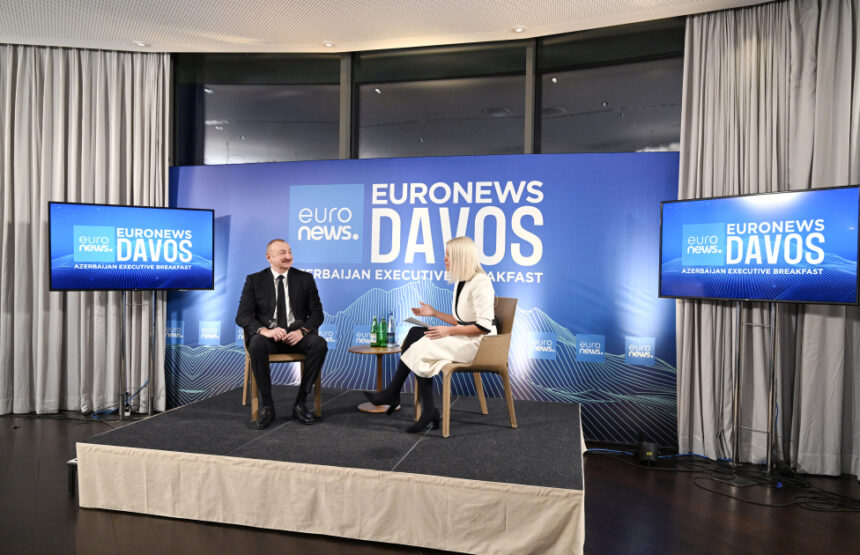
The international community is watching developments in Azerbaijan with keen interest, analysing nearly every detail in relation to the country and President Ilham Aliyev’s foreign policy. This attention was clearly demonstrated during questions posed to the head of state by a Euronews correspondent.
The journalist began by congratulating President Aliyev on receiving the Zayed Award for Human Fraternity in recognition of all his efforts. Before revealing the context of the question, it is worth noting that the prize is awarded by the prestigious Sheikh Zayed Foundation of the UAE (named after the country’s founding father) to individuals and organisations promoting the principles of peace, solidarity, and coexistence worldwide. According to the prize’s secretary-general, Mohamed Abdelsalam, awarding President Aliyev is justified by the historical agreements between Azerbaijan and Armenia, considered “a pivotal milestone in advancing global peace and a major diplomatic achievement.”
Thus, the famous phrase spoken by the country’s leader during the 80th session of the UN General Assembly – “We won, both in war and in peace” – has gained universal recognition. In this context, when responding to a Euronews correspondent’s question on his assessment of the current situation in the region, President Aliyev first emphasised that receiving the prestigious Sheikh Zayed Prize was a great honour. This, in effect, recognises the efforts of official Baku in establishing peace in the Caucasus after more than 30 years of bloodshed and war.
In other words, the country’s president publicly highlighted, with subtlety and clarity, that Azerbaijan’s inherently peaceful approach to policy has ushered the region into a new phase of development. This includes Baku’s initiatives to remove any restrictions on freight transportation to Armenia, including petroleum products so vital to the neighbouring country. This aspect, combined with President Aliyev’s definition of Azerbaijan’s goal as ensuring lasting peace in the Caucasus, exposes the falsity of various insinuations propagated by certain external actors—who, even today, continue to unjustly accuse the country of alleged geopolitical “wrongs” that do not exist.
However, the strength and authority of Azerbaijan—anchored in Baku’s unequivocally just position—has brought the situation surrounding these insinuations to a unique point. As a victorious nation, Azerbaijan does not respond to biased criticism, fully aware that such actions are driven by well-known lobbying groups opposed to the independent policies of a sovereign state.
This also explains the suspension of any cooperation with the European Parliament and PACE, while Baku confidently builds relations with the European Commission. As for European parliamentarians, it would be wise for them to acknowledge past mistakes and, taking into account the August 2025 agreements in Washington between Baku and Yerevan in the presence of President Donald Trump, find the courage to reconsider their unfair position toward Azerbaijan. At a minimum, this requires recognising that historical justice has triumphed in the South Caucasus solely through Baku’s implementation of UN Security Council resolutions by its own means, in full compliance with all norms and principles of international law—since all hopes of international mediation have completely collapsed, and Azerbaijan no longer relies on anyone else to settle everything for it.
As a result, during the panel discussion, President Aliyev highlighted Baku’s unilateral opening of regional corridors and noted that, at this stage, transport is being carried out via Georgia. He assured that, in due course, the route will extend through Armenia. Moreover, the day is not far off when Armenian goods will pass directly through Azerbaijani territory.
Notably, there is a parallel process of rapprochement between Azerbaijan and Armenia and between Türkiye and Armenia, which will ultimately lead to “the establishment of diplomatic relations between Türkiye and Armenia, and Azerbaijan and Armenia at the same time.”
However, the head of state emphasised that reconciliation over a relatively short period is only possible with “a strong political will from both sides” and a genuine commitment to peace. Baku is clearly following this path, and Yerevan must now move beyond rhetoric to implement concrete steps.
Moreover, President Aliyev also addressed issues of global significance. He emphasised that, amid violations of international law by major global actors, Baku always achieves results grounded in national interests while fully adhering to international law. As he stated, “if you are dedicated to your national interests and to the future of the nation you are leading, then you can achieve success.”
At the same time, in the context of managing socio-political situations in many regions of the world at this historical stage—where decisions are often guided not by the rule of law but by power—each country must base its decisions on adapting its strategy and policy to its own capabilities. This includes building good-neighbourly relations with as many states as possible, starting from its immediate region and gradually extending influence to more distant areas.
As the world has clearly observed, President Ilham Aliyev always follows words with action. Consequently, Baku’s focus on building positive relations with various countries has become almost a hallmark of its foreign policy. Aliyev has repeatedly emphasised that Azerbaijan’s national interests are pursued without harming other states.
This enables the country—the only one in the South Caucasus with significant energy resources—to export them far beyond its immediate neighbours. Moreover, the supply of Absheron’s natural resources to Europe (achieving first place globally in terms of pipeline gas coverage) strengthens the EU’s energy security. At the same time, Baku also exports gas to the Middle East, including to Syria.
The Azerbaijani leader clarified that all of Azerbaijan’s actions, aimed at strengthening economic and political sovereignty, are accompanied by confident engagement with a wide range of partners. Therefore, it should come as no surprise that, alongside documents on strategic partnerships with ten EU member states, Azerbaijan has a comprehensive strategic partnership agreement with China. In line with this, a Charter of Strategic Partnership with the United States is also under discussion.
There is no contradiction here, because, as President Aliyev emphasised, “When you have a clear vision for your country, for your future, when you have power—even a consolidated society—and when you do what is right, it does not matter who says what or who publishes articles about you and what you are doing.”
To illustrate this, he cited both the alliance with brotherly Türkiye and the opportunities created by the Zangezur Corridor (the “Trump Route” – TRIPP) from the perspective of transport connectivity. Ultimately, under U.S. oversight of the project, a new transport corridor will be established, “stretching from Asia across the Caspian, through Azerbaijan, Armenia, part of Azerbaijan—which is Nakhchivan—Türkiye, and further down to Europe, in addition to the existing corridors through Georgia.”
The underlying principle is straightforward: the more routes there are, the better it is for consumers, suppliers, and transit countries. Therefore, Azerbaijan always focuses on its regional agenda: “If we cannot achieve what we want in the region, we cannot have any aspirations for any kind of global event. But today, especially after the parallel tracks of Armenia-Azerbaijan and Armenia-Türkiye rapprochement—which go in parallel and will definitely end in parallel with the establishment of diplomatic relations between Türkiye and Armenia, and Azerbaijan and Armenia at the same time—we are changing the broad geographical area, part of Eurasia, which is very important for connectivity, energy security, and peaceful stability. This sets the example of how long-lasting wars and conflicts can transform into partnership and cooperation.”
The most important context here is that, as President Ilham Aliyev has repeatedly emphasised, to achieve all of Azerbaijan’s objectives—both domestic and foreign—it is crucial to maintain peace, stability, and security in the region. Azerbaijan pursues this through careful, precise steps in all directions, whether by participating in various international organisations or by developing bilateral relations.
Consequently, Baku cannot ignore the potential destabilisation in Iran. Ensuring and maintaining regional stability has always been, and remains, a top priority for Azerbaijan. In this regard, the head of state expressed hope that the situation in the South Caucasus and the broader region will not deteriorate. He also made an important remark: every country must contribute to regional stability and security.
Both in his Euronews interview and in his speech at the Davos panel, President Aliyev made significant geopolitical points, calling events around Azerbaijan by their proper names. His clear and objective perspective on global developments, including the prospects for worldwide policy, allows all interested parties to draw their own conclusions—first and foremost for themselves.
It is no coincidence that Serbian President Aleksandar Vučić, who also participated in the open discussion, described our head of state as one of the ideal leaders in the modern world. In his view, this is a highly symbolic moment, carrying a “profound impact.”
Teymur Atayev
Caliber.Az