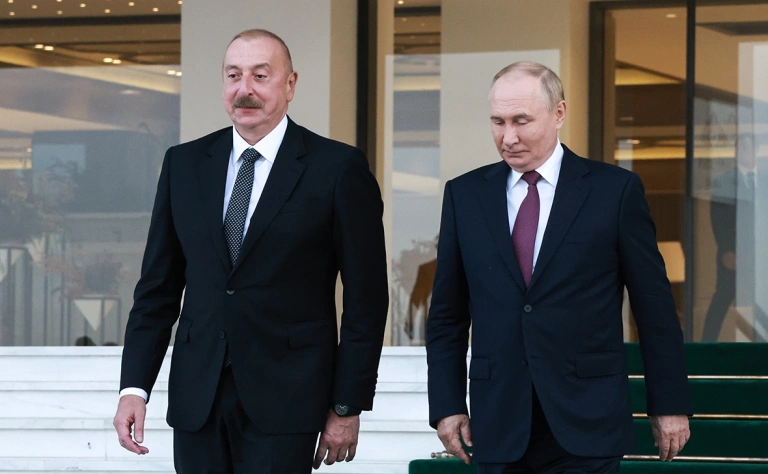
The absence of President of Azerbaijan Ilham Aliyev from the informal CIS summit may at first glance appear to be a procedural decision dictated by a busy schedule. In reality, however, it reflects a much deeper process that touches on the fundamental principles of interstate relations, trust, and responsibility in the post-Soviet space.
Politics, unlike diplomatic ritual, rarely forgives unresolved crises. The crash of the AZAL civilian aircraft was not merely a tragedy, but an institutional challenge — a test of states’ ability to act within recognized norms: to acknowledge responsibility, offer an apology, provide compensation, and hold those responsible accountable. This very sequence was publicly articulated by Russian President Vladimir Putin in Dushanbe. Yet, as time has shown, the declaration remained detached from practice.
Nearly two and a half months have passed since the fact of involvement by Russia’s air defense system was acknowledged. However, none of the actions considered a minimum standard of responsibility in the modern international system have been carried out. Investigative procedures are being delayed, compensation has not been paid, and those responsible have neither been named nor punished.
See also: December 25 — the day when Tolopilo’s order destroyed the AZAL aircraft. Minval Politika publishes for the first time a minute-by-minute chronology of the tragedy.
In this context, Aliyev’s decision not to attend the summit is not an act of emotional diplomacy nor an attempt at demonstrative pressure. It is a rational signal: participation in a multilateral format is impossible when a fundamental crisis in bilateral relations remains unresolved. Political institutions cannot function on top of unclosed tragedies.
It is important to stress that the issue is not the CIS as a structure. Azerbaijan has consistently demonstrated its readiness to participate actively in this format, including at the Dushanbe summit. Moreover, in recent years Baku has built stable and pragmatic relations with Central Asia, Armenia, and Belarus. These directions are developing precisely because they are based on clear rules of engagement and mutual responsibility.
The Russian vector remains — and today it stands as a systemic exception. The reason is simple: a mismatch between promise and action. In political philosophy, this inevitably leads to an erosion of trust. States that are unable to resolve crises in accordance with established norms lose not only moral authority, but also the ability to form sustainable alliances.
Azerbaijan’s position in this situation is entirely logical. Baku is not rejecting dialogue and is not dismantling existing formats. On the contrary, it proposes a clear institutional fork: either the crisis will be resolved in line with international practice, or the country will continue to defend its position through international mechanisms. This is not an ultimatum, but adherence to the rules of the modern political order.
Thus, Ilham Aliyev’s non-participation in the CIS summit is not a pause in diplomacy, but an institutional signal. In a world where the resilience of states is measured by their capacity to bear responsibility, half-measures no longer work. Political order does not tolerate unresolved tragedies or empty promises. Only days remain until the anniversary of the tragedy, and Moscow still has time to correct its mistakes — if it truly intends to act as one is “supposed to act in such situations.”
Magsud Salimov