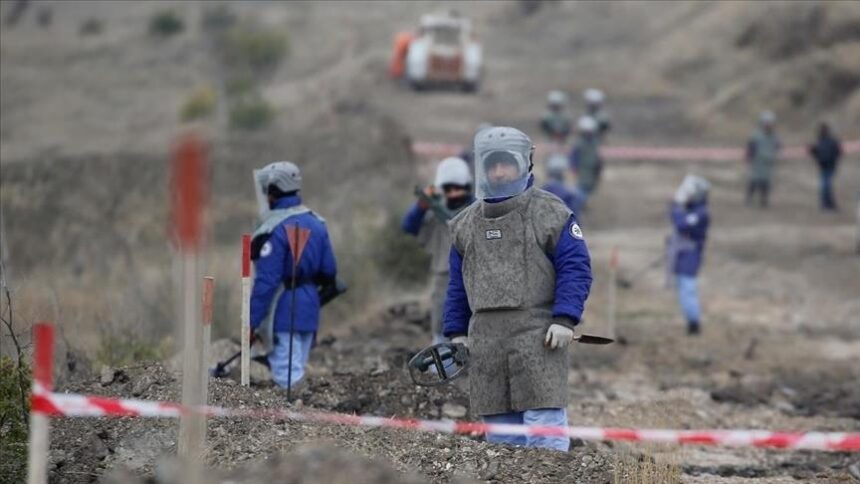
Even after a conflict ends, war leaves its mark. In some cases, the scars of war are found not only in ruined cities and shattered infrastructure but hidden beneath the soil itself. Nowhere is this clearer today than in Ukraine, where Russia’s full-scale invasion has created one of the most heavily mined territories in the world.
International organizations estimate that nearly one-fifth of Ukraine’s landmass is now contaminated by landmines and unexploded ordnance, making it the largest mined zone in Europe since World War II. Ukraine’s experience illustrates that long after the damage of ordnance ends, landmines continue to kill and cripple citizens and destabilize countries. They prevent displaced families from returning home, obstruct reconstruction, and can lead to decades of hidden suffering.
Azerbaijan knows this reality all too well.
In Azerbaijan, the deadly legacy of the 30-year war on its territory with Armenia lives on beneath the soil, where landmines and improvised explosive devices remain hidden across enormous swaths of territory. These hidden killers claimed the lives of cousins Israyil and Amid when they stepped on a landmine in the Yusifjanli village, Aghdam. Their tragedy is not an isolated incident. Experts have warned that the long-term impact of landmines makes much of Azerbaijani territory dangerous, inaccessible, and uninhabitable for future generations.
With an estimated 1.5 million mines and countless other explosive remnants contaminating more than 12 percent of its total territory, Azerbaijan is now among the most heavily mine-affected countries in the world. This crisis, largely invisible to the outside world, demands urgent international attention and support.
Since 2020, when Azerbaijan restored its territorial integrity in accordance with international law and four UN Security Council resolutions, Baku’s reconstruction of Karabakh has been paralyzed by landmines planted in homes, roads, schools, and even cemeteries. These mines have devastating long-term consequences against future civilian life, effectively weaponizing time itself.
To date, nearly 3,500 Azerbaijanis have fallen victim to landmines, including 361 children. Since the end of major hostilities in November 2020, 388 people have been injured or killed by mines, the vast majority civilians. These tragedies are compounded by the delay in returning more than 700,000 internally displaced Azerbaijanis to their rightful homes and by the ongoing difficulty in locating the remains of some 4,000 citizens who went missing during the war.
According to reports, Armenia has still not provided comprehensive landmine maps to Azerbaijan, despite repeated formal requests by the Azerbaijani government, including the petitions to the International Court of Justice and European Court of Human Rights. International humanitarian law is unambiguous on this point: any state that lays landmines must record their placement and ensure they are cleared or rendered harmless once hostilities end. Should Armenia continue not to provide accurate maps, it would violate customary International Humanitarian Law, which requires militaries to mark minefields, facilitate post-conflict demining, and share all relevant information needed to protect civilians after the fighting stops.
Azerbaijan has taken the lead in demining efforts, using its Mine Action Agency (ANAMA) to clear hundreds of thousands of explosive devices. Azerbaijan has also hosted three annual global mine-action conferences with the United Nations and, in May 2024, Baku launched a joint initiative with UNDP to create an International Centre of Excellence and Training for Mine Action, headquartered in Azerbaijan.
But the scale of the humanitarian demining challenge remains a global responsibility when the consequences of war violate legal and moral norms. That is why Azerbaijan has called on the United Nations, the Non-Aligned Movement, and other international forums to treat demining as a cross-cutting issue, one that affects peace, development, human rights, and environmental recovery, and has declared demining its 18th National Sustainable Development Goal. Without clearing mines, achieving Azerbaijan’s other sustainable development goals—poverty reduction, education, climate resilience, and infrastructure development—will continue to face obstacles.
The international community has a long and successful history of supporting large-scale demining efforts in post-conflict regions, from the Balkans and Afghanistan to Cambodia, Iraq, and parts of sub-Saharan Africa. In each of these cases, coordinated international assistance dramatically accelerated recovery, enabling displaced families to return home and restoring economic activity. Donor-funded mine action programs, UN-led training hubs, and bilateral technical partnerships proved that sustained engagement can transform contaminated territories into functioning communities. Azerbaijan’s appeal for similar support is a continuation of this well-established global practice, as major mine-affected regions require major international responses.
Effective mine action is the prerequisite for durable peace, sustainable development, and the successful return of displaced families. No infrastructure investment, agricultural recovery, or environmental restoration can move forward without safe land. Azerbaijan has taken on this challenge at scale, but the magnitude of contamination demands a coordinated international response. Partner-driven demining assistance—technical, financial, and operational—will determine how quickly the liberated areas can transition from insecurity to stability.
Sebastian Stodolak is the vice president of the Warsaw Enterprise Institute, economic columnist for Dziennik Gazeta Prawna.