In recent years, Eurasia has undergone a structural transformation in how regions connect, trade, and cooperate. The combination of geopolitical shocks, disrupted supply chains, and the search for secure east–west routes has elevated the importance of the Trans-Caspian space. The states of Central Asia, once constrained by geography, have taken unprecedented steps to strengthen regional coordination, modernize infrastructure, and integrate more closely with Europe. Meanwhile, Azerbaijan has rapidly emerged as an indispensable connector linking Central Asia with the South Caucasus, Türkiye, and European markets.
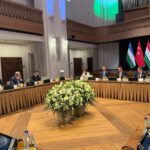
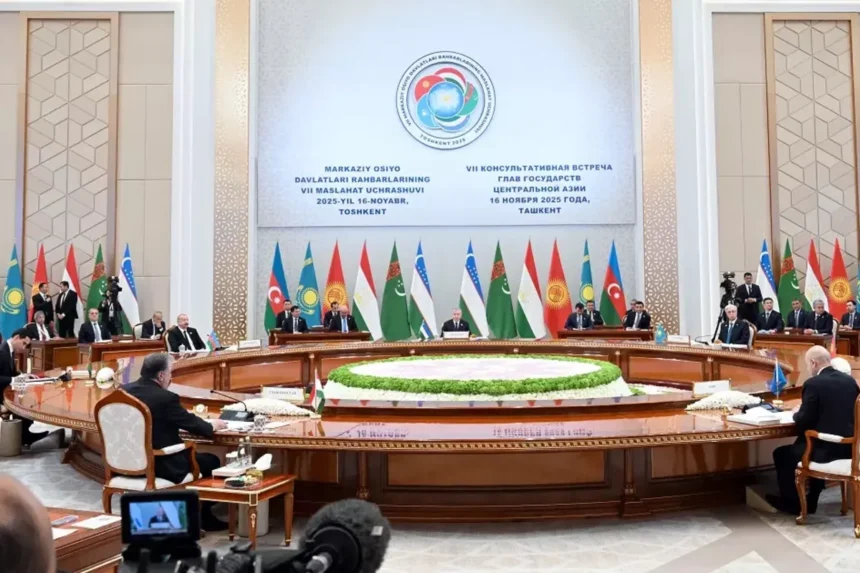
This new reality was formally acknowledged in November 2025 when Azerbaijan was unanimously welcomed as a full participant in the Consultative Meeting of Central Asian Heads of State in Tashkent. What had long been a C5 grouping transformed into a C6, marking a historic moment: the Caspian was no longer a frontier separating two regions but the center of a unified geopolitical and geo-economic space. President Ilham Aliyev described this alignment as the emergence of “a single geopolitical and geo-economic region,” while President Shavkat Mirziyoyev called Azerbaijan’s inclusion “historic” and proposed transforming the consultative platform into a structured regional institution capable of shaping security, economic, environmental, and digital policy.
The institutional logic behind this change is clear. Azerbaijan’s modern infrastructure – including the Port of Alat, digitalized customs systems, and multimodal logistics platforms – anchors the western segment of the Middle Corridor.
Central Asia, with its expanding economies and growing connectivity plans, anchors the eastern segment. The region’s interdependence is no longer theoretical but operational: cargo flows have quadrupled since 2022, and Europe increasingly views the corridor as essential to its long-term economic resilience.
The European Union has responded decisively. Under the Global Gateway initiative, the EU announced €12 billion in financing for connectivity, energy transition, and digital cooperation at the first EU–Central Asia Summit in Samarkand in April 2025. Much of the investment is directed toward strengthening the Middle Corridor – an objective the EU reaffirmed at the EU–Central Asia Economic Forum and at the Connectivity Investors Forum in Tashkent later that year. Brussels now openly acknowledges that the corridor’s success depends on a cohesive region spanning both sides of the Caspian.
However, the EU’s institutional engagement still operates through the C5+1 format, created at a time when Azerbaijan was not part of Central Asia’s internal coordination mechanisms. With the regional platform now expanded to C6, the EU’s cooperation architecture is increasingly misaligned with the geopolitical and economic realities of Eurasia. Just as Central Asian states transformed their own grouping into C6, the EU’s C5+1 framework must also evolve into C6+1. Only this expanded format would allow Brussels to engage fully the regional actors shaping the East–West corridor, ensuring coherent investment, harmonized standards, and integrated policy planning.
The argument for transformation applies equally to the United States. Washington hosted the first-ever U.S.–C5 Summit in November 2025, reflecting a renewed American commitment to the region. The summit emphasized supply-chain resilience, critical minerals, clean energy, and secure transport routes. Yet, like the EU, the U.S. continues to operate within an outdated C5+1 architecture that no longer reflects the region’s internal evolution. If Azerbaijan is now a full member of the Central Asian consultative format and a core actor in Trans-Caspian connectivity, then the U.S.–Central Asia partnership should also transition into C6+1.
This is not simply a matter of diplomatic symbolism. Azerbaijan is the only country that completes the Middle Corridor’s western half. Without Baku’s ports, railways, energy infrastructure, and digital corridors, the east–west link cannot function as a competitive route. The EU and U.S. strategies toward the region – focused on diversification, resilience, and open connectivity – will remain incomplete unless they fully integrate Azerbaijan.
Beyond connectivity, Azerbaijan and the Central Asian states increasingly share priorities in energy transition, digital transformation, environmental management, water security, and youth mobility. These shared agendas require a regional platform that recognizes the full constellation of actors shaping the Caspian basin and its links to Europe. The C6 format provides this foundation; now external partners must adapt their engagement to it.
Azerbaijan’s incorporation into the C6 is not merely a political gesture but a structural shift in Eurasia’s regional geometry. With the EU and U.S. intensifying their strategic outreach, and with the C6 states articulating more ambitious regional goals, the moment is ripe to build a C6+1 framework that aligns political, economic, and infrastructural coordination across the entire region.
The Caspian is no longer a boundary; it is the heart of an integrated region. The transformation of the EU and U.S. C5+1 formats into C6+1 is the logical next step to ensure that both sides of the Caspian advance together – coherently, strategically, and with shared purpose.
Dr. Vasif Huseynov, is a Senior Advisor at the Center of Analysis of International Relations (AIR Center) and Adjunct Lecturer at Khazar University in Baku, Azerbaijan.