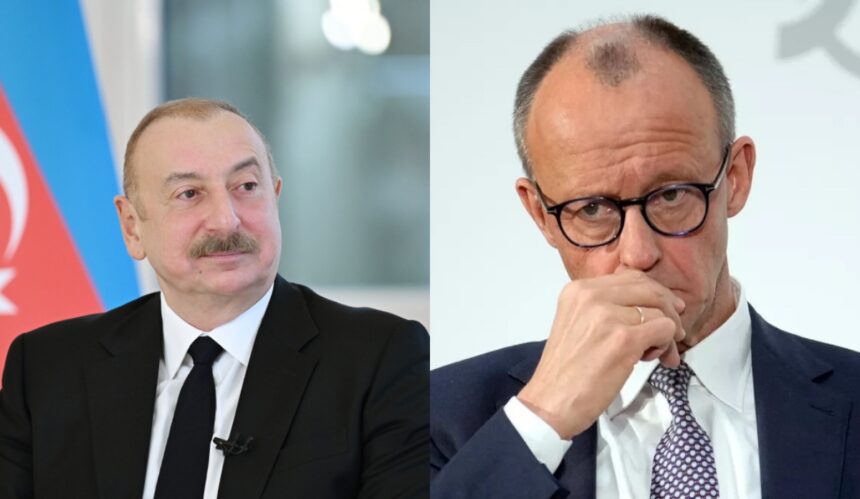
Amid the recent chain of events, one episode stands out — the sudden phone call from German Chancellor Friedrich Merz to Azerbaijani President Ilham Aliyev. Behind the short official readout lies a clearly growing German interest in deepening cooperation with Azerbaijan — an interest that is becoming ever more visible as Baku’s role in regional processes expands. Today, Azerbaijan is shaping the post-conflict agenda in the South Caucasus and simultaneously emerging as a key link in the developing transcontinental chain connecting Central Asia, the Caspian region, the Black Sea, and the European Union. Under these circumstances, Berlin’s attention to Azerbaijan appears not episodic but strategically driven, reflecting Germany’s intention to anchor itself in the new architecture of regional connectivity and energy security, where Baku is one of the central actors.
It is in line with this intention to build a deeper and more stable dialogue that Chancellor Merz invited Ilham Aliyev to visit Germany at any convenient time. The invitation was gratefully accepted, which itself underscores the mutual interest of both sides and their readiness to elevate bilateral relations to a new level of strategic engagement.
Looking back at recent years, ties between Azerbaijan and Germany developed unevenly. During the tenure of the so-called “traffic light” coalition — a political alliance formed by ideologically divergent parties — a paradoxical situation often emerged. Chancellor Olaf Scholz, representing the Social Democratic Party, sought a pragmatic and productive dialogue with Baku, while Foreign Minister Annalena Baerbock, one of the key figures of the Greens, frequently undermined many of the positive steps achieved in the bilateral relationship through her statements and actions. This internal foreign-policy divergence created the impression of an incoherent German line toward Azerbaijan, hindering the formation of a stable partnership.
Metaphorically speaking, it was as if the political “traffic light” showed red and green simultaneously, creating paralysis. It was unclear whether to move forward or stay put: the chancellor’s attempts to pursue constructive dialogue were in clear tension with the foreign minister’s harsh, often ideologically driven rhetoric. As a result, Azerbaijan received mixed signals, undermining trust in Berlin’s predictability and consistency.
That phase now appears to be over. Moreover, the official visit of German President Frank-Walter Steinmeier to Baku in March this year demonstrated that bilateral relations hold substantial, still untapped potential. The visit showed that with a thoughtful and consistent approach, cooperation between the two countries can bring enormous benefits across economics, energy, logistics, and political interaction.
Berlin seems to have concluded that the right time to unlock this potential has arrived — and that missing the moment would be a strategic mistake. Judging by recent contacts, Germany seeks to capitalize on the opportunities at hand and build a deeper, more pragmatic partnership with Azerbaijan, aligned with the new realities of regional and European politics.
It is worth noting that Berlin traditionally reacts very sensitively to issues related to human rights and political freedoms. Yet recent developments in Azerbaijan, involving the arrest of several opposition figures, did not trigger the expected critical reaction in Germany. This may largely be due to the presence of a “Russian link” in these cases. Amid the sharp confrontation between Germany and Russia and deeply strained bilateral relations, Berlin is clearly unwilling to publicly defend individuals whose activities — directly or indirectly — might be interpreted as aligned with Moscow’s interests. Such caution reflects a desire to avoid politically ambiguous signals and prevent speculation about differences within the Western camp regarding Russia’s influence.
Berlin follows a similar approach toward Armenia, where the fate of pro-Russian opposition figures is likewise not attracting notable attention. Germany prefers not to involve itself in situations that might be interpreted as interference with political forces aligned with Moscow. Against the backdrop of acute tensions with Russia and efforts to minimize any channels of Russian influence in the region, Berlin is demonstrating a pragmatic line — separating democratic-standards rhetoric from cases where the “Russian factor” might distort political interpretations and cause unwanted diplomatic complications.
Taken together, these developments show that Germany is undergoing a profound recalibration of its regional policy, seeking a more coherent and strategically motivated line in both the South Caucasus and Central Asia. As the geopolitical landscape rapidly evolves, Berlin clearly recognizes that Azerbaijan is becoming the key connector between these two spaces — from post-conflict processes in the South Caucasus to the emerging architecture of transit, energy, and logistics corridors linking Central Asia to Europe. Azerbaijan’s strengthened regional role, growing autonomy, and ability to shape interregional agendas make it a partner whose importance Germany cannot overlook.
This is why Berlin aims to intensify its dialogue with Baku, smoothing political frictions and focusing on areas where cooperation can yield strategic benefits — from energy security and transport routes to political coordination across the expanding Caspian–Black Sea region. Against this backdrop, relations with Azerbaijan are becoming not just another direction of German foreign policy but a central element of its new geopolitical configuration, driven by Berlin’s increasing interests in a region that is acquiring critical importance for all of Europe.
Ilgar Velizade