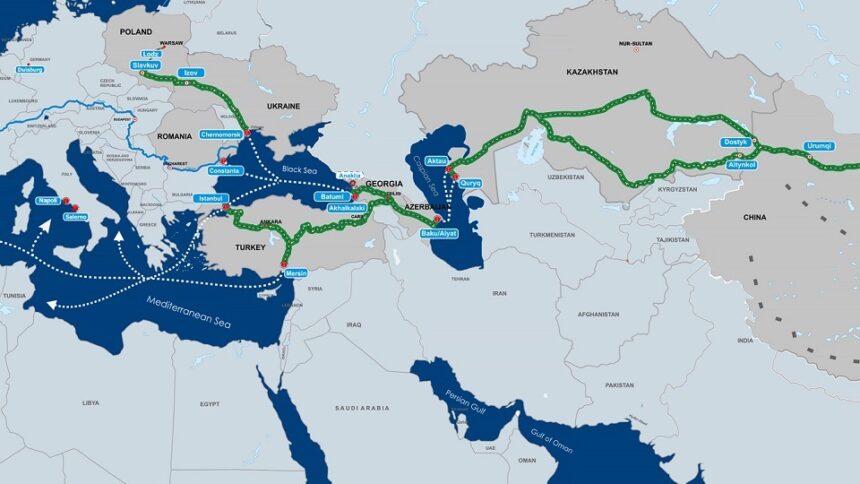
As prolonged and simmering conflicts in Ukraine and the Middle East continue to cost lives and cause disruptions to everything from trade to transit to energy production, there is a strategic region located between these two theaters that is currently experiencing the opposite effect. That theater is the Caspian region, which is rich in natural resources and transit potential and is composed of the South Caucasus states of Azerbaijan, Armenia, and Georgia, as well as the Central Asian states of Kazakhstan, Uzbekistan, Turkmenistan, Kyrgyzstan, and Tajikistan. Both of these regions are undergoing significant transformations in which diplomatic breakthroughs are being formed and international infrastructure and energy connectivity efforts are being enhanced, in no small part due to direct and increasing engagement from the United States.
One case in point was a recent announcement by Armenian economy minister Gevorg Papoyan on November 6 that Armenia had received a direct cargo shipment of grain supplies from Azerbaijan. While the volume of just over 1,000 tons was relatively modest, this shipment represented the first direct, cross-border trade between the two countries since the collapse of the Soviet Union in 1991. For much of the ensuing three decades, Armenia and Azerbaijan were at war, and virtually all connections between the countries had been cut off. International mediation led by Russia and Western states failed to gain traction.
However, in the early part of the 2020s, the geopolitical realities of this conflict began to shift. Moscow, which was the most influential external player in the Caucasus and Armenia’s de facto security guarantor, began to lose much of its influence. Russia’s involvement in the Ukraine conflict, US and EU focus on that theater, and the emergence of regional players like Turkey enabled Azerbaijan (along with its own oil and gas-backed growth of economic and military power) to strengthen its position vis-à-vis Armenia. Starting in 2020 and culminating at the end of 2023, Baku launched military operations to retake the territory of Nagorno-Karabakh, as well as neighboring regions around it, seized by Armenian forces in the early years of the conflict.
Rather than leading to further military escalation, the leadership of Azerbaijan under President Ilham Aliyev and Armenia under Prime Minister Nikol Pashinyan both used this shift on the ground as a means to begin a diplomatic normalization process, one that was explicitly designed around shared interests to unlock stifled economic, transport, and energy connections within the region. Azerbaijan wanted to secure access to its Nakhchivan exclave and expand its connections to Turkey and further on to Europe, while Armenia wanted to break out of its landlocked isolation and over-dependence on Russia to build its own connections within the region and beyond.
This normalization process between Armenia and Azerbaijan was one that experienced numerous challenges, from internal political dynamics to resistance from regional players like Russia and Iran. However, Baku and Yerevan continued to make gradual progress in their negotiations. This was then accelerated by another geopolitical shift, this time within the US.
President Trump’s victory in the 2024 US elections set off a rapid and dramatic rewiring of US foreign policy, one that was centered around a transactional approach and economic-focused deal-making. Trump aimed to sign or renegotiate agreements to gain economic benefits for the United States, encompassing everything from the use of reciprocal tariffs to form new trade deals to attracting investments into the United States to securing greater access to critical minerals as a hedge against China (which also built inroads into the region via its Belt and Road Initiative).
A key focus of Trump’s transactional approach is ending long-standing wars or international disputes that served to undermine economic and trade activity or were perceived by the administration to be a drain on US resources. While implementing this strategy has proven difficult in protracted conflicts like the Russia-Ukraine War and Middle Eastern conflicts like Gaza and Lebanon, the Caspian region proved ripe for the new Trump administration’s approach. Trump oversaw the signing of an official peace agreement between Azerbaijan and Armenia in August, which also coincided with the announcement of the Trump Route for International Peace and Prosperity (TRIPP) to enhance regional connectivity initiatives throughout the region.
This initiative launch was contextualized by several other agreements, including an MoU for a strategic partnership between the United States and Azerbaijan centered around energy and enhancing the Southern Gas Corridor, as well as several deals between the United States and Armenia on infrastructure and building technological capacity. The United States has also been involved in a parallel diplomatic normalization process between Armenia and Turkey, which would further unlock regional connectivity efforts if secured.
Perhaps no less importantly, the United States has set its sights on the other side of the Caspian Sea by pursuing several agreements with Central Asia. This region, too, has previously experienced political volatility and tensions between neighboring states. However, like the Caucasus, it has trended toward diplomatic de-escalation and economic integration efforts in recent years. In early November, Trump hosted each of the five Central Asian presidents at a summit in Washington, DC, commemorating the 10th anniversary of the C5+1, an initiative that spans numerous US presidents going back to the Obama administration. This summit coincided with numerous deals between the United States and Central Asian states on energy, transport, and critical minerals, including a $100 billion investment pledge into the United States from Uzbekistan.
Thus, the Caspian region has emerged as a critical example of the Trump administration’s transactional foreign policy. The region provides the United States with economic benefits like access to energy and mineral resources, and it also aligns with many of Trump’s core diplomatic initiatives. This includes the recent addition of Kazakhstan to the Abraham Accords as part of Trump’s broader Middle Eastern strategy, giving the US leverage with China via critical minerals in its geopolitical competition with Beijing, and secures formal peace deals in long-running conflicts. The Caspian states themselves have been able to leverage this transactional focus to their own advantage, securing their own trade and investment benefits as previous emphasis from the United States on issues like democracy and human rights promotion no longer serve as major stumbling blocks.
This is not to say that all challenges have been overcome for the United States and the Caspian region. Many of the agreements on the connectivity side are still at an MoU stage, while the actual transit volumes of non-energy goods like grain are still relatively low in absolute terms. There will continue to be some internal political challenges, even as regional players like Russia and Iran could seek to stymie regional connectivity projects that they see as counter to their interests.
There is always concern among regional states that the Trump administration could lose interest and shift its priorities to other areas. However, if the substantial diplomatic momentum between the United States and Caspian states is translated into the functional and sustained implementation of connectivity enhancement, this has the opportunity to be nothing short of transformative for the Caspian region and potentially well beyond.
Eugene Chausovsky is a Senior Director at the New Lines Institute. Chausovsky previously served as a Senior Eurasia Analyst at the geopolitical intelligence firm Stratfor for more than ten years.