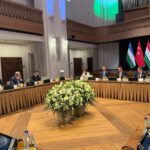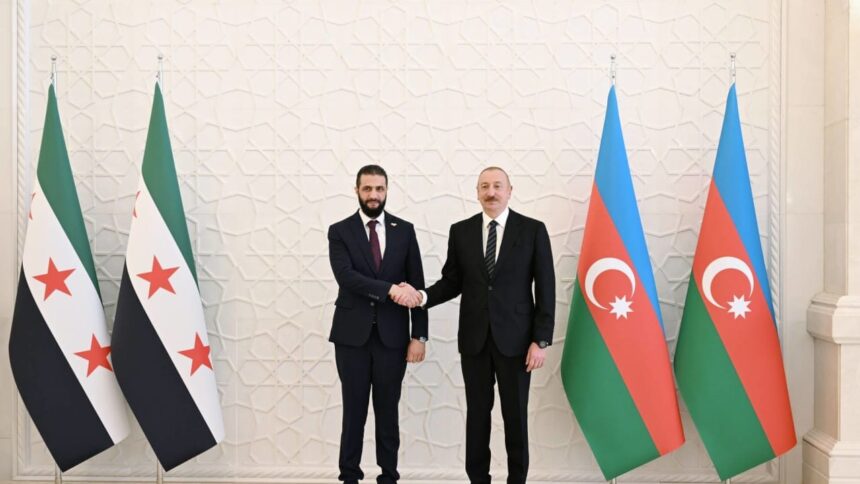
As the region undergoes swift economic and geopolitical change, Syria is looking to establish new avenues of cooperation to help revive its economy, which has been in crisis for more than a decade. In this effort, Azerbaijan has emerged as a promising and significant partner, particularly in the energy and precious metals sectors.
Following the signing of a memorandum of understanding to supply Syria with natural gas, discussions have resurfaced about a new phase in bilateral relations—one that restores long-broken ties and opens the way for extensive economic and political cooperation. Over the past two years, Syrian-Azerbaijani relations have seen notable progress after a prolonged period of stagnation.
The most significant development was an agreement to deliver Azerbaijani natural gas to Syria via Turkish territory, as part of Baku’s broader plan to expand its energy exports across the Middle East. Announced in July 2025, the deal provides for the supply of roughly 3.4 million cubic meters of gas per day, gradually increasing to between 1 and 2 billion cubic meters annually. The additional supply is expected to help restart idle power plants and ease pressure on Syria’s strained energy sector.
Syria aims to diversify economic relationships
This partnership reflects a new Syrian strategy to diversify its economic relationships and reduce reliance on any single partner. It is also part of a broader government plan to revitalize the gold and precious metals sector, seen as a key source for generating hard currency and offsetting losses in traditional industries.
Dr. Ibrahim Qoushji, a banking and economic expert, told The Media Line that cooperation with Azerbaijan provides a rare opportunity for Syria to reintegrate itself into the regional trade network, especially in sectors considered among the main drivers of growth, such as energy and gold jewelry. He added: “If the file is managed through clear institutional mechanisms, it can help stimulate Syrian exports and restore part of the lost monetary reserves, especially if the exchange is priced in national currencies or through direct exchange agreements, to avoid the impact of sanctions on financial transfers.”
Qoushji noted that the Syrian banking sector must keep pace with this openness by modernizing electronic payment systems and opening external banking communication channels, considering that “the Syrian economy needs practical partnerships, not slogans, and Azerbaijan is a suitable gateway for that.”
The significance of Syrian-Azerbaijani cooperation goes beyond economics, carrying important political implications as well. Analysts note that Baku aims to expand its influence in the Middle East by forging balanced partnerships with countries beyond its traditional sphere, while Damascus views this cooperation as a chance to end its regional isolation and reclaim a role in the emerging geopolitical order.
Dr. Samer Al-Khatib, professor of international relations at the University of Damascus, explained this dimension in an interview with The Media Line, saying: “The relationship with Azerbaijan represents for Syria both a political and economic window, as it is a Muslim country with balanced relations with Turkey, Iran, and Russia, making it a point of equilibrium in the region’s interactions.”
He continued: “From a geopolitical perspective, the entry of Azerbaijani gas into Syria means expanding the circle of regional interests within Syrian territory, which grants Damascus wider room for maneuver in its international relations and lays the groundwork for potential security and technical cooperation.”
Despite the official optimism surrounding this renewed partnership, the path forward remains challenging. Western sanctions continue to restrict Syria’s capacity for direct financial transactions, while the country also struggles to rebuild the infrastructure needed to receive and distribute Azerbaijani gas. In addition, Syria faces major gaps in the quality and competitiveness of its metal and gold industries compared with other markets.
Economic experts note that the wide price gap between Syrian and international gold, along with high local production costs, may hinder the competitiveness of Syrian jewelry in Azerbaijani and other foreign markets. For this reason, the creation of an independent authority to oversee the precious metals sector is seen as essential to regulating the market, curbing smuggling, and promoting formal production.
Diplomatic ties between Syria and Azerbaijan were established in 1992, soon after Baku gained independence from the Soviet Union. Throughout the 1990s, the two countries maintained modest cooperation in areas such as education, culture, and tourism, supported by occasional official visits. However, relations cooled over the past decade because of divergent political stances—most notably Syria’s position on the Nagorno-Karabakh conflict and its close relations with Armenia.
In recent years, as the regional landscape has shifted, new signs of rapprochement have emerged between Syria and Azerbaijan. Baku has expressed interest in contributing to Syria’s reconstruction, particularly in the energy and infrastructure sectors, while Damascus has shown willingness to facilitate Azerbaijani investments and share technical expertise. Analysts view this warming of ties as a quiet diplomatic realignment driven more by economic pragmatism than by past political alliances.
Observers suggest that Syrian-Azerbaijani cooperation could evolve into a model for regional economic integration if managed with flexibility and transparency. Azerbaijan offers extensive energy resources and experience in infrastructure, ports, and logistics, while Syria’s strategic location on the Mediterranean makes it a potential transit hub for energy and trade routes linking the Middle East to Europe. Cooperation could also extend into agriculture, technology, and port development, advancing shared economic goals and contributing to broader regional stability.
Syrian-Azerbaijani cooperation appears to go far beyond a single gas deal or temporary economic initiative. It signals a broader shift in Syria’s regional relationships and a concerted effort to move past years of financial and political isolation. If both sides can turn their agreements into concrete projects and effectively leverage Azerbaijan’s expertise in energy and industry, this partnership could emerge as a new model of Middle Eastern cooperation—one that moves beyond rhetoric to deliver real, measurable outcomes.
Adelkhan Gadilishiev, an analyst at the Eurasian Integration Institute, told The Media Line that although ties between Azerbaijan and Syria once existed, they deteriorated under the leadership of former President Bashar Assad. He said Assad had weakened relations with a country that could have become a strategic ally by allowing Syria to become a haven for the ASALA terrorist organization and the Kurdistan Workers’ Party (PKK).
He added that although Syria is a member of the Organization of Islamic Cooperation, it failed to show support for Azerbaijan during the Karabakh conflict. Instead, he noted, ties between the Assad government and the authorities in Armenia strengthened over time, while Syria’s internal mismanagement led to civil war and opened the door to terrorist activity. Gadilishiev emphasized that these issues are now in the past and that new opportunities are emerging for both the Syrian government and its people.
He noted that Azerbaijan was among the first nations to congratulate the Syrian people and government following the regime change, stressing that Baku has consistently reaffirmed its commitment to Syria’s territorial integrity and national sovereignty. At the same time, he pointed out that while Azerbaijan has demonstrated genuine solidarity with Damascus, many Arab states have maintained a policy of double standards in their dealings with Syria.
The Azerbaijani expert affirmed that ties between Azerbaijan and Syria are now a key component of Baku’s evolving policy toward the Middle East. “Following the directives of President Ilham Aliyev,” he said, “Azerbaijani delegations have visited Syria to express our country’s support for its reconstruction, rebuilding, and recovery efforts.”
He stressed that “Baku received extremely positive messages from Damascus in this regard,” adding that “President Ilham Aliyev’s personal influence paved the way for other countries to establish new partnership models with Azerbaijan.” He said that Syria is considered one of the key pivotal countries in the Middle East, and that Azerbaijan’s development of its relations with this country is of utmost importance for the reshaped Middle East.
He added that Azerbaijan, with its experience in mediation, could draw on its strong ties with both Israel and Syria to serve as a bridge for dialogue between Damascus and Tel Aviv. He noted that such efforts would not be limited to improving relations between the two countries but could also help advance a broader and lasting peace across the region.
Rizik Alabi